Why Enterprise Brands Hire a B2B Paid Social Agency
The best b2b paid social agency for your team is one that can show how ad spend leads to qualified opportunities, sales, or other real outcomes. Look for clear reporting, experience reaching buying committees, and a plan to test and improve campaigns across the platforms your buyers use.
For enterprise teams, the value is more than help running ads. A strong agency connects targeting, creative, and follow-up so promising prospects do not stop at a click or a form fill. That gives marketing managers a clearer way to defend budget and move spend toward campaigns that build pipeline.
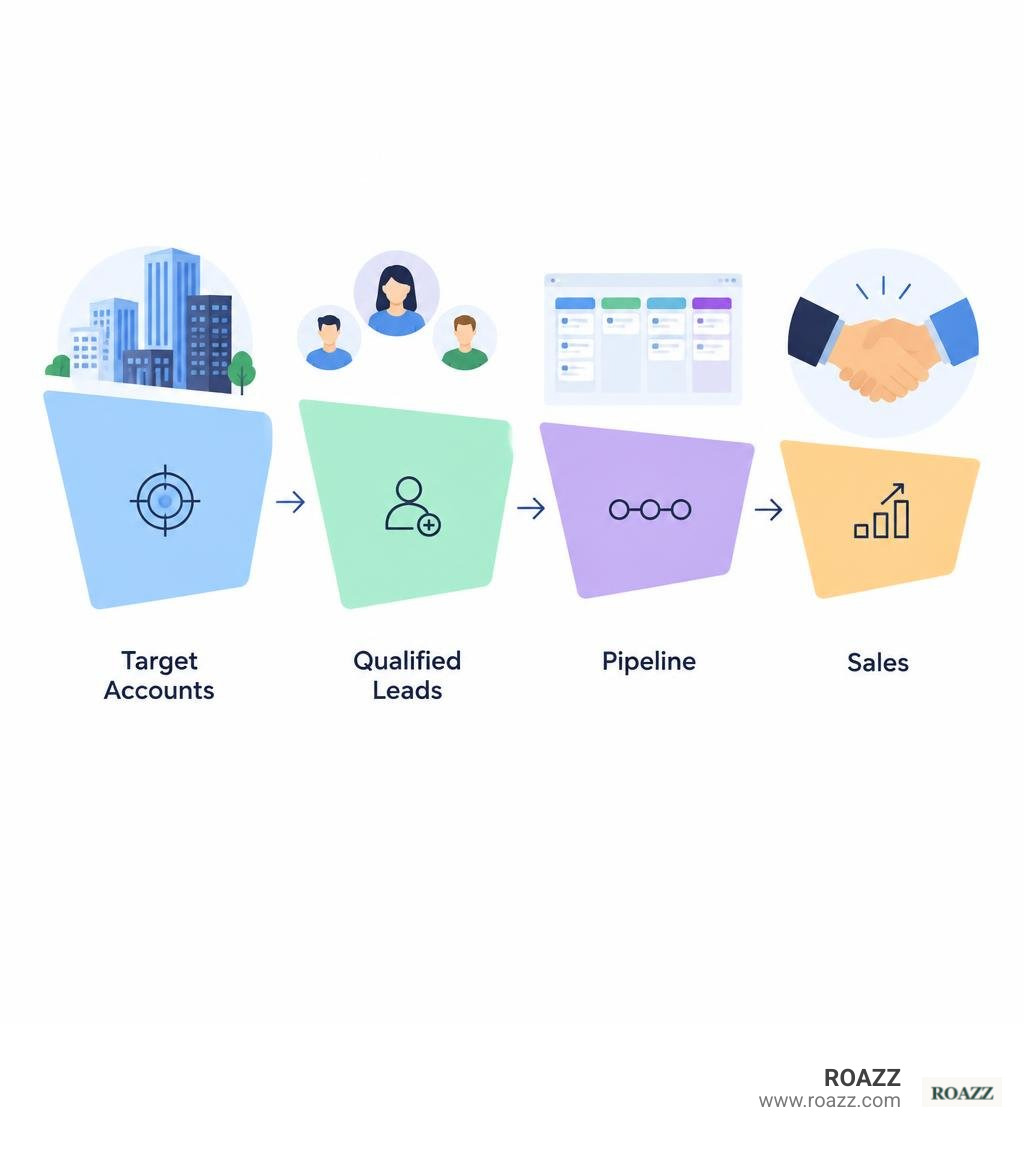
1. Platform-Specific Strategies for High-Value B2B Acquisition

Enterprise customer acquisition requires treating each ad platform as a distinct stage in the buyer journey rather than blasting identical creative everywhere. Modern enterprise buyers do not spend their days sitting on a single network waiting to download an eBook. They research solutions during business hours, catch up on industry peers over their lunch breaks, and scroll through general feeds during off-hours.
A mature paid social framework balances platform capabilities against user intent. LinkedIn delivers the most accurate professional targeting on the web. It accounts for 80% of all B2B leads generated through social media, providing direct access to job titles, company sizes, seniorities, and industry classifications. However, relying solely on LinkedIn Sponsored Content and Conversational Ads can lead to high media costs if you do not balance your mix.
Pairing targeted social campaigns with our specialized PPC management agency solutions allows enterprise brands to capture active search intent while building sustained demand across social feeds. Furthermore, research highlighted in The B2B Effectiveness Code: Creativity and effectiveness in B2B marketing from 2010-2021 | demonstrates that creative commitment and emotional resonance drive long-term business effects just as effectively in B2B markets as they do in consumer segments.
Multi-Channel Allocation Across LinkedIn, Meta, and X
Paid social ads now account for roughly 28% of total B2B marketing budgets. The primary challenge is allocating that capital to produce the highest return. On average, B2B campaigns experience a Cost Per Lead (CPL) of around $80 on LinkedIn compared to $45 on Facebook.
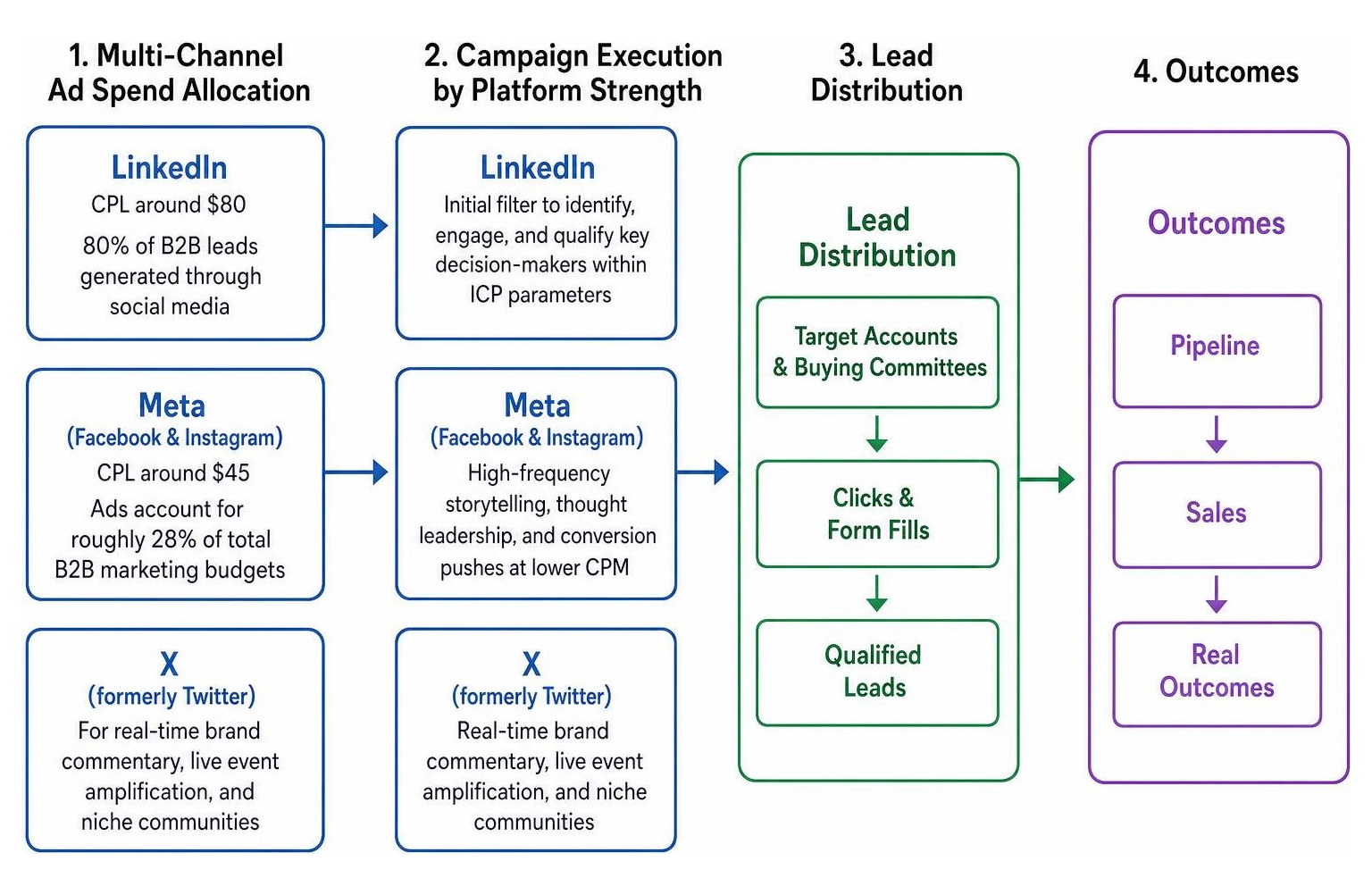
Instead of choosing one platform over another, we build complementary platform ecosystems:
- LinkedIn: Used as the initial filter to identify, engage, and qualify key decision-makers within specific Ideal Customer Profile (ICP) parameters.
- Meta (Facebook & Instagram): Leveraged for high-frequency storytelling, thought leadership distribution, and mid-to-lower-funnel conversion pushes at a fraction of LinkedIn's CPM rates. Our Facebook ads management services focus on converting warm enterprise prospects when they are relaxed and browsing off-hours.
- X (formerly Twitter): Utilized for real-time brand commentary, live event amplification, and targeting niche tech or developer communities.
By reviewing tactical platform changes in our Facebook lead gen guide 2026, brands can maintain high lead volume without sacrificing lead quality.
Retargeting Strategies for Complex Buying Committees
Enterprise B2B purchases are rarely made by an individual. The average enterprise deal involves six to ten distinct stakeholders—from direct practitioners and department heads to procurement officers and finance executives.
Targeting only the initial prospect leaves the rest of the buying group uninformed. B2B paid social campaigns that incorporate strategic retargeting deliver a 76% higher conversion rate compared to cold audience targeting alone. We orchestrate comprehensive retargeting display ads and social remarketing sequences that deliver tailored messaging based on a prospect's role and website interaction history:
- Practitioners: See ad units highlighting product workflows, ease of integration, and daily time savings.
- VPs & Directors: Receive case studies focused on team efficiency, cost reductions, and operational scale.
- C-Suite & Finance: Receive high-level content focused on total ROI, compliance standards, and risk mitigation.
2. Advanced Audience Targeting and Account-Based Marketing (ABM)

Generic demographic targeting burns enterprise ad spend quickly. A skilled B2B paid social agency moves past broad interests by combining first-party CRM lists, third-party firmographic intelligence, and verified buyer intent.
Executing Intent-Driven ABM Campaigns
Intent-driven ABM allows enterprise teams to prioritize accounts showing active purchasing behavior. Rather than spreading ad budget equally across thousands of potential accounts, we segment accounts into distinct tiers:
- Tier 1 (High-Priority/Active Intent): High ad frequency, bespoke creative referencing their specific sub-industry, and targeted direct messaging.
- Tier 2 (Qualified ICP/Low Intent): Problem-aware messaging designed to educate and surface latent pain points.
- Tier 3 (Broad ICP): Light-touch brand awareness campaigns to nurture future demand.
We leverage tools like LinkedIn Matched Audiences, CRM synchronization, and programmatic digital advertising layers to ensure target accounts see cohesive messaging across every digital touchpoint.
Overcoming Extended Sales Cycles and Lead Quality Challenges
With sales cycles often stretching from 6 to 18 months, enterprise demand generation requires patience and precise milestone tracking. A surge in cheap form fills usually results in frustrated sales reps contacting junior employees who lack purchasing power.
To eliminate pipeline friction, we establish clear qualification gates directly inside campaign architectures:
- Utilizing native lead gen forms with mandatory business emails, job function filters, and company size requirements.
- Aligning ad copy directly with mid-funnel pain points to repel low-intent clicks.
- Implementing automated lead-routing workflows to ensure high-intent prospects reach sales within minutes, not days.
Enterprise marketing leaders can explore our proven case studies to see how shifting focus toward post-click outcomes accelerates sales velocity and eliminates wasted pipeline capacity.
3. Full-Funnel Attribution, Downstream KPIs, and Channel Integration
B2B companies using paid social advertising see an average 24% lift in brand awareness and a 15% increase in lead quality over organic-only strategies. However, if your attribution model only measures first-touch or last-click interactions, paid social will often appear undervalued.
Aligning Paid Social with Email and Content Marketing
Paid social should never operate in a silo. It acts as an amplifier across your entire marketing stack. When a target executive engages with a paid social asset, their interaction should trigger automated downstream actions:
- Synchronizing paid social ad views with email nurture sequences so inbox messaging mirrors active social campaigns.
- Retargeting subscribers who open specific email sequences with deep-dive social proof assets.
- Leveraging content syndication via our PPC lead generation agency framework to capture intent data across external publications.
Tracking Metrics Beyond Clicks and Form Fills
Top-of-funnel indicators like clicks, impressions, and raw form submissions do not pay the bills. Enterprise leadership requires downstream visibility into commercial metrics:
| Traditional Vanity Metrics | Strategic Downstream KPIs |
|---|---|
| Impressions & Reach | Pipeline Value Generated |
| Cost Per Click (CPC) | Cost Per Sales Qualified Opportunity (SQO) |
| Click-Through Rate (CTR) | Pipeline Velocity & Deal Acceleration |
| Raw Form Fills | Closed-Won Revenue & Marketing Efficiency Ratio (MER) |
We focus ad spend on post-click actions that signal genuine buying interest—such as confirmed sales demos, qualified discovery calls, and software trial subscriptions.
4. Key Factors to Evaluate in a B2B Paid Social Agency
Selecting the right partner requires auditing their operational capabilities, technical depth, and alignment with bottom-line business outcomes.
| Dimension | In-House Team Execution | Specialized B2B Agency Execution |
|---|---|---|
| Domain Focus | Often divided between organic, content, and events | Dedicated focus on paid social optimization and testing |
| Media Efficiencies | Limited cross-account benchmarks | Cross-industry datasets and platform beta access |
| Creative Bandwidth | Constrained internal design resources | Rapid iteration of B2B-specific ad assets |
| Technology Stack | Subscriptions to attribution and ABM tools can be costly | Built-in enterprise analytics and tracking infrastructure |
In-House Demand Gen Teams vs. a Dedicated B2B Paid Social Agency
Building an internal paid social team requires hiring media buyers, copywriters, motion designers, and tracking specialists. This introduces considerable overhead and management friction. Partnering with a dedicated agency grants immediate access to a complete growth unit.
Our clients rely on our proven framework to accelerate their go-to-market execution without the overhead of expanding internal headcount.
Pricing Models and Retainer Structures for a B2B Paid Social Agency
Most enterprise agencies utilize one of three commercial models:
- Flat Monthly Retainer: Predictable costs tied to clear deliverables and ongoing management.
- Percentage of Ad Spend: Scalable pricing (typically 12% to 20%) that adjusts alongside monthly media budgets.
- Hybrid Performance Models: A baseline management fee paired with performance incentives tied to qualified meetings or closed-won revenue.
Staying Ahead of Platform Algorithms and Privacy Changes
With third-party cookie deprecation and tightened privacy frameworks, successful campaigns rely on first-party data and direct Conversions API (CAPI) server integrations. A capable agency ensures tracking integrity stays resilient against browser limitations, allowing machine learning algorithms to optimize around real business results.
Frequently Asked Questions About B2B Paid Social
What is the average ROI enterprise brands achieve with paid social campaigns?
B2B marketers leveraging targeted paid social campaigns achieve an average ROI of 3.5x across all channels. Returns are significantly higher when campaigns combine LinkedIn's precision targeting with Meta's cost-effective remarketing scale.
How do specialized agencies handle lead qualification and CRM routing?
Agencies integrate ad platforms directly into enterprise CRMs (such as Salesforce or HubSpot) via secure webhooks and APIs. Leads are scored instantly based on firmographic attributes, job levels, and engagement history before being routed to the appropriate account executives.
Which platform drives the lowest cost per qualified lead for enterprise B2B?
While Meta typically delivers a lower raw CPL ($45 on average versus $80 on LinkedIn), LinkedIn often yields a lower Cost Per Qualified Lead for niche enterprise products due to precise job title and company size targeting. The best results come from combining both networks strategically.
Conclusion
Enterprise demand generation requires moving past vanity metrics and aligning paid social campaigns with tangible revenue outcomes. By orchestrating multi-channel campaigns, executing precision ABM targeting, and optimizing for real conversions, enterprise brands can turn paid social into a reliable growth engine.
Explore our scalable performance marketing services to see how we help enterprise marketing teams optimize spend toward the highest-performing, intent-driven actions.