Finding the Perfect PPC Management Agency Without the Sales Fluff

Core Services and Outcome-Focused Campaign Capabilities
A top-tier pay-per-click agency does far more than bid on a few high-volume search terms. True performance marketing begins with comprehensive planning, precise launching, and continuous optimization designed to generate bottom-line business value. While vanity metrics like raw impressions and clicks look nice on a chart, the goal of a strong PPC management agency is always tied directly to post-click outcomes: completed purchases, booked appointments, qualified software demos, charitable donations, and recurring subscriptions.
When evaluating a PPC management agency, look for capabilities that cover every stage of the paid media lifecycle:
- Audience & Intent-Driven Keyword Research: Identifying commercial search intent rather than paying for broad, informational queries that drain budgets without converting.
- Multi-Platform Campaign Management: Seamlessly managing paid media across Google Ads, Microsoft Advertising (Bing), Meta, LinkedIn, and YouTube to reach your prospects wherever they spend their time.
- Ad Creative and Copywriting: Drafting conversion-focused copy and testing dynamic visual assets that speak directly to user pain points and search triggers.
- Conversion Rate Optimization (CRO) & Landing Page Auditing: Aligning ad messaging with landing page experiences to ensure traffic converts efficiently once it arrives.
- Full-Funnel Attribution & Budget Allocation: Constantly shifting ad spend to the highest-performing campaigns and platforms based on measurable revenue rather than surface-level interaction rates.
Across all industries on Google Ads, the average cost per click (CPC) sits at $2.69 for search and $0.63 for display, while average conversion rates reach 3.17% on search and 0.46% on display. Capturing this value requires meticulous campaign design that cuts wasted spend and focuses every dollar on tangible actions. A capable PPC management agency should also provide clear documentation of account structure, conversion tracking, and optimization history so you can verify that budget decisions are tied to revenue outcomes rather than surface-level engagement. For a closer look at the full range of services that support this level of accountability, review the campaign planning, launch, and optimization work that goes into every engagement.
Benefits of Outsourcing vs. In-House PPC
Deciding between hiring an internal specialist, contracting a freelancer, or partnering with a dedicated agency often comes down to cost, scalability, and depth of technical expertise.
| Factor | In-House Team | Freelancer | PPC Management Agency |
|---|---|---|---|
| Cost Structure | High fixed overhead (salary, benefits, payroll tax) | Low hourly or project-based rates | Predictable monthly retainer or percentage tiers |
| Skill Breadth | Limited to the specific hire's skill set | Individual specialty; single point of failure | Multi-disciplinary team (analysts, copywriters, strategists) |
| Software & Tools | Internal budget required for enterprise platforms | Relies on free or basic tool stacks | Full suite of enterprise bid, tracking, and analytics tools |
| Scalability | Slow (requires recruiting and onboarding) | Limited by individual bandwidth | Instant resource scaling across channels and budgets |
| Average ROAS Impact | Baseline internal performance | Variable depending on contractor expertise | Typically 20% higher return on ad spend |
On average, businesses partnering with an outside agency achieve 3x more conversions than those managing campaigns in-house. Furthermore, companies outsourcing their paid advertising frequently see a 20% higher return on ad spend (ROAS) compared to single-operator internal teams.
How a PPC Management Agency Differs from In-House and Freelance Options
Building an in-house team requires significant financial and operational overhead. Beyond base salaries, you must account for benefits, software licenses, ongoing platform training, and recruitment costs. If your single in-house paid search specialist takes time off or leaves the company, your campaign momentum stalls entirely. Moreover, an internal specialist rarely has the bandwidth to stay on top of rapid changes across search algorithms, audience modeling, and bidding automation.
Freelancers offer flexibility and lower upfront costs, but their bandwidth is finite. An individual contractor rarely has the time or cross-channel expertise to master paid search, paid social, tracking infrastructure, and creative design simultaneously. They also manage multiple accounts alone, which can cause response delays when urgent campaign adjustments are required.
A dedicated agency bridges these gaps by providing an entire team of specialists—from certified platform strategists to tracking engineers—without adding internal administrative burden. With PPC management agencies maintaining an average client retention rate of 80% or higher, the model delivers long-term stability, continuous cross-channel synergy, and deep platform mastery.
What to Look for in a Top-Tier PPC Management Agency
Finding the right partner requires looking beyond flashy slide decks. Look for clear proof of strategic alignment and operational discipline:
- Robust Conversion and Tracking Setup: The agency must track server-side events, offline conversions, and exact post-click actions before spending a single dollar.
- Negative Keyword and Search Query Hygiene: Routine maintenance should include identifying and excluding irrelevant search queries to protect your ad spend against wasted clicks.
- Disciplined A/B Testing Protocols: An established framework for testing ad copy, landing pages, bidding strategies, and audience segments continuously to lower acquisition costs.
- Transparent Communication: Direct access to your account managers, routine strategy sessions, and live reporting dashboards that display clean, unfiltered data.
To see how we structure our campaigns around post-click results, explore How It Works to review our performance-driven methodology. For a deeper look at account standards, you can review the official Google Ads support documentation.
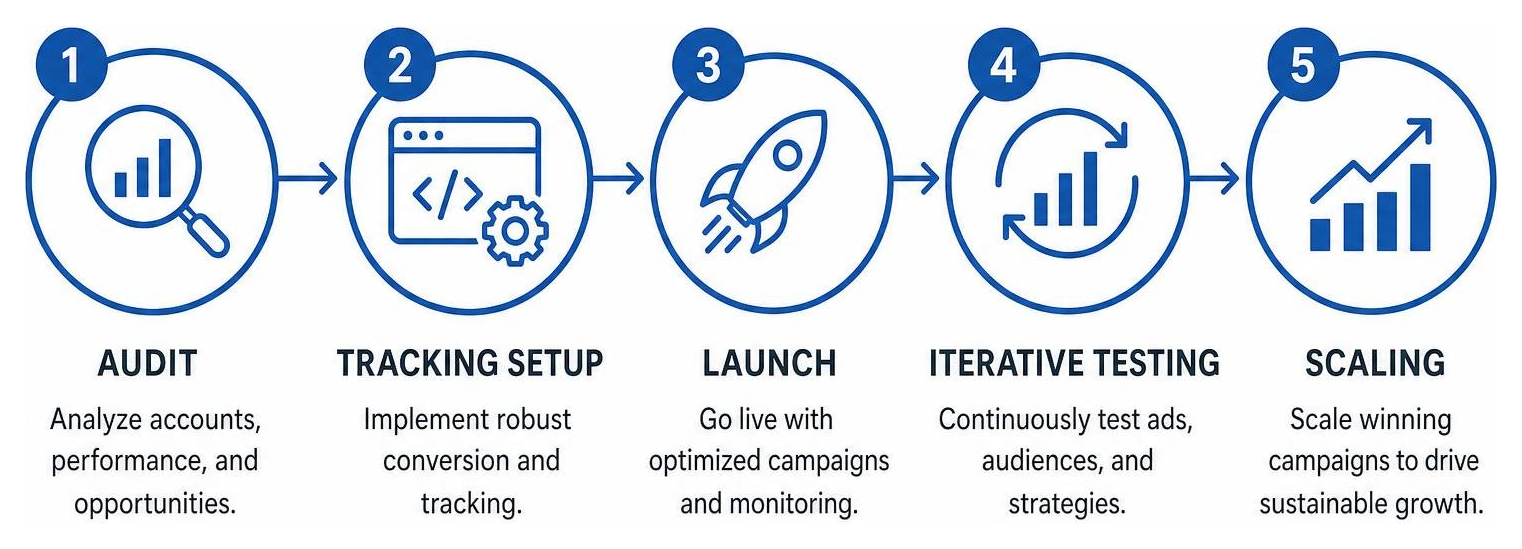
Standard Pricing Models of a PPC Management Agency
PPC agencies structure their management fees in a few primary ways:
- Percentage of Ad Spend: The agency charges a tiered percentage (typically 10% to 20%) of your monthly advertising spend. This aligns well for growing, dynamic budgets where campaign complexity expands with media investment.
- Flat Monthly Retainer: A fixed fee based on the scope of work and channel complexity, offering predictable monthly billing and clear deliverable outlines.
- Performance-Based Pricing: Fees tied directly to generated leads, sales volume, or specific ROAS milestones, ensuring incentives are directly linked to bottom-line profitability.
- Hybrid Model: A lower base monthly retainer paired with a smaller percentage of ad spend or performance bonuses once specific growth targets are hit.
Whatever model an agency uses, pricing should remain transparent, with no hidden markups on media spend.
Red Flags and Hidden Pitfalls to Avoid
Watch out for these warning signs during discovery calls:
- Proprietary Account Hostage-Taking: If an agency insists on creating campaigns inside their own account rather than granting you administrative ownership of yours, walk away.
- Focusing on Vanity Metrics: Agencies that celebrate impressions and clicks while ignoring cost per acquisition (CPA) or revenue are hiding ineffective strategy.
- Cookie-Cutter Approaches: Beware of agencies that apply identical campaign templates regardless of your industry, audience, or margins.
- Long-Term Lock-In Clauses: Avoid rigid annual contracts that do not include performance milestones or fair cancellation windows.
Realistic ROI and Critical Metrics to Track
Across Google Ads, businesses make an average of $2 in revenue for every $1 spent, representing a baseline 200% ROI. In addition, paid search ads can lift overall brand awareness by as much as 80% when campaigns maintain strong impression share across high-intent search terms.
When monitoring your campaign progress, hold your agency accountable to the metrics that directly impact profitability:
- Return on Ad Spend (ROAS): Total revenue generated divided by total ad spend across each channel and product line.
- Cost Per Acquisition (CPA) / Cost Per Lead (CPL): The exact media cost required to earn a paying customer, booked consultation, or qualified sales lead.
- Post-Click Conversion Rate: The percentage of visitors who complete your primary target action after arriving on your dedicated landing page.
- Click-Through Rate (CTR): An indicator of ad relevance, quality score health, and messaging resonance with search intent.
- Customer Lifetime Value to CAC Ratio: Measuring customer acquisition cost against long-term customer value to ensure sustainable scale.
- Mobile vs. Desktop Efficiency: With mobile devices driving over 50% of all paid search clicks, channel-specific efficiency must be monitored closely.
For companies scaling aggressively, the top 25% of PPC advertisers invest over $1 million annually in paid search, demonstrating that paid media remains a primary growth driver when managed with discipline.
Frequently Asked Questions About PPC Agencies
How quickly can a newly hired agency generate measurable results?
Most campaigns require an initial 30-day learning and calibration period. Modern automated bidding algorithms need baseline data to identify top-converting audiences, search queries, and creative combinations. While initial traffic and early conversions arrive immediately upon launch, peak efficiency and full optimization typically emerge between 60 and 90 days.
Do PPC agencies require long-term binding contracts?
Agencies vary, but many operate on standard 3-month onboarding agreements followed by flexible month-to-month terms. This gives the team adequate time to build, test, and refine campaigns while keeping them accountable for ongoing performance.
Who owns the ad accounts and historical campaign data?
You should always maintain 100% administrative ownership of your ad accounts, conversion data, and creative assets. An agency should access your accounts as a manager or partner. If you ever part ways, your historical data, negative keyword lists, and campaign structures should remain entirely with your business.
Conclusion
Maximizing return on paid search and paid social requires moving past vanity metrics and prioritizing post-click conversions. Learn more About Us to discover how our team builds transparent, high-performing media campaigns, or reach out directly to our team through our contact page to review your current ad performance.
Ready to eliminate wasted spend and accelerate revenue? Visit ROAZZ to build a data-driven paid advertising strategy tailored to your business goals.