Introduction

To fix funnel leaks with smart retargeting display ads, segment drop-offs by intent depth, deploy time-decay creative sequences, and use server-side tracking to maintain accurate audience matching. This approach recovers visitors who leave without converting, turning lost traffic into measurable revenue.
Getting someone’s attention online is an expensive uphill battle. Keeping it long enough to secure a purchase, booking, or sign-up is even harder. Industry data shows that nearly 97% of first-time visitors leave a website without converting. If you let those visitors slip away without a follow-up mechanism, your acquisition budget ends up subsidizing competitors who catch them downstream.
When executed strategically, retargeting display ads act as a safety net across the entire digital ecosystem. Industry benchmarks indicate that retargeting can boost ad engagement by up to 400%, and potential buyers who encounter these targeted banners are 70% more likely to convert on a retailer’s website. Furthermore, surveys show that 57% of marketing leaders cite brand awareness and driving direct sales as their twin priorities for remarketing.
Instead of treating retargeting as a generic billboard that follows everyone everywhere, modern performance marketing focuses on precision: delivering relevant creative based on specific post-click actions.
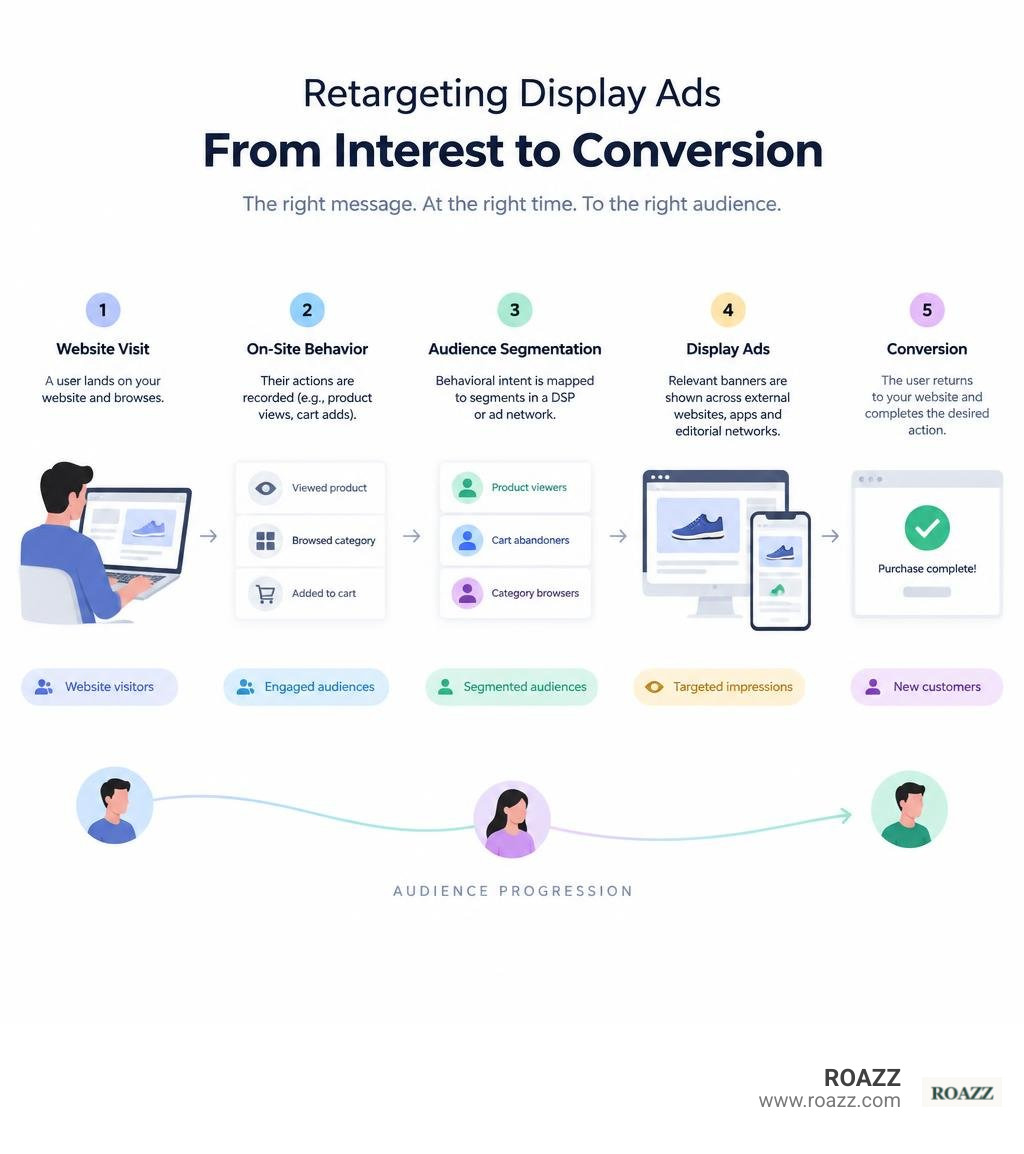
What Are Retargeting Display Ads and How Do They Work?
Display retargeting serves visual banner units (static imagery, rich media, video, or responsive layouts) to users who previously engaged with your digital properties as they browse external websites, apps, and editorial networks.
When a visitor lands on your site, their on-page behavior—viewing a category page, reading a service overview, or placing an item in a cart—is recorded. That behavioral intent is mapped to audience segments within programmatic demand-side platforms (DSPs) or ad networks, allowing you to bid on ad inventory across millions of publisher sites when that specific user appears.
To configure these campaigns efficiently, performance marketers rely on dynamic feeds and responsive display ads that automatically tailor product recommendations and layouts to individual visitor browsing histories.
| Tracking Method | Primary Mechanism | Data Longevity | Resilience to Signal Loss | Match Rate Quality |
|---|---|---|---|---|
| Browser Cookies | Client-side third-party cookies | 1–7 days (restricted by ITP/browsers) | Low (severely degraded by privacy updates) | 40%–55% without first-party data |
| Server-Side Tracking | Cloud server containers & direct APIs | Extended (first-party domain storage) | High (bypasses ad blockers and browser limits) | High (Event Match Quality scores 7.5–9.0) |
Core Technical Foundations of Retargeting Display Ads
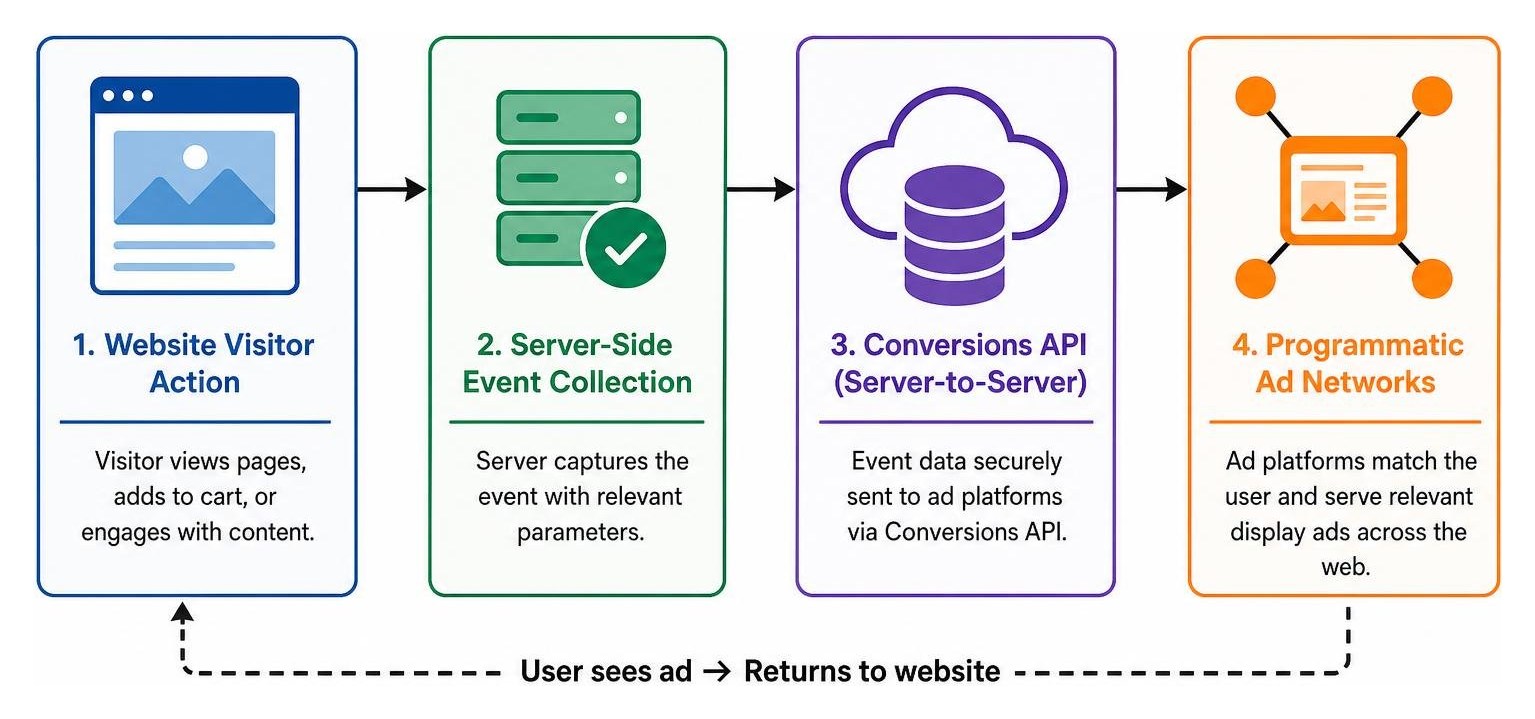
Historically, digital campaigns relied almost exclusively on client-side JavaScript snippets (tracking pixels) embedded in the site header. Today, privacy frameworks and cookie deprecation require a hybrid architecture.
Modern retargeting integrates client-side tags with server-to-server Conversions APIs (CAPI). When a user browses your product pages, the server logs custom parameters—such as item IDs, cart values, and hashed customer identifiers—and synchronizes them directly with ad platform identity graphs.
Understanding how performance tracking works across server containers helps maintain high Event Match Quality (EMQ) scores, ensuring ad networks recognize return visitors and serve the right creative in real time.
Retargeting vs. Remarketing: Key Strategic Differences
While these terms are frequently interchanged, they serve distinct operational functions:
- Retargeting: Relies primarily on programmatic display, video, or paid social placements across third-party websites to bring anonymous or semi-identified visitors back into the funnel based on digital browsing signals.
- Remarketing: Historically refers to reaching identified contacts who have previously shared contact information or created user accounts.
Direct outreach channels only reach prospects who have already submitted contact details. Display retargeting captures the significantly larger portion of unauthenticated visitors, maintaining brand visibility and guiding them back toward conversion across the web.
5 High-Impact Types of Retargeting Display Ads to Evaluate
Evaluating the right display retargeting formats depends on your business model, catalog complexity, and sales cycle duration.
1. Dynamic Retargeting Display Ads for E-Commerce
Dynamic retargeting connects your product feed directly to automated display banner templates. If a user browses a specific leather bag or a software tier, the ad unit dynamically pulls the image, pricing, and live availability of that exact item.
This level of personalization is critical on mobile devices: research indicates that about 63% of smartphone users are more likely to buy from businesses whose mobile sites or apps provide relevant product recommendations. Dynamic creative bridges the gap between general brand recall and specific purchasing intent.
2. Sequential Display Ads for Multi-Stage Trust Building
Rather than blasting prospective customers with the same banner for 30 consecutive days, sequential retargeting serves an intentional narrative:
- Days 0–2: Focus on clean product imagery and feature reminders.
- Days 3–5: Shift to customer reviews, user-generated content, or press accolades to counter hesitation.
- Days 6–10: Present an offer-led urgency hook (such as free shipping or a limited-time bundle) to close the sale.
This structured storytelling prevents ad fatigue and systematically addresses consumer hesitation.
3. Cross-Device and Contextual Programmatic Display
Consumers frequently research products on mobile devices during a morning commute, only to finalize checkout on a desktop computer at work or home.
Cross-device programmatic retargeting resolves disparate session IDs to a single unified customer profile. By combining identity matching with contextual brand safety filters, your banners appear across high-authority news outlets and niche editorial sites without paying for fraudulent or low-visibility ad placements.
4. CRM and List-Based Display Banners
Customer Relationship Management (CRM) retargeting matches encrypted, hashed email lists with publisher networks. This enables highly targeted retention campaigns, such as:
- Cross-selling complementary accessories to customers who bought 60 days ago.
- Displaying renewal notifications to software subscribers nearing contract expirations.
- Re-engaging high-value VIP customers who have not visited your site over the past quarter.
5. Intent-Based Static Display Units
For service businesses, B2B firms, or brands running tight product lines, static display banners provide total control over visual presentation. Instead of relying on automated feeds, static ads deliver focused messaging:
- Category-specific promotions addressing clear search intent.
- Direct invitations to book a consultation or schedule a product demonstration.
- Single, uncompromised calls-to-action (CTAs) tailored to top-of-funnel content consumers.
How to Build a Modern Retargeting Display Strategy in 2026
Signal loss from mobile operating system updates and browser restrictions has permanently altered digital marketing. Browser-only setups that once produced 70% to 80% match rates on ad networks have compressed to 40% to 55% for brands lacking modern data pipelines.
To overcome this, leading organizations invest heavily in first-party data capture—such as progressive profiling, interactive sizing quizzes, and immediate email opt-ins. Analyzing blueprints for DTC scaling and retargeting architecture illustrates how sustainable growth requires moving away from fragmented pixel tracking toward unified identity layers.
Audience Segmentation and Window-Based Creative Sequencing
Segmenting retargeting audiences purely by "all site visitors (last 30 days)" is one of the fastest ways to exhaust ad budgets. Instead, divide audiences by intent depth and time decay.
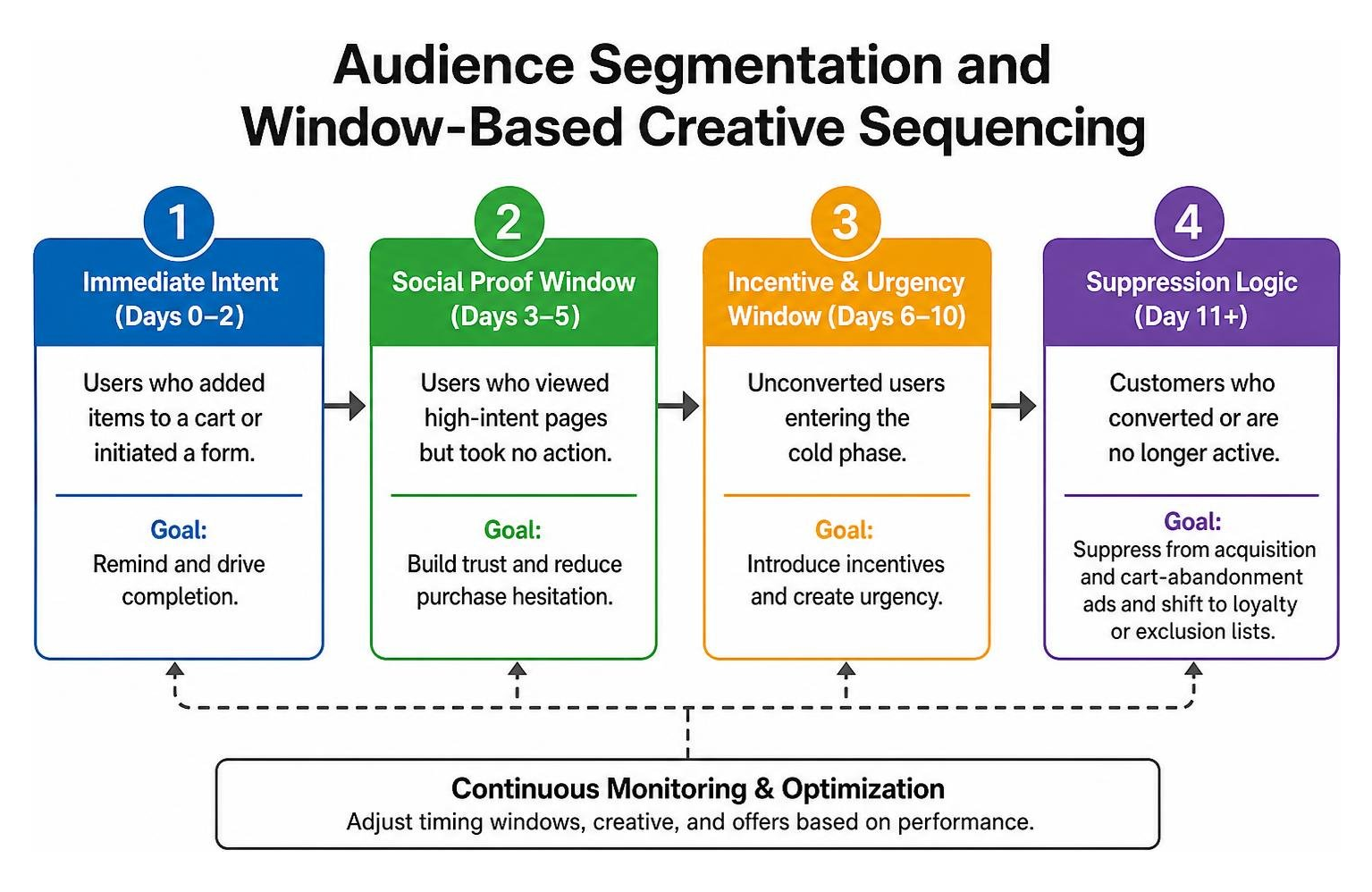
- Immediate Intent (Days 0–2): Users who added items to a cart or initiated a form. Serve dynamic product banners reminding them to finish what they started.
- Social Proof Window (Days 3–5): Users who viewed high-intent pages but took no action. Show reviews, star ratings, and risk-reversal policies (e.g., money-back guarantees).
- Incentive & Urgency Window (Days 6–10): Unconverted users entering the cold phase. Introduce targeted incentives or highlight inventory limitations.
- Suppression Logic (Day 11+): Automatically suppress converted customers from acquisition and cart-abandonment ads, shifting them into loyalty or exclusion lists.
Frequency Capping and Mobile Optimization Rules
Overexposure is the quickest path to brand irritation. If a prospect sees your display ad 18 times a day across every mobile app they open, engagement plummets.
Enforce strict frequency caps inside your DSP or ad manager—typically 3 to 4 impressions per user over a rolling 7-day window. Furthermore, ensure display creative is responsive, lightweight, and loads instantly on mobile networks. The banner must link directly to the exact product or offer page rather than dumping visitors onto a generic homepage.
Measuring Real ROI: Incrementality vs. Attributed ROAS
Standard platform metrics often present an inflated view of performance. If a loyal customer was already navigating to your site to complete a purchase, and happens to see a banner ad along the way, standard attribution models credit the ad with that conversion.
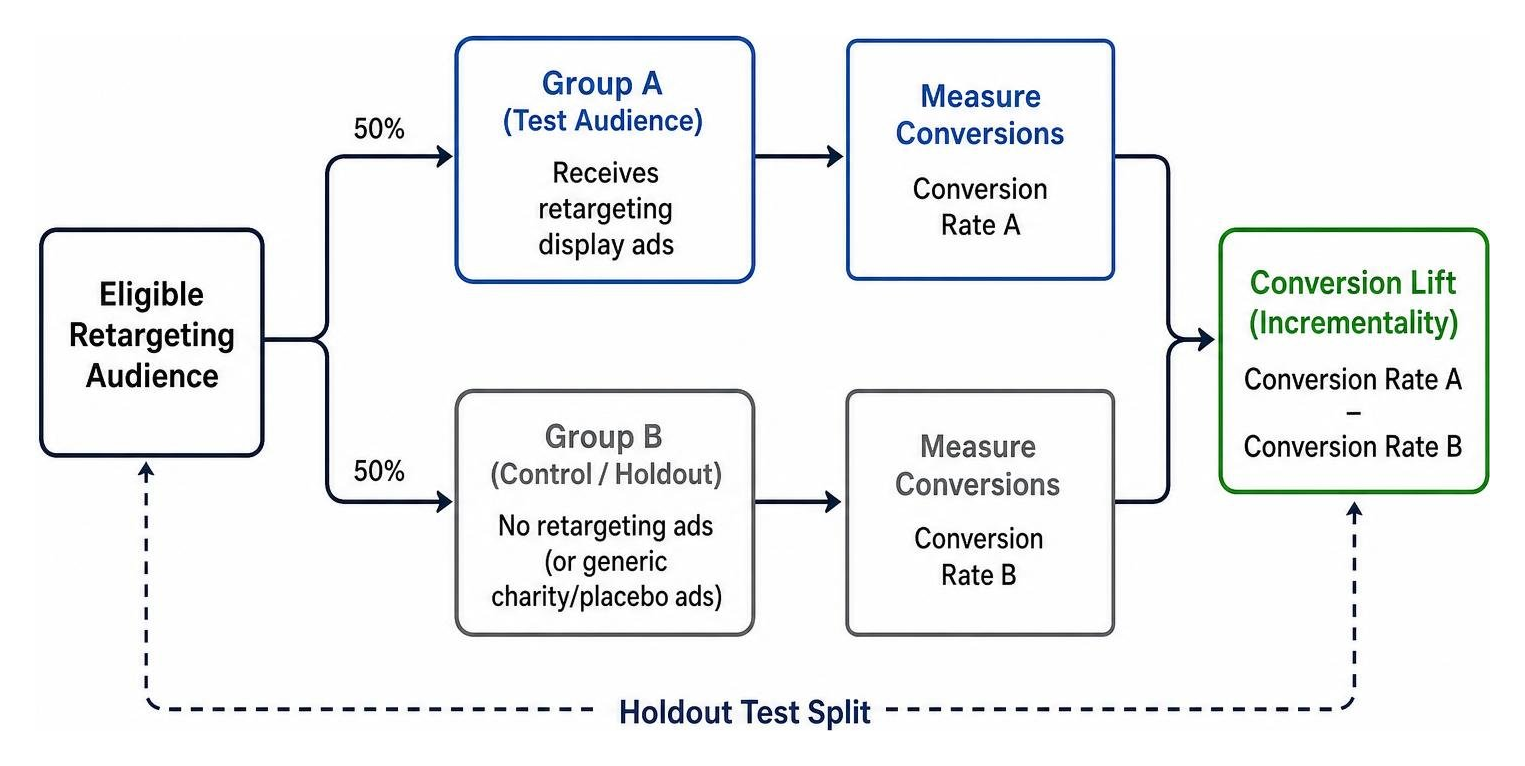
Sophisticated advertisers run incrementality tests using randomized holdout groups:
- Group A (Test Audience): Receives your standard retargeting display ads.
- Group B (Control / Holdout): Segmented out and served no retargeting ads (or generic charity/placebo ads).
By comparing the overall conversion rate between both groups, you determine your true incremental ROAS—revenue generated solely because the ad was served. Performance audits frequently reveal that a substantial portion of platform-reported retargeting revenue is non-incremental. Reallocating that spend into net-new demand generation can dramatically improve overall marketing efficiency.
Exploring our tailored campaign optimization services can help you set up reliable incrementality testing and eliminate wasted ad spend.
Common Retargeting Pitfalls to Avoid
Even seasoned marketing teams encounter common traps when scaling display retargeting campaigns:
- Neglecting Conversion Exclusions: Failing to fire a real-time suppression tag after a user completes a purchase leads to paying for ad impressions on people who just bought the item.
- Collapsing Audiences Together: Grouping 10-second blog readers in the same bucket as multi-item cart abandoners results in misaligned creative and poor conversion rates.
- Relying on Early Discounts: Offering price cuts within hours of abandonment trains your audience to leave carts intentionally to wait for lower prices. Save promotions for later retargeting windows.
- Overlooking Mobile User Experience: Serving non-responsive desktop creative on mobile devices creates unreadable text and broken post-click journeys.
If your team wants an outside perspective on auditing funnel leaks and campaign architecture, consider consulting with performance marketing specialists to streamline your approach.
Frequently Asked Questions About Retargeting Display Ads
What is the ideal frequency cap for retargeting display ads?
For most brands, setting a frequency cap of 3 to 4 impressions per user every 7 days prevents banner fatigue while maintaining steady brand presence. Review our frequently asked campaign questions for deeper technical guidance on programmatic bidding caps.
How long should retargeting display ad windows run?
Lookback windows must align with your natural sales cycle. Fast-moving consumer goods (FMCG) and low-ticket e-commerce typically see intent drop sharply after 7 to 14 days. B2B, enterprise SaaS, and high-ticket luxury goods may require structured retargeting sequences spanning 30 to 90 days.
How has cookie deprecation affected display retargeting match rates?
Browser privacy changes have significantly reduced the reliability of client-side tracking pixels alone. Ad platforms now depend on server-side conversions APIs, first-party identity graphs, and machine-learning modeled conversions to maintain accurate audience matching.
Conclusion
Retargeting display ads are not a tool for artificially inflating attribution reports—they are an operational mechanism for repairing funnel leaks and capturing genuine customer intent. By pairing first-party server infrastructure with structured creative sequencing, strict frequency limits, and incrementality-based measurement, your business can maximize revenue across every marketing dollar spent.
At ROAZZ, we focus on measurable post-click business outcomes—driving real sales, qualified leads, and sustained enterprise value rather than chasing superficial impressions. Visit our performance marketing services to discover how we can optimize your retargeting campaigns for profitable scale.