How to Choose Facebook Ads Management Services That Drive Results

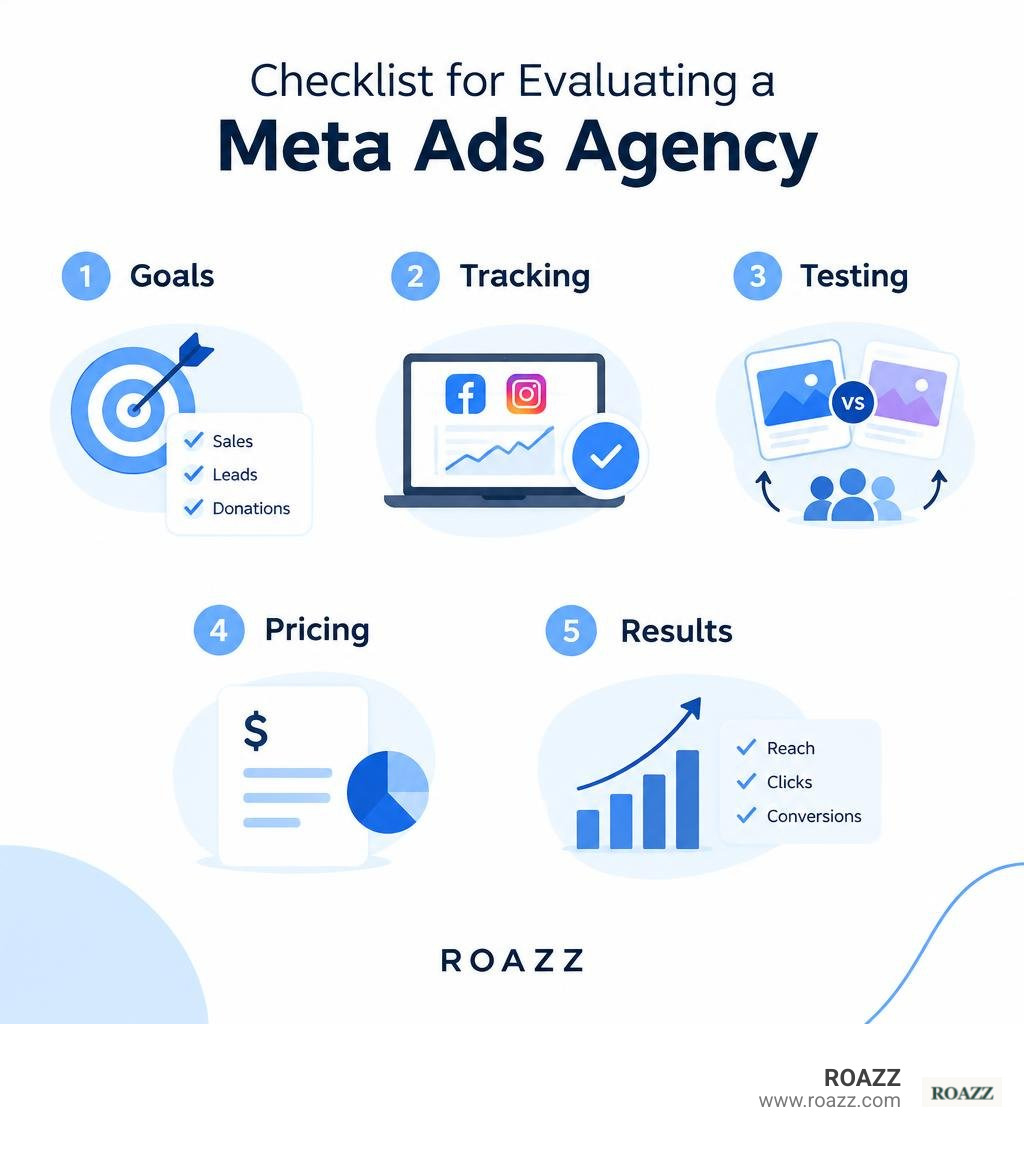
Facebook ads management services plan, run, and improve paid campaigns across Facebook and Instagram. To choose a provider, start with your business goal: sales, qualified leads, or donations. Then ask how the team will track that outcome, test audiences and creative, and report results after the click. Compare its management fee and ad spend against the value of the results it can deliver.
Reach and clicks matter, but they do not pay the bills. This guide will help you evaluate an agency based on targeting, tracking, pricing, and its plan for improving return on your budget. For broader context on how paid social fits into online advertising, evaluating your core campaign goals is essential.
What Are Facebook Ads Management Services and How They Drive Growth
Navigating Meta's advertising ecosystem requires more than boosting a post and hoping for the best. With over 2.93 billion monthly active users on Facebook, the platform offers unprecedented access to global audiences. However, capturing that market requires an end-to-end strategy that connects creative assets to bottom-line business outcomes.
Professional Facebook ads management services take full ownership of your paid social strategy. Instead of treating paid social as an isolated vanity-metric generator, a professional partner builds full-funnel architectures that attract cold prospects, nurture engaged consideration, and convert high-intent buyers.
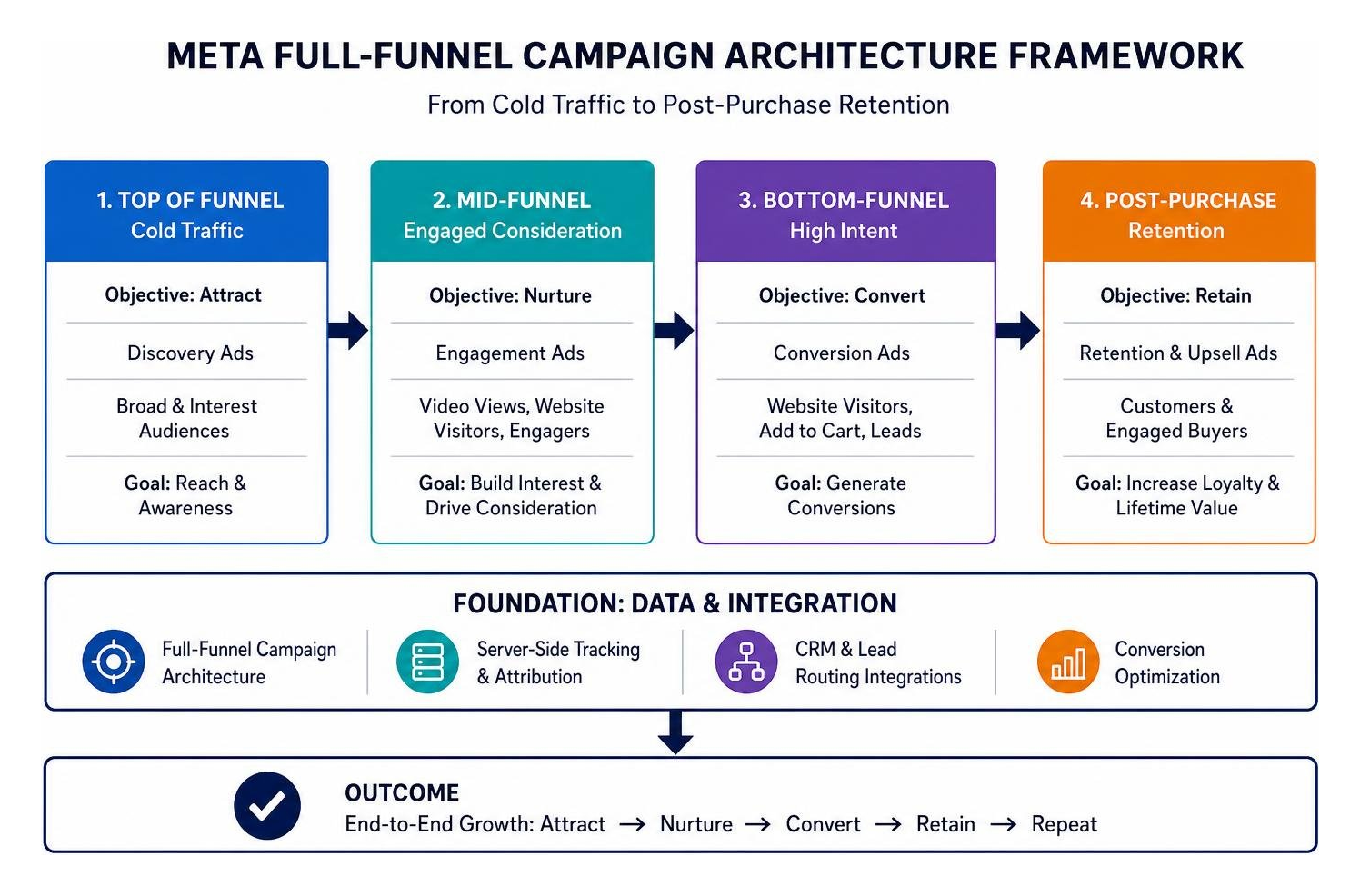
At its core, a sustainable Meta growth engine relies on several integrated pillars:
- Full-Funnel Campaign Architecture: Structuring campaigns to separate cold prospecting (top of funnel), mid-funnel engagement, and bottom-of-funnel retargeting to eliminate audience overlap and wasted ad spend.
- Server-Side Tracking & Attribution: Implementing the Meta Conversions API (CAPI) alongside standard pixel implementations to maintain signal accuracy despite browser privacy updates.
- CRM and Lead Routing Integrations: Connecting lead forms and post-click landing pages directly to your sales pipeline or email automation tools to ensure rapid lead processing.
- Conversion Optimization: Setting up custom conversion events focused on bottom-line results like booked calls, subscriptions, and revenue rather than raw traffic.
By aligning these components, our comprehensive services ensure that every dollar allocated to paid media is held accountable to measurable business growth.
Audience Segmentation and Advanced Precision Targeting
The Meta advertising platform allows brands to reach over 2.1 billion people using granular demographic, behavioral, and interest-based criteria. While basic targeting focuses on broad categories, specialized management services deploy advanced segmentation strategies to maximize efficiency.
An experienced agency segments audiences into clearly defined tiers:
- Custom Audiences: High-intent segments generated from your customer lists, previous website visitors, app users, and video viewers.
- Lookalike Audiences (LLAs): Algorithmic modeling that identifies users who mirror your highest-value customers based on seed lists of top-tier purchasers or high-scoring leads.
- Broad and Behavioral Targeting: Utilizing machine learning and broad interest clusters to allow Meta’s delivery algorithm to find intent signals across large audience pools.
Proper segmentation prevents ad fatigue and internal auction competition. Rather than bidding against yourself, your budget is dynamically distributed across cold prospecting and conversion-ready segments.
Creative Strategy, Copywriting, and Video Production
Creative is the single largest performance lever on Meta platforms. High-performing campaigns rely on a consistent output of dynamic creative variations, compelling direct-response copy, and intent-driven design.
Because 74% of users rely on Facebook to make purchasing decisions, creative must communicate value instantly. Video ads on the platform yield an average view-through rate of 25.6%. However, 85% of video views happen with the sound off. Professional ad managers account for these platform nuances by building mobile-optimized, sound-off video assets featuring clear captions, high-contrast visual hooks, and explicit value propositions.
Furthermore, integrating clear call-to-action (CTA) buttons provides a direct lift, driving a 2.5% higher click-through rate (CTR) compared to ads without one. Agencies continually test headlines, user-generated content (UGC), product angles, and CTA configurations to identify winning combinations before creative fatigue degrades return on ad spend.
In-House Management vs. Hiring an Agency
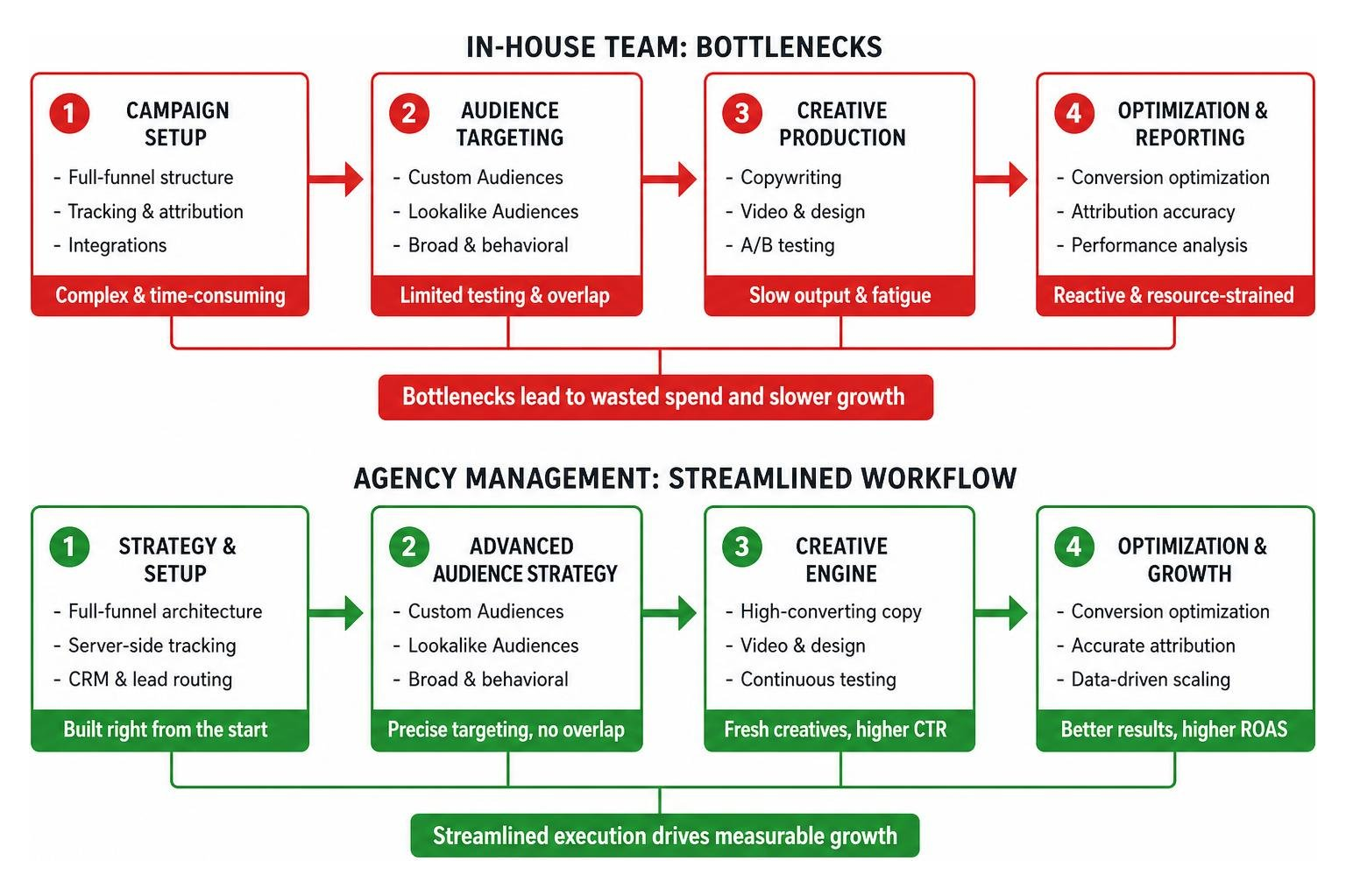
Managing Meta campaigns in-house often seems cost-effective initially. However, the complexity of modern attribution, rapid creative degradation, and rising auction costs make self-management challenging for resource-constrained internal teams.
The table below outlines the core differences between managing campaigns internally versus partnering with an external specialist:
| Dimension | In-House Management | Professional Agency |
|---|---|---|
| Skill Breadth | Limited to internal team bandwidth and experience | Cross-functional team of copywriters, designers, and media buyers |
| Creative Volume | Often constrained by daily operational priorities | Dedicated creative testing pipelines and asset iteration |
| Tracking Infrastructure | Basic pixel setups vulnerable to data loss | Server-side Conversion API (CAPI) and offline attribution |
| Platform Expertise | Knowledge limited to single-brand data | Insights gathered across multiple accounts and millions in ad spend |
| Overhead Cost | Fixed salaries, software subscriptions, and benefits | Scalable monthly management or performance-based fees |
In-House Execution vs. Facebook Ads Management Services
When brands manage campaigns internally, media buyers frequently operate in silos. A single marketer is often expected to write direct-response copy, design visual assets, troubleshoot tracking discrepancies, and optimize bidding algorithms. This dynamic leads to bottlenecked testing cycles and missed optimization windows.
In contrast, our structured How It Works framework demonstrates how a dedicated partner deploys specialized roles to manage every stage of execution. Delegating campaign management frees up internal bandwidth while ensuring your advertising strategy benefits from continuous optimization and tested scaling frameworks.
Evaluating Agency Pricing Models and Performance Metrics
Across all industries on Facebook, the average cost per click (CPC) sits at $1.72, the average cost per thousand impressions (CPM) is $12.62, and the average conversion rate is 9.21%. While finance and insurance lead conversion benchmarks at 13.3%, businesses across sectors see an average return on ad spend (ROAS) of 4.2x.

To capture these returns, you must understand how agencies charge for their services and how those costs affect your overall campaign economics.
Pricing Models for Facebook Ads Management Services
Agency pricing models vary based on spend tier, account complexity, and required creative volume. The following table highlights common agency fee structures:
| Pricing Model | How It Works | Best Suited For | Key Considerations |
|---|---|---|---|
| Monthly Flat Retainer | Fixed monthly fee regardless of spend variations | Predictable monthly ad spends ($3k–$15k) | Ensures budget predictability; scope must be clearly defined |
| Percentage of Ad Spend | Tiered fee (e.g., 10%–20%) scaling with monthly spend | High-growth brands spending $20k+ per month | Aligns agency workload with media scale; watch for artificial spend inflation |
| Performance-Based | Base retainer plus a percentage of generated revenue or profit | Mature brands with verified tracking and high sales volume | Aligns incentives; requires transparent attribution systems |
| Hybrid Structure | Lower baseline retainer paired with performance milestones | Scaling brands looking for shared risk and aligned incentives | Clear definitions of qualifying conversions are essential |
While small businesses typically allocate between $200 and $800 per month for preliminary testing, establishing a consistent scaling engine requires sufficient budget to feed Meta's machine-learning algorithms with reliable conversion signals.
Essential KPIs and Conversion Analytics
To accurately evaluate performance, focus on post-click conversion metrics rather than surface-level vanity data:
- Cost Per Acquisition (CPA): The total media and management cost required to generate a paying customer, booked consultation, or subscriber.
- Return on Ad Spend (ROAS): Gross revenue generated directly by ad campaigns divided by ad spend.
- Click-Through Rate (CTR): Measures ad resonance and creative hook engagement.
- Conversion Rate (CVR): The percentage of landing page visitors who take the desired post-click action.
- Blended Marketing Efficiency Ratio (MER): Total business revenue divided by total paid marketing spend to account for cross-channel halo effects.
Tracking these numbers ensures optimization decisions are rooted in business profitability rather than superficial platform engagement.
How to Select the Right Meta Advertising Partner
Selecting a partner requires a clear evaluation framework. The ideal agency should balance creative strategy with rigorous technical capabilities.

Before signing an agreement, review our comprehensive faqs or prepare the following questions for your prospective partner:
- How do you configure server-side tracking to prevent attribution loss?
- What is your process for refreshing ad creative when ad fatigue sets in?
- How do you structure testing budgets versus scaling budgets?
- What frequency and format can we expect for performance reporting?
Vetting Technical Capabilities and Tracking Infrastructure
A qualified agency must demonstrate proficiency beyond the Meta Ads Manager interface. They should be able to implement server-to-server tracking, configure offline event sets, and set up automated rules to safeguard your ad spend during auction fluctuations.
Without robust technical foundations, Meta's bidding algorithms optimize toward incomplete data, increasing acquisition costs and skewing reporting accuracy.
Multi-Channel Marketing and Funnel Alignment
Paid social does not operate in a vacuum. A high-converting Facebook campaign relies on well-aligned post-click experiences, including fast-loading landing pages, clear value propositions, and reliable automated email sequences.
Top-tier agencies audit the entire conversion pathway. By aligning ad messaging with landing page copy and post-opt-in nurture flows, they ensure that traffic generated from Meta channels yields the highest possible conversion rate.
Frequently Asked Questions About Facebook Ads Management
How much do professional Facebook ad management services cost?
Agency management fees typically range from $1,500 to $5,000+ per month for flat retainers, or 10% to 20% of monthly ad spend for larger accounts. Setup fees, creative production requirements, and technical tracking audits may also factor into initial costs.
What is an average ROAS for Facebook and Instagram ad campaigns?
Across industries, the benchmark average ROAS on Meta is approximately 4.2x. However, target returns depend heavily on profit margins, average order value (AOV), and customer lifetime value (LTV). High-margin software products may operate profitably at a 2.5x ROAS, whereas low-margin e-commerce brands often require higher baseline returns.
How long does it take for a Meta ads agency to produce results?
While initial data collection begins immediately, campaigns typically require an initial 2 to 4-week testing phase. During this window, the agency tests creative angles, stabilizes the algorithmic learning phase, and identifies winning audience combinations before aggressively scaling spend.
Conclusion
Hiring the right advertising agency comes down to finding a team that prioritizes business outcomes over vanity impressions. Scalable growth on Facebook and Instagram requires an integrated approach combining direct-response creative, precise audience segmentation, robust server-side attribution, and continuous post-click optimization.
If you are ready to eliminate wasted ad spend and scale your customer acquisition with a performance-first framework, contact us today to schedule a strategy session. You can also explore our complete suite of services to see how we build reliable, revenue-focused acquisition engines.