How to Make B2B Paid Social Advertising Drive Revenue

To make B2B paid social advertising profitable, start with the accounts most likely to buy. Match each ad and landing page to what those buyers need now. Then connect campaign data to your CRM so you can judge spend by qualified sales opportunities, customers, or donations, not just clicks and cheap leads.
Most campaigns fall short when they stop measuring at the form fill. A lead may look good in an ad report but never become a real opportunity. The fix is to use sales outcomes to guide targeting, creative, and budget decisions.
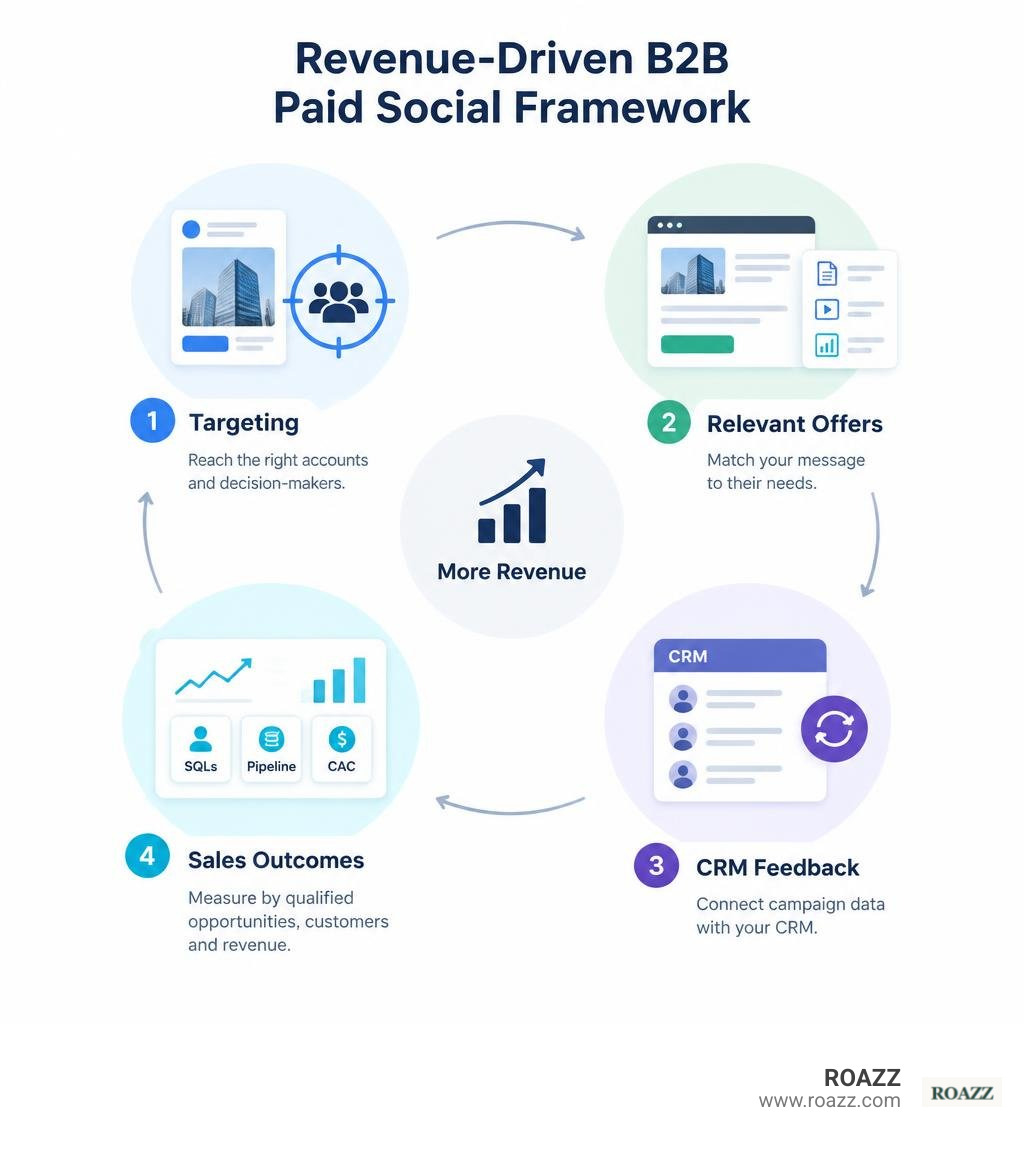
In 2026, digital transformation in B2B buying is undeniable. Roughly 80% of all B2B buyer interactions occur through digital channels, and more than 62% of business buyers finalize their purchasing decisions solely on digital content. Yet, many B2B organizations burn through marketing budgets because their paid social programs function in an isolated silo, completely detached from actual pipeline attribution and closed-won revenue.
To win today, we must look beyond vanity metrics like cost per click (CPC) or cost per lead (CPL). The path forward is building a predictable revenue engine by focusing entirely on post-click business outcomes: sales qualified leads (SQLs), qualified pipeline, and customer acquisition cost (CAC).
The Core Pillars of Successful B2B Paid Social Advertising
High-performing B2B campaigns do not succeed by accident. They rely on a reliable architecture designed to eliminate wasted impressions and turn targeted ad engagement into pipeline.
When analyzing campaigns that scale profitably versus those that stall, success consistently boils down to three primary pillars:
- Surgical Targeting: Reaching specific buying committees and accounts exhibiting real purchase intent rather than casting broad nets.
- Deep Feedback Loops: Feeding post-click milestone data (pipeline stage advancements, demo completions, and closed deals) back to ad platform algorithms.
- Frictionless Prospect Experiences: Providing relevant, journey-matched content from the initial ad impression all the way through the post-click landing page.
By focusing on these core mechanisms, businesses can leverage structured frameworks proven by a dedicated PPC lead generation agency to build reliable, high-intent pipeline engines.
Strategic Foundations: Choosing Between ABM and Demand Generation
Before setting up a single campaign, you must decide whether your business motion demands an Account-Based Marketing (ABM) approach or a broader Demand Generation strategy.
The primary deciding factor is your Average Contract Value (ACV) and the complexity of your buying committee. As a general rule:
- Account-Based Marketing (ABM) is ideal for high ACVs (typically $50,000+), long sales cycles (6 to 18 months), and multi-stakeholder buying committees (6 to 10 decision-makers).
- Demand Generation thrives when deal sizes sit below $50,000, target markets contain tens of thousands of potential accounts, and sales cycles run shorter (under 90 days).
| Strategy Element | Account-Based Marketing (ABM) | Demand Generation |
|---|---|---|
| Typical ACV | $50,000 to $200,000+ | Under $50,000 |
| Target Audience | Defined list of target accounts (Tier 1–3) | Broad persona and firmographic parameters |
| Buying Committee | Multi-stakeholder (Execs, Ops, Users) | Single decision-maker or small team |
| Primary Platforms | LinkedIn, Programmatic Display, YouTube | Meta (Facebook/Instagram), LinkedIn, Search |
| Core KPIs | Account Engagement, Pipeline, Win Rate | Cost per SQL, Demo Volume, Inbound Velocity |
| Sales Cycle | 6 to 18 Months | 14 to 90 Days |
The Three Overlooked Keys to B2B Paid Media Success
Even with the right strategic motion, teams frequently overlook three critical factors that make or break campaign efficiency:
- Closed-Loop Feedback: Tracking clicks and form fills is not enough. You must pass offline CRM lifecycle events back to ad platforms so their machine learning models optimize toward real pipeline rather than low-quality submissions.
- Message Matching and Post-Click Continuity: If an ad promises an operational cost teardown, the landing page must immediately deliver that specific teardown. Dropping high-intent prospects onto a generic product page destroys conversion momentum.
- Buying Committee Alignment: In high-ticket enterprise sales, one person rarely makes a software or service purchase alone. Paid social must distribute tailored messages to end-users (addressing daily pain points), managers (focusing on efficiency), and C-level executives (emphasizing ROI and security).
With B2B customer lifetime values (LTV) frequently ranging between $20,000 and $200,000, acquiring even a handful of incremental enterprise accounts per quarter delivers massive returns on advertising spend.
Precision Targeting: Leveraging Intent Data and Technographic Signals
Wasted ad spend happens when you show ads to companies that have zero interest, no budget, or no technical compatibility with your solution. Modern B2B paid social eliminates guesswork by pairing first-party customer intelligence with third-party intent data and technographic signals.
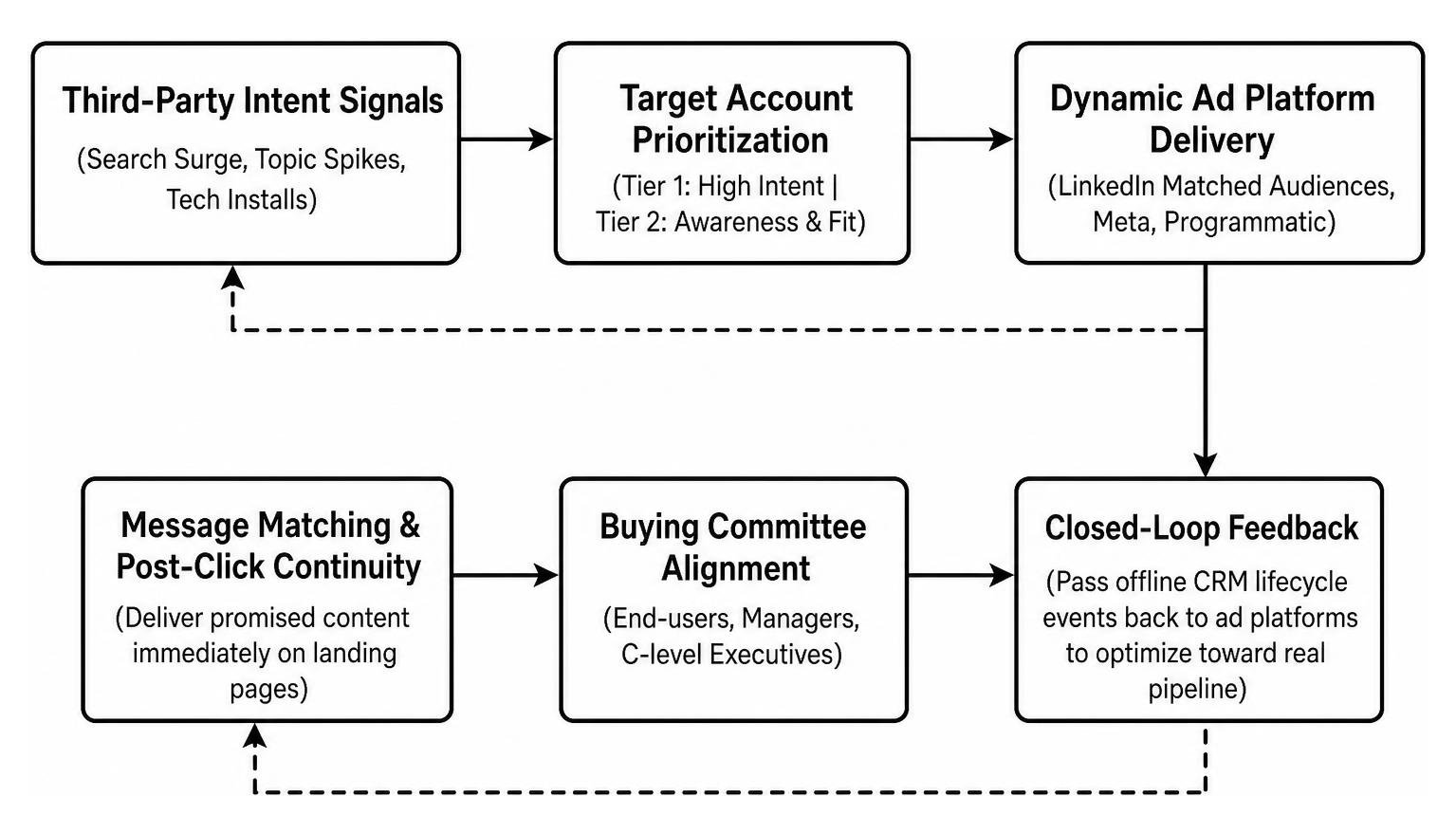
By deploying sophisticated programmatic digital advertising techniques, we can trigger hyper-targeted paid campaigns the moment an account starts researching solutions in our category.
Advanced Audience Layering for B2B Paid Social Advertising
Effective targeting requires audience layering. Rather than relying on simple job titles or broad industry categories, layer your audiences using multiple attributes:
- Firmographics: Company size, revenue bands, growth velocity, and geographic footprints.
- Technographics: The software, infrastructure, and tools currently installed in their tech stack.
- Job Function and Seniority: Specific functional responsibilities, excluding irrelevant levels like interns or individual contributors when targeting executive buyers.
- Custom Match Lists: Uploading prioritized Tier-1 account lists directly into ad networks for granular delivery.
This ensures every dollar is directed at active buyers with the authority and budget to make purchasing decisions.
Intent Trigger Workflows and Buying Committee Mapping
Instead of running continuous, unsegmented campaigns, construct automated workflows that adjust delivery based on external and internal buying triggers:
- Third-Party Research Surges: Launch targeted educational ads when an account shows increased research activity around your category.
- Tech Stack Changes: Deliver transition and migration messaging when a target account drops a competitor or installs complementary software.
- Company Growth & Funding Triggers: Highlight scaling and operational efficiency solutions after target companies complete funding rounds or executive changes.
- Physical Expansion Signals: Use commercial real estate expansions or regional hiring spikes as leading indicators of increased infrastructure needs.
Channel Selection and Budget Allocation Across the Funnel
No single ad channel should carry your entire marketing strategy. Maximizing return on investment requires a coordinated approach combining paid search and paid social. As detailed in this guide to B2B paid search strategy, combining high-intent search with precision social targeting creates full-funnel coverage that captures active demand while nurturing long-term opportunities. Pairing these channels through an experienced paid search marketing agency ensures seamless messaging across all touchpoints.
Evaluating Core Platforms: LinkedIn, Meta, YouTube, and Emerging Channels
Different social networks serve distinct roles across the B2B buyer's journey:
LinkedIn Ads
LinkedIn remains the foundation for B2B paid media. About 80% of all B2B social leads originate on LinkedIn, and 44% of B2B marketers rank it as their most important network. With 9 out of 10 business decision-makers consuming content on the platform weekly, its job title, company name, and industry targeting capabilities justify its premium CPMs.
Meta (Facebook & Instagram)
With over 3 billion monthly active users, decision-makers use Meta properties outside working hours. While cold B2B targeting on Meta requires broader parameters, it is one of the most cost-effective platforms for middle- and bottom-of-funnel retargeting. Partnering with a skilled Facebook advertising agency or leveraging an Instagram advertising agency lets you re-engage warm site visitors with case studies and product walkthroughs at a fraction of LinkedIn's CPM.
YouTube Ads
YouTube sits uniquely between search and social. Because technical decision-makers and architects frequently consult YouTube for tutorials and software demonstrations, in-stream and in-feed video ads build strong brand credibility and visual trust.
TikTok for B2B
While traditionally viewed as consumer-focused, TikTok's reach among tech workers and younger executives makes it an intriguing test channel. It works best for top-of-funnel brand awareness, cultural employer branding, and lightweight SaaS tools.
Full-Funnel Budget Allocation and Channel Testing Frameworks
According to CMO benchmark data, overall B2B marketing budgets hover around 9.5% of annual company revenue, with 15% to 20% of that total directed toward paid social channels.
How you distribute that budget across funnel stages depends largely on your company's growth stage:
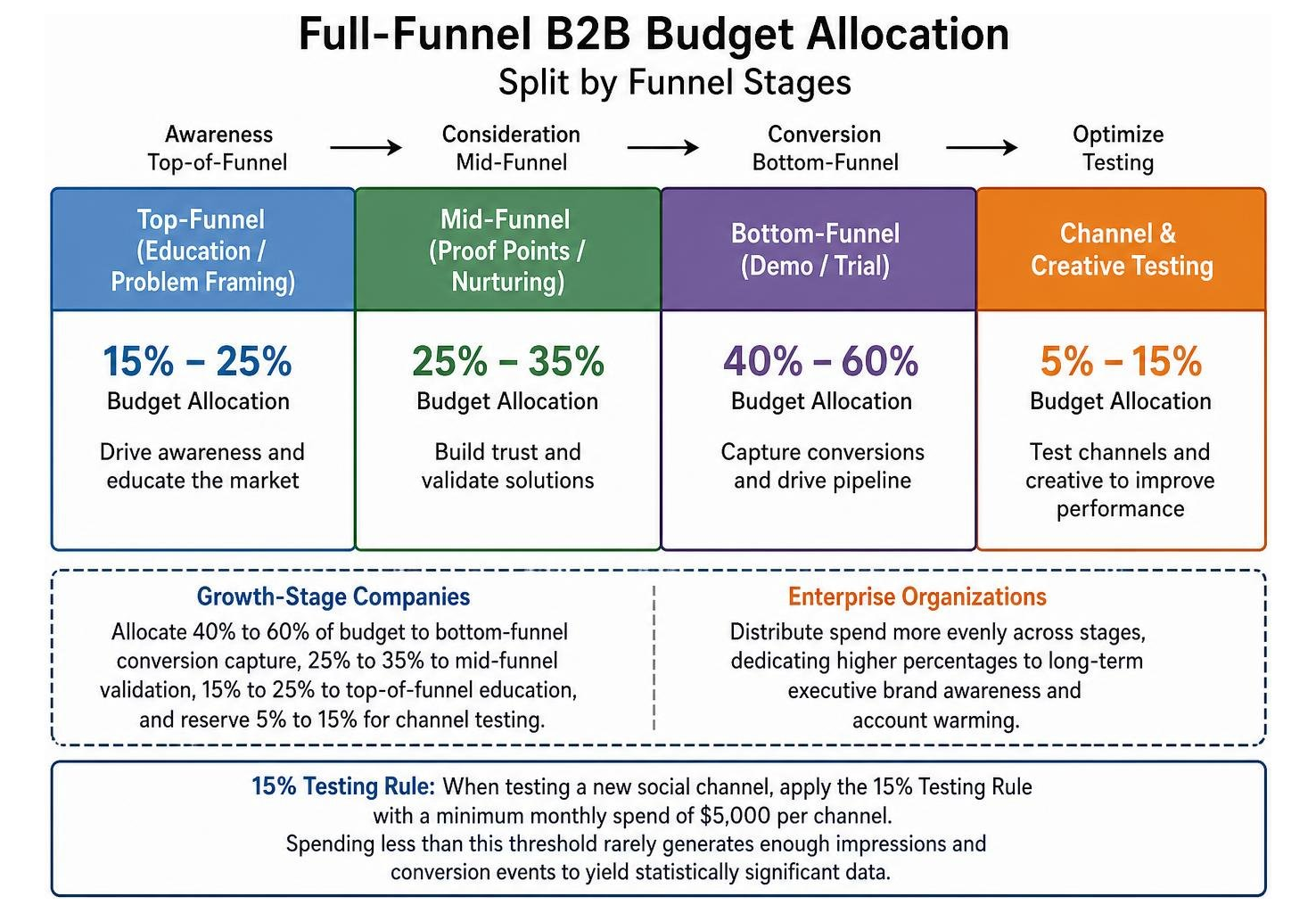
- Growth-Stage Companies: Allocate 40% to 60% of budget directly toward bottom-funnel conversion capture, 25% to 35% on mid-funnel validation, 15% to 25% on top-of-funnel education, and reserve 5% to 15% for channel testing.
- Enterprise Organizations: Distribute spend more evenly across stages, dedicating higher percentages to long-term executive brand awareness and account warming.
When testing a new social channel, apply the 15% Testing Rule with a minimum monthly spend of $5,000 per channel. Spending less than this threshold rarely generates enough impressions and conversion events to yield statistically significant data.
Optimizing the Post-Click Experience and CRM Feedback Loops
The ad creative's job is simply to earn the click; the landing page and post-click experience must close the interest gap and convert that attention into a sales conversation.

Journey-Stage Content Alignment: Awareness to Decision
Every asset and call-to-action (CTA) must align with the prospect's current mindset:
Top-of-Funnel (Awareness):
- Goal: Frame the business problem and establish category authority.
- Assets: Ungated diagnostic tools, industry benchmarks, educational video clips.
- CTA: "Explore Benchmark Data" or "Read the Analysis."
Middle-of-Funnel (Consideration):
- Goal: Prove why your approach solves the operational bottleneck better than alternatives.
- Assets: Detailed customer case studies, architecture breakdowns, feature comparison matrices.
- CTA: "See How [Customer] Scaled" or "Review Technical Specs."
Bottom-of-Funnel (Decision):
- Goal: Convert high-intent interest into pipeline.
- Assets: Interactive product tours, ROI calculators, custom implementation consultations.
- CTA: "Book an Architecture Consultation" or "Start Free Trial."
Integrating CRM Closed-Loop Attribution in B2B Paid Social Advertising
To prevent ad platforms from optimizing for low-intent form fills, you must connect your CRM (HubSpot, Salesforce) directly to ad networks using offline conversion tracking.

When an ad platform learns which specific campaigns, audiences, and creatives generate validated SQLs and revenue, its optimization algorithms automatically favor those high-performing segments over dead-end leads.
Common B2B Paid Social Mistakes and How to Avoid Them
Running profitable campaigns requires ongoing discipline. Working with a dedicated PPC management agency helps teams establish sound measurement practices and avoid costly pitfalls that quietly drain budgets.
Vanity Metrics vs. Revenue-Driven KPIs
The most dangerous pitfall in B2B marketing is celebrating a dropping Cost Per Lead (CPL) while pipeline volume declines.
- The CPL Trap: A campaign generating $25 eBook downloads from non-decision-makers looks great in surface-level reports but delivers zero pipeline.
- The Revenue Focus: A campaign generating $450 demo requests from verified enterprise directors may look expensive on paper, but if 40% of those convert to closed deals worth $60,000, it produces exceptional ROI.
Always optimize your campaigns against business outcomes: Cost per SQL, Opportunity Win Rate, Customer Acquisition Cost (CAC), and Pipeline Velocity.
Landing Page Failures and Creative Ad Fatigue
Two major operational issues frequently undermine campaign performance:
- Sending Paid Traffic to the Homepage: A generic homepage offers too many distractions and lacks tailored messaging. Direct all paid traffic to dedicated, distraction-free landing pages that match your ad copy.
- Creative Ad Fatigue: B2B audiences are relatively compact. When frequency metrics climb above 4.0 within a 30-day window, engagement drops and CPCs rise. Rotate ad creatives every 3 to 6 weeks using a structured mix of video, static cards, and customer proof points.
Frequently Asked Questions About B2B Paid Social
How much budget should be allocated to testing new paid social channels?
We recommend dedicating 5% to 15% of your total monthly media budget to testing new networks. To gather statistically reliable data, maintain a minimum spend of $5,000 per month per test channel over a 60- to 90-day testing window.
What is the ideal contract value threshold for running ABM versus demand generation?
An Average Contract Value (ACV) of $50,000 is the standard benchmark. Deals valued above $50,000 typically involve complex buying committees and extended sales cycles that justify high-touch ABM campaigns. Deals under $50,000 scale more efficiently through broader Demand Generation frameworks.
How does offline CRM conversion tracking improve paid social ROAS?
Offline conversion tracking feeds actual pipeline milestones (SQLs, qualified pipeline, and closed-won deals) back into platform bidding algorithms. This steers machine learning models away from low-quality form fills and trains them to bid aggressively on users matching your most profitable customer profiles.
Conclusion: Turning Paid Social into a Predictable Revenue Engine
B2B paid social advertising fails when it prioritizes surface-level vanity metrics over actual sales outcomes. To build a predictable revenue engine, you need surgical targeting, strong CRM feedback loops, and post-click journeys tailored to each stage of the buyer's journey.
At ROAZZ, our performance-marketing services focus on what actually moves the needle: measuring post-click outcomes and allocating budget toward your highest-performing, intent-driven opportunities. Stop settling for cheap clicks—align your paid media with your revenue goals and scale your pipeline with confidence.