What Top Search Engine Marketing Agencies Do Differently
What to Look for in a Paid Search Marketing Agency

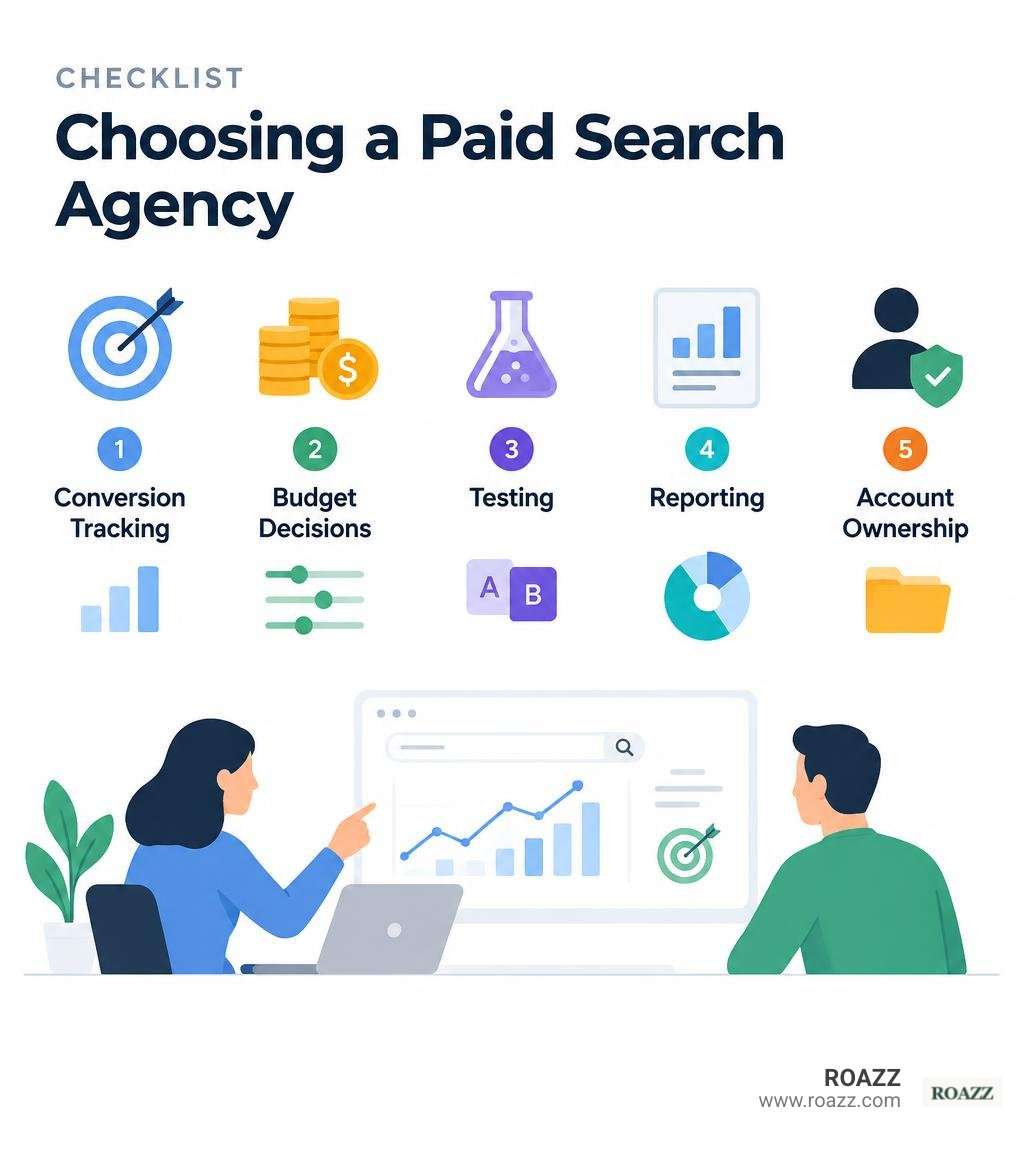
Choose a paid search marketing agency that can show how its work leads to sales, qualified leads, or donations, not just clicks. Ask how it tracks conversions, decides where to spend your budget, tests ads and landing pages, and reports results. Make sure your business will own its ad accounts and data.
Unlike a general digital marketing agency, a paid search specialist focuses on the details of search ads: what people are looking for, which searches deserve your budget, and what happens after someone clicks. The best partner can explain those choices in plain language and tie them to your goals.
Search advertising is the largest single digital channel in the United States, accounting for nearly 40% of all digital ad spend. With an average benchmark return of 200%—delivering $2 for every $1 spent—paid search remains one of the most measurable and scalable acquisition channels available. However, capturing that return requires more than launching a few keyword campaigns. It demands rigorous conversion tracking, disciplined budget allocation, and continuous testing of both ads and post-click experiences.
A strong agency partner should also be able to explain how it uses first-party data, audience signals, and platform automation to improve bidding efficiency. Whether you are evaluating your first paid search partner or replacing an underperforming vendor, the questions you ask during the selection process will directly shape your return on ad spend. The right agency treats your budget as its own, prioritizes post-click outcomes over surface-level metrics, and gives you full visibility into every optimization decision.
Core Differentiators: What Sets Elite Search Engine Marketing Firms Apart

Paid search represents nearly 40% of all digital ad spend in the United States, making it the single largest digital channel. With an average benchmark return of 200%—delivering $2 for every $1 spent—search advertising is a powerful revenue engine. Yet, many organizations struggle to capture these returns because they treat search ads as simple set-it-and-forget-it campaigns.
Elite partners build their approach on post-click outcomes. Rather than celebrating vanity metrics like impressions, we focus on driving actual business growth, including sales, booked appointments, product demos, and paid subscriptions. Delivering these outcomes requires comprehensive performance marketing services that align budget allocation with high-intent customer actions.
This distinction matters because paid search is fundamentally different from awareness-oriented channels. A user who types a specific query into Google or Microsoft Bing is already expressing commercial intent. The job of a skilled search marketing team is to capture that intent at the exact moment it occurs, match it with the most relevant ad and landing page, and guide the user toward a measurable action. Agencies that excel at this process consistently outperform those that treat search as just another media buy.
Specialized Paid Search Marketing Agency vs. Generalist Digital Agency
Generalist marketing agencies often spread their resources across social media management, organic search, branding, PR, and web design. While full-funnel visibility has value, paid search requires deep technical precision.
A dedicated paid search marketing agency works directly in the mechanics of ad platforms. This includes Google Ads, Microsoft Advertising, and specialized retail media networks. Technical paid search requires active management of bid automation algorithms, custom conversion tracking scripts, query matching logic, and first-party data integrations. When your agency lives in these platforms every day, they spot shifts in auction dynamics and algorithmic updates long before generalists notice them.
Specialists also develop institutional knowledge that generalists rarely accumulate. They understand how match types interact, which negative keyword patterns prevent waste, and how to structure accounts for clean data collection. They know when to consolidate campaigns and when to segment them, how to interpret auction insights, and which platform features are worth testing. This depth of expertise translates directly into lower costs per acquisition and more predictable scaling.
Advanced Audience Targeting and Search Platform Innovation
Modern search marketing goes far beyond standard keyword targeting. Leading agencies use audience segmentation and first-party data to guide bidding decisions.
By feeding CRM data, customer lifetime value tiers, and purchase history back into ad networks, we teach smart bidding models which users are worth aggressive bids. Top agencies also test platform beta features, implement server-side tracking, and continuously analyze search queries to prevent budget waste on low-converting clicks.
This approach is especially important as privacy changes reduce the availability of third-party cookies. Agencies that build robust first-party data pipelines are better positioned to maintain targeting precision and measurement accuracy. They can create custom audiences based on actual customer behavior, exclude existing customers from prospecting campaigns, and adjust bids based on predicted lifetime value rather than simple click probability. The result is a more efficient auction strategy that prioritizes the users most likely to become profitable customers.
Essential Services Provided by Top Paid Search Marketing Agency Partners
The best search partners provide end-to-end campaign management designed to improve efficiency at every stage of the user journey. From initial keyword research to post-click conversion optimization, each service layer contributes to a more profitable account.
| Capability | In-House Team | Specialized Agency |
|---|---|---|
| Platform Expertise | Broad, often single-channel focused | Deep, multi-platform mastery across search networks |
| Tooling & Technology | Limited to basic native platform tools | Enterprise analytics, bid modifiers, and tracking scripts |
| Cost Optimization | Slower response to auction inflation | Average 30% reduction in CPC within 90 days |
| Creative Testing | Occasional copy updates | Systematic, continuous ad copy and landing page A/B tests |
| Click-Through Performance | Standard baseline metrics | Up to 20% higher CTR from specialized copy matching |
Comprehensive Account Restructuring and Strategy
Messy account architecture leads to overlapping keywords, internal auction competition, and wasted budget. Top agencies audit and restructure campaigns into clear, intent-driven hierarchies.
Through match type governance and proactive negative keyword hygiene, accounts run leaner and cleaner. In fact, businesses partnering with specialized agencies frequently report an average 30% reduction in cost-per-click (CPC) within the first three months of engagement.
A well-structured account also makes optimization easier. When campaigns are organized by intent, product category, or audience segment, performance data becomes clearer and more actionable. Budgets can be shifted toward the campaigns that generate the most valuable conversions, while underperforming segments are paused or refined. This level of control is difficult to achieve in an account that has grown organically without a clear architectural plan.
Continuous A/B Testing and Conversion Rate Optimization
Clicking an ad is only the first step. Top agencies obsess over what happens after the click.
By running continuous creative variations, responsive search ad testing, and message-matched landing page experiments, agency-managed accounts regularly secure a 20% higher click-through rate (CTR) than in-house campaigns. Aligning the exact search query with compelling ad copy and a frictionless landing page ensures that incoming traffic converts into measurable pipeline value.
Testing should never be a one-time event. Consumer behavior, competitive pressure, and platform algorithms all change over time. The most effective agencies maintain a structured testing calendar that covers ad headlines, descriptions, sitelink extensions, landing page layouts, form fields, and calls to action. Each test generates data that informs the next iteration, creating a compounding cycle of improvement. This systematic approach is what separates agencies that deliver consistent growth from those that simply manage accounts.
How to Select and Evaluate the Right PPC Partner

Over 65% of small to mid-sized businesses outsource their paid search marketing to agencies to boost performance and reduce overhead. Finding the right partner requires a structured vetting process. Understanding our proven onboarding and management process helps clarify how top performers audit existing accounts and establish clear communication rhythms.
The selection process should go beyond reviewing a proposal deck. Ask to see actual account screenshots, conversion tracking setups, and examples of how the agency has restructured underperforming campaigns. A credible partner will be transparent about both successes and challenges, and will explain its methodology in terms you can understand. If an agency cannot clearly articulate how it would improve your specific account, it is unlikely to deliver meaningful results.
How to Evaluate and Choose a Paid Search Marketing Agency
When vetting prospective partners, ask detailed questions about their day-to-day workflow:
- Account Ownership: You must retain 100% administrative ownership of your ad accounts and historical data. Never work with an agency that locks campaigns inside proprietary accounts you cannot access.
- Reporting Transparency: Look for custom dashboards that track revenue, cost per acquisition, and post-click conversions, rather than confusing vanity metrics.
- Track Record and Domain Expertise: Ask for case studies showing measurable post-click outcomes in business models similar to yours.
- Contract Terms: Look for flexible terms that reward performance rather than multi-year lock-ins that protect stagnant management.
Critical PPC Pricing Models, Contracts, and ROI Benchmarks
Agencies typically use one of three pricing structures:
- Percentage of Ad Spend: The fee scales as your media spend grows, typically ranging between 10% and 20%.
- Flat Monthly Retainer: A predictable monthly management fee based on campaign scope and deliverables.
- Hybrid or Performance-Tiered Models: A base fee combined with performance incentives tied to hitting specific CPA or ROAS targets.
Regardless of the model, your agency should aim to meet or exceed the standard 200% ROI benchmark for paid search, ensuring that ad spend remains profitable and scalable. When evaluating pricing proposals, consider the total cost of management relative to the expected return. A lower management fee is not a bargain if it comes with less experienced strategists, fewer optimizations, or limited access to advanced tools. The goal is to find a partner whose fee structure aligns with your growth objectives and whose performance justifies the investment.
Performance Measurement: Critical Metrics and Common Pitfalls
To keep your campaigns profitable, focus on the numbers that affect your bottom line. If you are auditing current agency performance or exploring a new partnership, you can schedule an initial strategy session to review your metrics.
Effective measurement starts with a clear definition of what constitutes a valuable conversion. For some businesses, that means a completed purchase. For others, it means a qualified lead form, a booked appointment, or a requested demo. Once those definitions are established, every optimization decision should be evaluated against its impact on those outcomes. Agencies that report only on impressions, clicks, or average position are not providing the insight you need to make sound budget decisions.
Key Metrics for Tracking Paid Search Success
- Cost Per Acquisition (CPA): The total ad spend required to generate a paying customer, completed lead form, or demo request.
- Return on Ad Spend (ROAS): Total revenue generated divided by total ad spend.
- Conversion Rate (CVR): The percentage of ad clicks that result in valuable post-click actions.
- Customer Lifetime Value (LTV): The long-term revenue a converted customer brings, helping guide profitable target CPAs.
Common Mistakes in Agency Partnerships and How to Avoid Them
The most frequent breakdown in agency engagements comes from misaligned goals. If an agency optimizes for low cost-per-click while your team needs qualified, enterprise-level leads, both sides end up frustrated.
Avoid communication silos by agreeing on target business outcomes during onboarding. Ensure tracking pixels, server-side events, and offline conversion tracking are configured accurately so both teams look at the exact same conversion data.
Another common pitfall is failing to establish clear service-level agreements around reporting cadence, response times, and optimization frequency. Without these expectations in writing, accountability becomes ambiguous. The strongest partnerships include regular strategy calls, transparent access to performance dashboards, and a shared understanding of which metrics matter most. When both sides are aligned on definitions and expectations, the relationship becomes a true growth partnership rather than a vendor transaction.
Frequently Asked Questions About Search Engine Marketing Agencies
How quickly should a business expect results after hiring a search agency?
Most accounts go through an initial 30-day onboarding and restructuring phase, followed by a 60- to 90-day algorithmic learning and optimization cycle. Many businesses see cost-per-click reductions and cleaner traffic within the first few weeks, with sustainable conversion gains stabilizing by month three. The timeline can vary based on account history, competitive landscape, and the quality of existing conversion data. Agencies that promise overnight results are often cutting corners in ways that will hurt performance later.
What pricing models do search marketing agencies typically use?
Most agencies utilize a percentage-of-ad-spend model, a flat monthly retainer, or a hybrid structure. The right model depends on your overall monthly budget, the complexity of your account, and the level of landing page testing included. Some agencies also offer performance-based pricing, where a portion of the fee is tied to hitting specific CPA or ROAS targets. When comparing pricing models, ask what is included in the management fee and whether additional costs apply for creative development, landing page builds, or advanced tracking implementation.
Why do companies outsource paid search instead of managing it in-house?
Hiring and training an in-house team requires significant overhead and continuous education as platform features change. Outsourcing gives businesses instant access to dedicated specialists, enterprise-grade bid tools, and insights gathered across diverse paid search accounts. According to industry research, more than 65% of small to mid-sized businesses outsource their paid search marketing to agencies. This approach allows internal teams to focus on core business operations while specialists handle the technical demands of campaign management, testing, and optimization.
What should a business look for in a paid search agency's reporting?
Strong reporting goes beyond surface-level metrics like impressions and clicks. Look for dashboards that connect ad spend to revenue, cost per acquisition, and post-click conversion actions. The agency should be able to explain how its optimizations influenced those outcomes and what it plans to test next. Transparent reporting also means you have direct access to your ad accounts and can verify performance independently at any time.
Conclusion
Choosing the right partner transforms paid search from an unpredictable expense into a reliable driver of customer acquisition. By prioritizing post-click outcomes, transparent reporting, and intent-driven budget allocation, the right team helps your business turn search intent into measurable revenue. Discover how our team at ROAZZ helps brands maximize search marketing returns with specialized performance services built around bottom-line business results.
The most successful search marketing partnerships are built on shared goals, clear communication, and a relentless focus on what happens after the click. Whether you are launching your first paid search campaign or scaling an established program, the principles outlined in this guide can help you evaluate potential partners and hold them accountable for meaningful business outcomes. For additional context on how search advertising fits into the broader digital marketing landscape, the Wikipedia overview of search engine marketing provides a useful foundation.