How to Run Event Geofencing Advertising That Drives Results

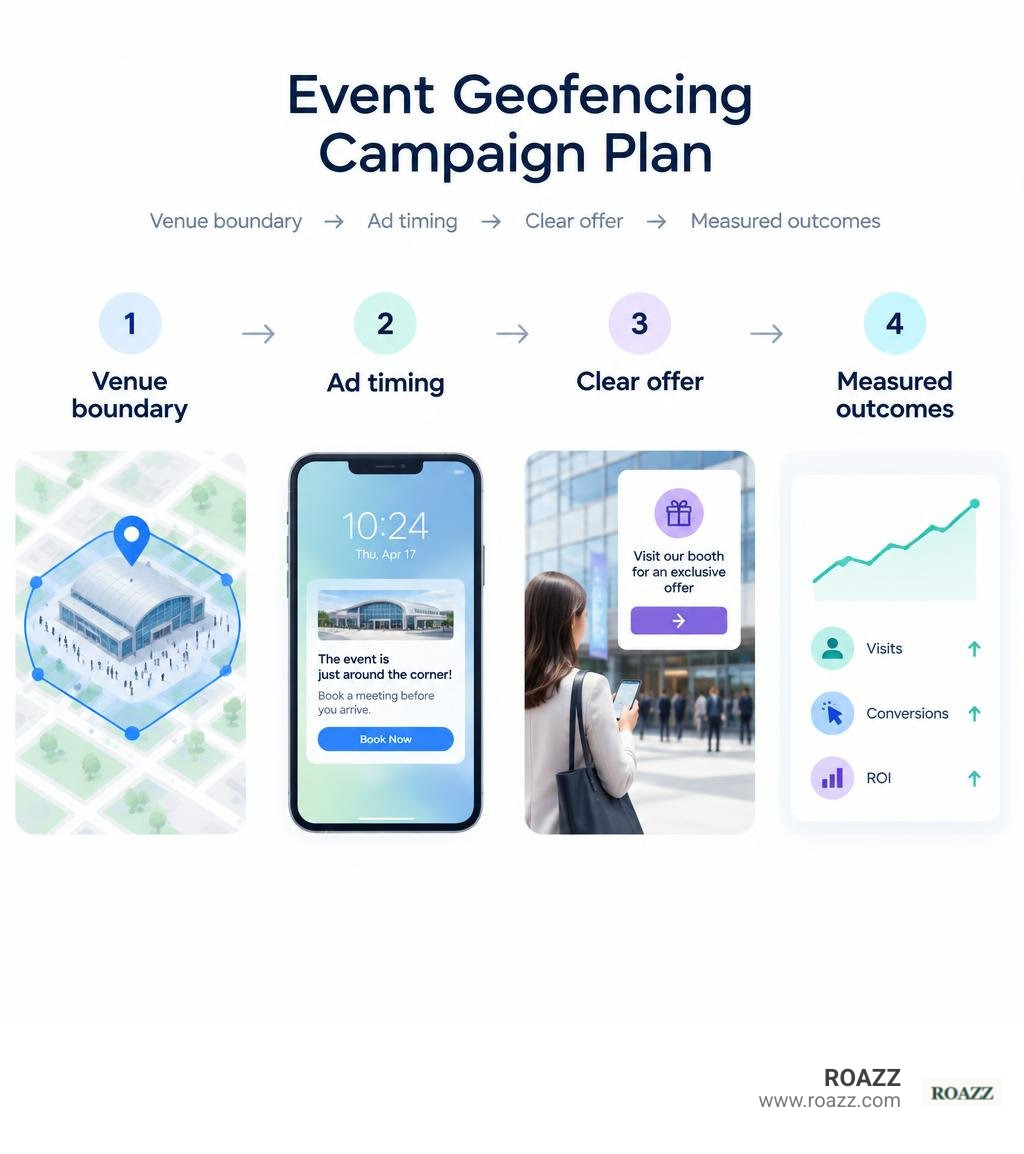
Event geofencing advertising puts mobile ads in front of people near an event venue during a set time. To run a campaign, map the venue boundary, schedule ads around the event, and give people a clear next step, such as booking a demo or making a donation. Then measure those actions, not just clicks.
The key is to match the message to the moment. An ad before the event might invite someone to book a meeting. During the event, it might point them to an on-site offer. Start with a tight boundary and adjust based on who responds.
As the live experiences landscape thrives in 2026, reaching prospects at physical venues has become a primary lever for growth. The global geofencing market was valued at $1.95 billion in 2022, reached $3.22 billion in 2025, and is projected to expand to $11.85 billion by 2034 at a compound annual growth rate of 14.8%. Americans check their phones roughly 80 times every day—about once every 10 to 12 minutes. When thousands of high-intent attendees gather in one physical footprint, location intelligence lets us serve contextually relevant ads that prompt real business outcomes.
Understanding Event Geofencing Advertising: Mechanics and Core Distinctions
At its foundation, event geofencing advertising creates a virtual perimeter around a physical venue—such as an expo hall, arena, or conference center. When a mobile device enters or leaves this designated boundary, location-aware applications trigger a bid request.
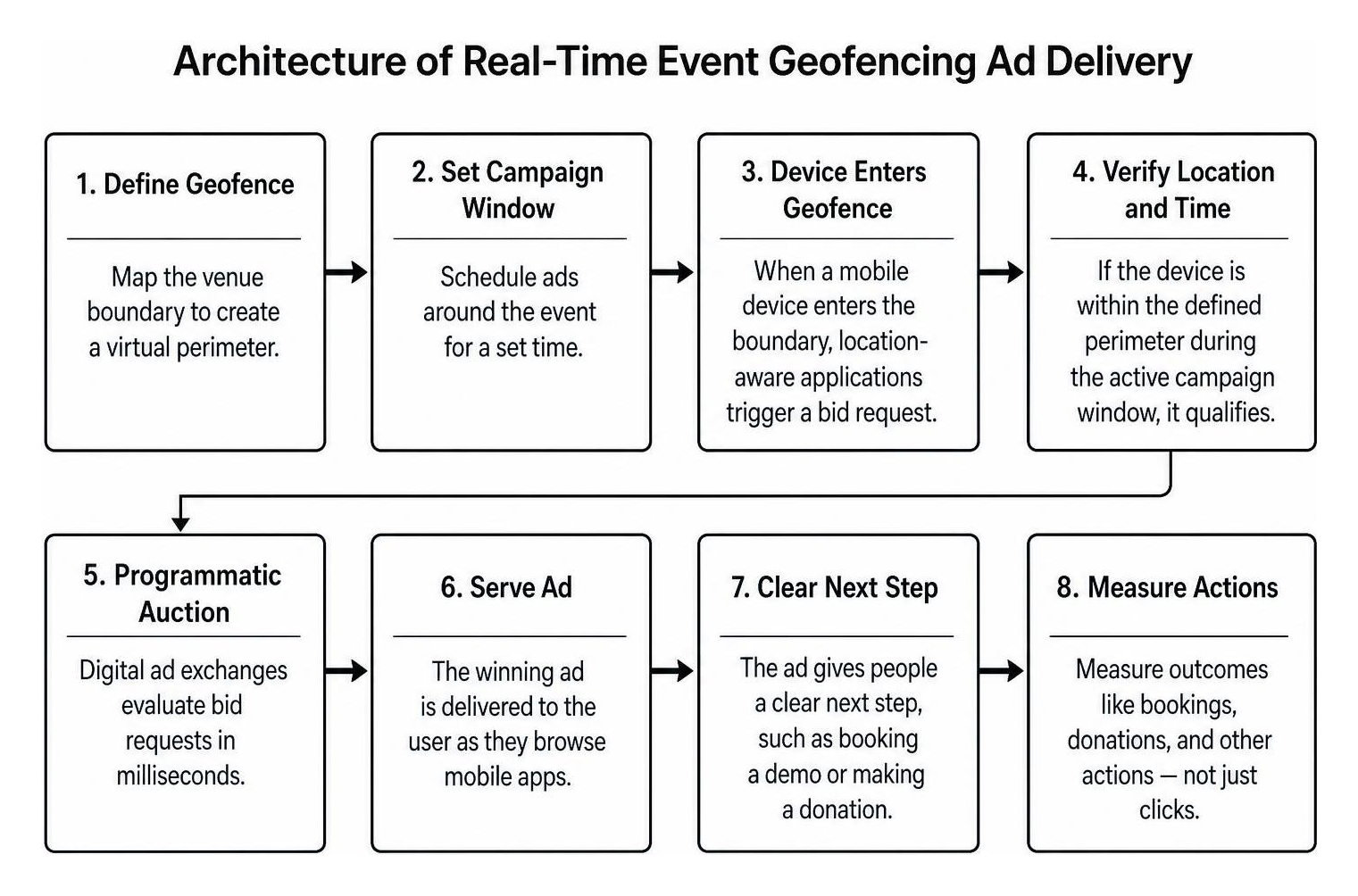
This process connects physical foot traffic directly to modern programmatic digital advertising ecosystems. As attendees browse mobile apps, digital ad exchanges evaluate bid requests in milliseconds. If a device’s latitude and longitude coordinates fall within our defined virtual perimeter during the active campaign window, the system serves our ad unit. Rather than blanketing an entire metro area, we concentrate media spend exclusively on users physically engaged with the event.
How Event Geofencing Advertising Differs from Standard Geotargeting
Marketers often confuse broad location filters with precision geofences. While traditional geotargeting blankets wide areas like postal codes or designated market areas (DMAs), geofencing creates exact, polygon-level perimeters tailored to specific buildings and walkways.
| Targeting Dimension | Standard Geotargeting | Event Geofencing | Beacon Proximity Marketing |
|---|---|---|---|
| Boundary Precision | Broad (1–15 miles; Zip code or city level) | Micro-targeted (50–500 feet; Custom venue polygon) | Hyper-local (1–10 feet; Line of sight) |
| Primary Technology | IP address, cell towers, GPS | Precise GPS, Wi-Fi networks, Cell-ID | Bluetooth Low Energy (BLE) hardware signals |
| Temporal Relevance | Always on or broad dayparts | Strict event duration (hours or specific event days) | Real-time immediate proximity |
| Audience Intent | General regional interest | Verified event participation or attendance | Immediate product/booth interaction |
| Typical Dwell Time | Variable / Unmeasured | Sustained venue dwell (30+ minutes) | Fleeting / Immediate micro-dwell (1–5 minutes) |
Understanding these distinctions helps us deploy geofencing digital advertising frameworks that focus strictly on high-intent environments without wasting budget on uninterested passersby.
The Underlying Technology: GPS, Wi-Fi, RFID, and Cell-ID
Delivering ads within an event perimeter relies on a combination of location data sources:
- Global Positioning System (GPS): Provides the highest outdoor accuracy, typically pinpointing devices within 10 to 30 feet under clear sky conditions.
- Wi-Fi Triangulation: Detects signal strength across public and venue-specific Wi-Fi access points, providing vital location accuracy indoors where satellite visibility drops.
- Cellular Trilateration (Cell-ID): Uses signal timing from surrounding cell towers. While less accurate than GPS, it serves as a reliable secondary signal in dense urban corridors.
- Radio Frequency Identification (RFID) and Bluetooth: Captures micro-proximity signals, often used inside convention centers for session attendance tracking and badge scanning.
Mobile software development kits (SDKs) embedded in popular weather, navigation, social, and lifestyle apps gather these signals to register when an attendee steps over our virtual perimeter.
Tactical Execution: Setting Up Geofences for Maximum Engagement
Setting up a successful campaign requires careful planning. If our boundary is too wide, we pay for irrelevant ad impressions. If it is too narrow, signal attenuation inside heavy concrete halls can restrict our delivery volume.
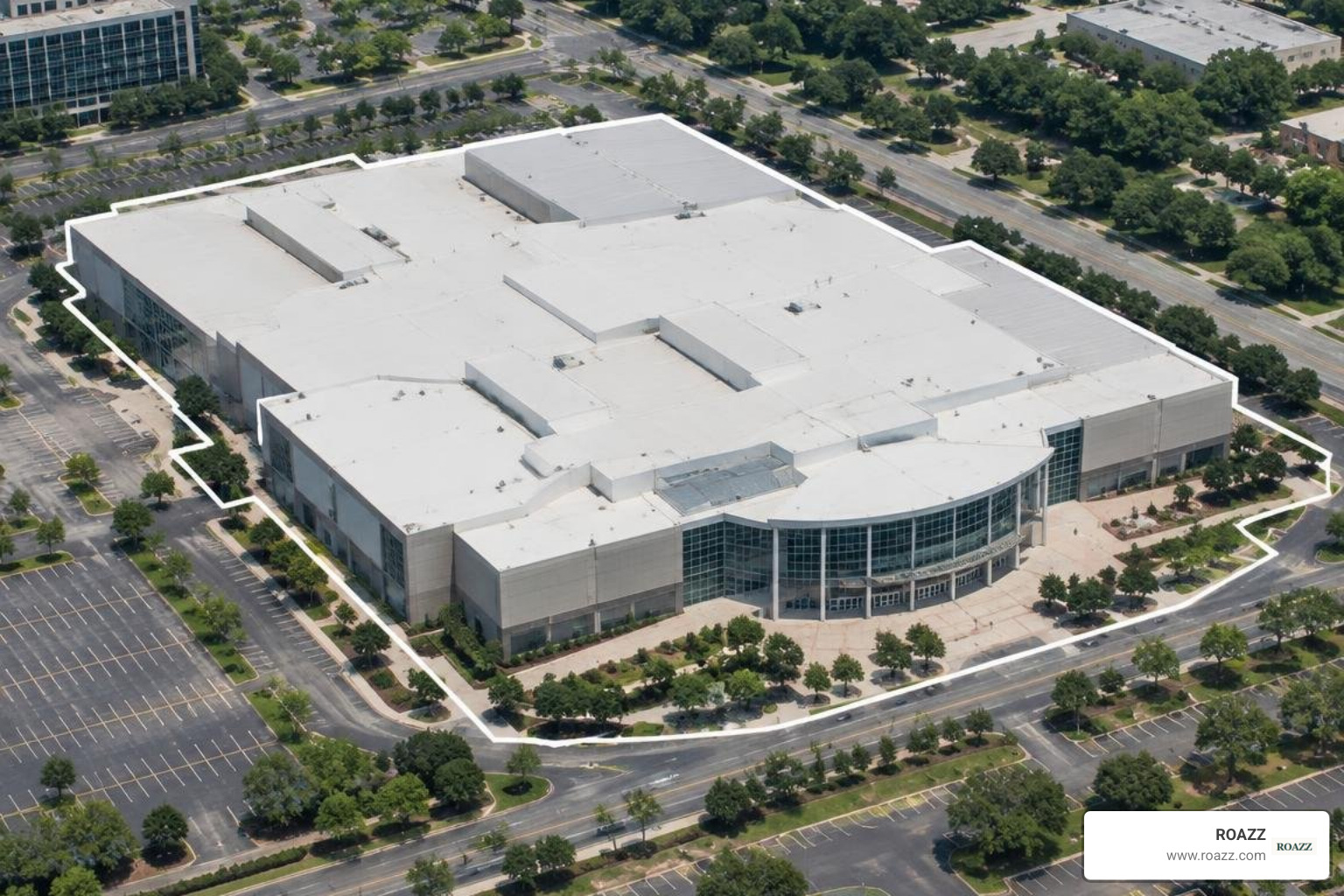
Perimeter Mapping: Building Footprints, Centroids, and Isochrones
Choosing the correct boundary geometry ensures your ad spend stays focused on verified attendees:
- Building Footprint Polygons: The gold standard for convention centers and trade show floors. We map the exact exterior walls of the facility, eliminating nearby parking lots, highways, or adjacent offices.
- Centroid Radius: A circle drawn from a single central point of interest (POI). While easy to configure, a basic 500-foot or 1-mile radius often causes perimeter bleed, accidentally serving ads to drivers on neighboring roads.
- Isochrones (Walk-Time and Drive-Time Contours): Boundaries defined by how far someone can travel within a set window—such as a 4-to-5-minute walk from the main entrance. Isochrones work well for directing attendees to nearby lunch spots, happy hours, or pop-up activations.
By adding exclusion zones around non-target areas (like neighboring competitor hotels or employee parking decks), we ensure our budget targets active attendees exclusively.
Timing Strategies and Multi-Channel Synchronization
Reaching attendees effectively means engaging them across their full daily schedule:
- Pre-Event Warm-Up (2–4 hours prior): Target transit corridors, airport routes, and partner hotels to capture inbound decision-makers.
- Live Event Engagement: Focus ad delivery on session breaks, lunch hours, and networking windows when attendees check their phones.
- Post-Event Retargeting (Up to 30 days): Capture mobile device advertising IDs (MAIDs) inside the geofence during the event, then serve follow-up display, search, or social ads while your brand is top of mind.
Synchronizing mobile geofencing with Digital Out-of-Home (DOOH) billboards near the venue creates a unified experience. For example, during a major music festival activation, Anheuser-Busch deployed mobile geofencing alongside digital billboards featuring dynamic countdown creative. This combined approach, highlighted in a hyperlocal festival campaign, achieved a 226% performance lift above industry benchmarks for the food and beverage vertical by guiding foot traffic directly to branded activation tents.
Enhancing On-Site Attendee Experience and Lead Capture
Inside the venue, location-based messaging should provide direct utility rather than generic promotional copy:
- Automated Booth Check-Ins: Welcoming attendees as they enter your exhibition zone with a streamlined link to download product spec sheets or join a giveaway.
- Session and Keynote Alerts: Delivering time-sensitive reminders 10 minutes before a sponsored executive presentation.
- Frictionless Lead Capture: Using dedicated event software and proximity marketing tools to collect digital contact details via Bluetooth or landing page forms without requiring manual badge scans.
- Crowd Routing & Live Offers: Directing visitors toward less congested demonstration stations or offering flash incentives during slow afternoon hours.
Real-World Applications and Campaign Performance
Event geofencing works across both B2B and B2C settings by connecting physical attendance with measurable digital responses.

B2B Conferences and Trade Shows: Capturing In-Transit Audiences
At large industry trade shows, reaching target accounts before they arrive on the crowded floor helps your brand stand out early.
During Dreamforce, four B2B technology brands used ride-share mobility targeting to engage enterprise decision-makers traveling to the Moscone Center. As detailed in the Uber event advertising case study, the brands served in-app Journey Ads to riders within geofenced pickup and drop-off zones.
The campaign reached 94,000 riders traveling to the event—more than double the 40,000 registered attendees—while generating an average ad view time of 175 seconds (compared to standard benchmarks of 90 to 100 seconds) and a 2.1% click-through rate.
Festivals, Sports, and Large-Scale Gatherings: Crowd Flow and Brand Lift
At consumer gatherings, festivals, and sporting events, geofencing provides both logistical visibility and commercial impact:
- Attendance Verification: At Daytona Bike Week in Florida, organizers used geofencing perimeter analysis along Main Street to determine that total event attendance exceeded 400,000 visitors, providing data for municipal planning and sponsorship valuation.
- Ticketing Protection: Major sports franchises, including the San Diego Padres, have applied geofencing boundaries around regional zip codes to ensure priority playoff ticket access went to local supporters while reducing secondary-market ticket scalping.
- Sponsorship Amplification: Consumer brands at sports stadiums can deliver limited-time promotional codes redeemable exclusively at concession stands or nearby retail partners during half-time.
Privacy, Compliance, and Technical Challenges
Targeting users by location requires strict adherence to privacy regulations, data security standards, and mobile hardware constraints.
Navigating Privacy Regulations and Consent Frameworks
Location data is subject to strict oversight under global and regional regulations, including the European Union's General Data Protection Regulation (GDPR) and the California Consumer Privacy Act (CCPA).
- Explicit User Consent: Location data must come from apps where users have actively opted in to share location services. Following Apple's App Tracking Transparency updates, average consumer opt-in rates hover near 25%, making privacy compliance essential.
- Data Anonymization: Location-based ad platforms must avoid collecting personally identifiable information (PII). Instead, they process anonymized Mobile Advertising IDs (MAIDs) or randomized device tokens.
- Consumer Transparency: Research shows that 37% of consumers report being extremely concerned about digital tracking. Ensuring privacy notices are clear and accessible protects brand trust.
Overcoming Technical Limitations: Battery Drain, Density, and Latency
Running geofencing campaigns in convention centers presents several technical hurdles:
- Network Congestion: Tens of thousands of devices connecting to local cell towers can delay real-time ad serving. Relying on lightweight ad formats and caching creative assets helps minimize latency.
- Battery Preservation: Continuous GPS tracking drains mobile device batteries quickly. Modern geofencing relies on geohash triggers and background location checks to keep power consumption low.
- Data Hygiene: Public GPS coordinates can experience drift inside concrete exhibition halls. Validating building footprint polygons against updated point-of-interest (POI) records prevents serving ads outside the venue.
Measuring Real Outcomes in Event Geofencing Advertising
Click-through rates and impression counts do not reflect commercial growth. Real campaign success is measured through concrete actions:
- Foot-Traffic Lift: Comparing the percentage of ad-exposed users who visited your booth or storefront against an unexposed control group.
- Post-Click Actions: Tracking completed demo requests, appointment bookings, trial sign-ups, or newsletter subscriptions generated on your landing pages.
- Cost Per Acquisition (CPA): Calculating total campaign spend divided by verified pipeline actions.
Our performance methodology focuses directly on these post-click outcomes. You can explore how attribution works across our campaigns to see how location signals connect directly to downstream revenue.
Frequently Asked Questions About Geofencing at Events
What is the typical cost structure for event geofencing campaigns?
Event geofencing campaigns typically run on a Cost Per Mille (CPM) model, charging per 1,000 ad impressions served. CPM rates generally range from $4.00 to $12.00, depending on several campaign factors:
- Audience Density: High-demand conventions featuring executive decision-makers command higher CPM rates due to competitive ad bidding.
- Data Precision: Building-footprint polygon targeting carries a slight data premium over basic radius circles, but eliminates wasted ad spend.
- Ad Format: High-impact rich media, interactive interstitial units, and video ads cost more than standard mobile banners, but generate higher engagement.
Some platforms offer Cost Per Click (CPC) pricing, though CPM with strict post-click conversion tracking remains the standard for programmatic location buys.
What is the ideal radius size when setting up an event geofence?
For dense indoor events like trade shows, the ideal setup is a custom polygon fitted to the venue's exterior walls. When using a circular radius, keep these parameters in mind:
- Urban Centers: Use a tight radius of 200 to 500 feet to avoid capturing unassociated foot traffic on neighboring city blocks.
- Suburban Venues: A radius of 1,000 feet to 0.5 miles works well when the property includes dedicated parking lots and transit plazas.
- Pedestrian Hubs: A 4-to-5-minute walking isochrone captures nearby foot traffic without wasting budget on distant, unengaged audiences.
How does indoor beacon marketing complement venue geofencing?
Geofencing and Bluetooth beacons operate at complementary layers of the attendee journey:
- Venue Geofencing: Establishes a macro-perimeter around the entire facility using GPS and cellular data, serving display and video ads as attendees arrive and navigate the grounds.
- Indoor Beacons: Deploy small hardware transmitters that emit Bluetooth Low Energy (BLE) signals with 1-to-10-foot precision. Beacons trigger in-app alerts when an attendee stands directly in front of a specific product display or booth counter.
Combining venue-wide geofencing with booth-level beacons creates a layered strategy that guides visitors from the front entrance straight to your sales team.
Conclusion: Driving Intent-Driven Results
Event geofencing advertising turns short-term physical gatherings into sustained, measurable marketing pipelines. By building precise venue boundaries, scheduling ads around attendee foot traffic, and retargeting engaged participants over the following weeks, you can turn passing event foot traffic into qualified business pipeline.
At ROAZZ, our focus centers on real business results rather than passive ad impressions. Explore our performance marketing services to see how we help brands plan, launch, and optimize high-return location campaigns that convert event audiences into measurable sales, demos, and pipeline.