How to Vet a Social Media Lead Generation Agency

Choose a social media lead generation agency that can show how posts and conversations become qualified leads, sales, or donations. Ask for results beyond impressions and clicks, including conversions by profile or location. Check who approves content, how leads reach your team, and whether the agency can show which work produced results.
Be wary of an agency that relies on cold DMs, reports only reach, or lets AI publish without human review. The seven red flags below will help you compare proposals and protect your budget.
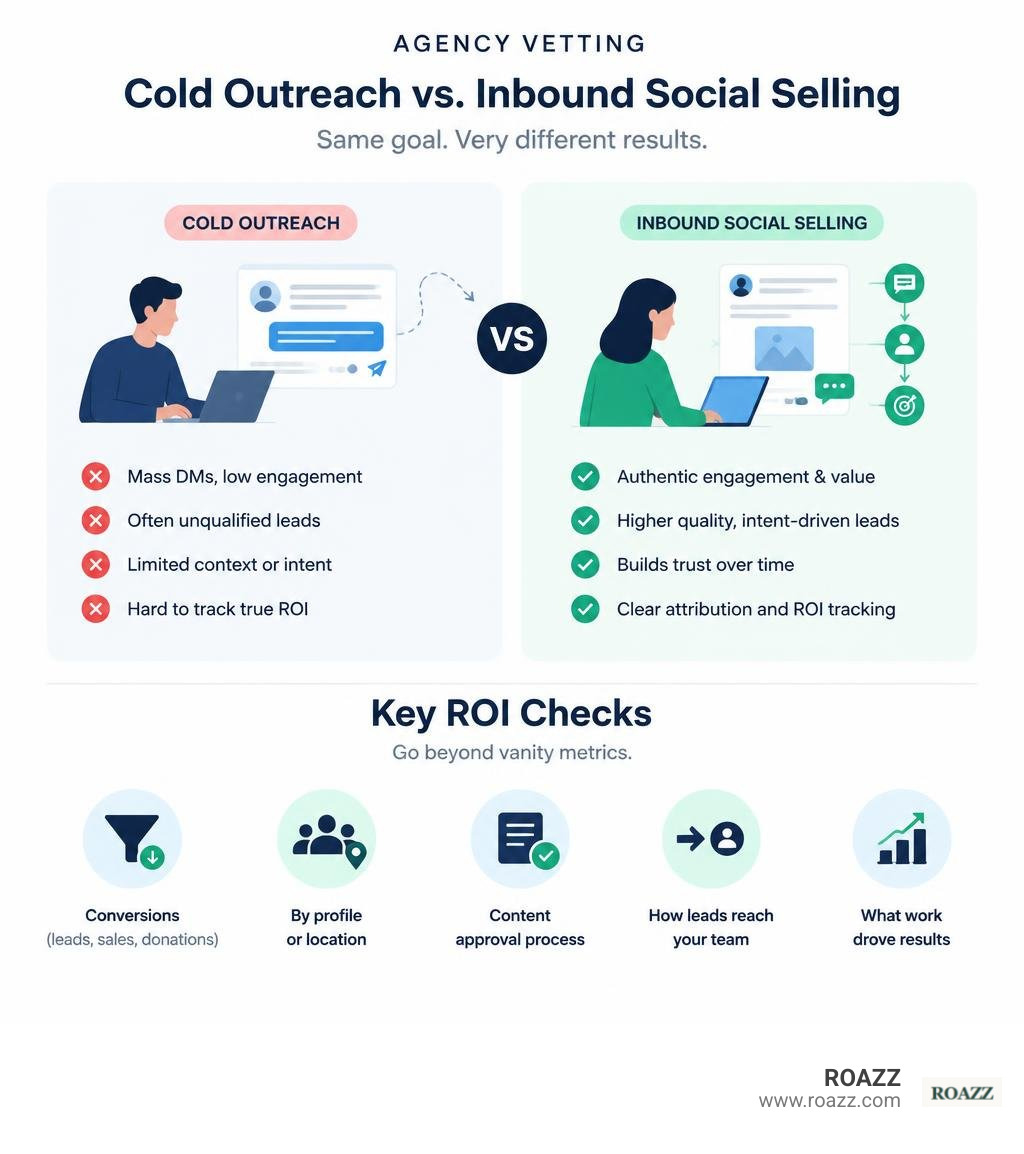
7 Red Flags to Watch Out For When Hiring an Agency
Selecting the right partner is often the difference between predictable pipeline growth and burning your marketing budget on empty metrics. When vetting prospective partners, it helps to understand what separates outdated lead generation tactics from modern performance workflows.

| Evaluation Area | Traditional Agency Pitfall | Modern Social Selling Standard |
|---|---|---|
| Outreach Strategy | Cold spam DMs, scraper tools, automated generic pitches | Inbound capture via organic authority, tailored profile publishing, and prompt conversational touchpoints |
| Reporting Focus | Top-of-funnel reach, impressions, views, raw click counts | Post-click outcomes: qualified appointments, demos, pipeline value, closed revenue |
| Sales Scope | Isolated single-checkout storefront links | Omnichannel social selling across the full buyer journey |
| Attribution | Blended top-level metrics hiding individual channel performance | Granular tracking by profile, physical location, and region |
| AI Governance | Ungoverned automated posting risking brand safety | AI-assisted workflows with mandatory mobile human review and approval |
| Funnel Integration | Social kept separate from paid search, programmatic, and email | Full alignment across programmatic media, search ads, and lead nurturing |
| Network Scale | Restricted to a single brand account | Scaled across distributed employee, creator, or branch profiles |
Red Flag 1: Relying on Cold DMs and Outbound Spam Instead of Inbound Attraction
The easiest way to spot an outdated agency is their reliance on high-volume outbound messaging. If an agency promises thousands of automated direct messages sent to scraped lists every week, you are looking at cold outreach disguised as social selling.
Buyers in 2026 suffer from severe inbox fatigue. Generic cold messages damage your brand authority, lower response rates, and frequently trigger spam filters on LinkedIn, Instagram, and X.
A modern social media lead generation agency builds inbound capture mechanisms instead. Rather than chasing strangers with unsolicited pitches, high-performing agencies publish high-intent content under your brand or executive profiles. By sharing domain expertise, addressing buyer objections, and encouraging authentic dialogue in the comments, potential clients naturally raise their hands. Consistent, value-driven content published under authentic names lets interested buyers initiate contact on their own terms.
Red Flag 2: Reporting Impressions and Vanity Clicks Instead of Post-Click Outcomes
If an agency report is filled with impressions, follower growth, and video views without connecting those figures to downstream revenue, treat it as an immediate warning sign.
Impressions only indicate how many times an asset flashed across a screen. They do not show whether the audience had genuine buying intent. In fact, post-click conversion rates are typically 2 to 5 times higher when campaigns focus on intent-driven actions rather than broad visibility.
We evaluate marketing performance by looking directly at post-click outcomes. You should demand transparency on downstream metrics:
- Booked sales appointments and completed product demos
- Submitted quote requests and inbound contact applications
- New paid memberships and recurring subscriptions
- Actual pipeline revenue and cost per customer acquisition
When agencies prioritize actual business outcomes over vanity metrics, every dollar spent connects directly to commercial growth.
Red Flag 3: Confusing Single-Checkout Social Commerce with Multichannel Social Selling
A common mistake among inexperienced media buyers is treating social selling as synonymous with social commerce.
Social commerce is transactional: it focuses on a single direct checkout inside an app, such as purchasing a low-ticket impulse item on TikTok Shop or Instagram Storefronts.
Social selling, by contrast, is relationship-driven and spans every touchpoint in a complex conversion path:
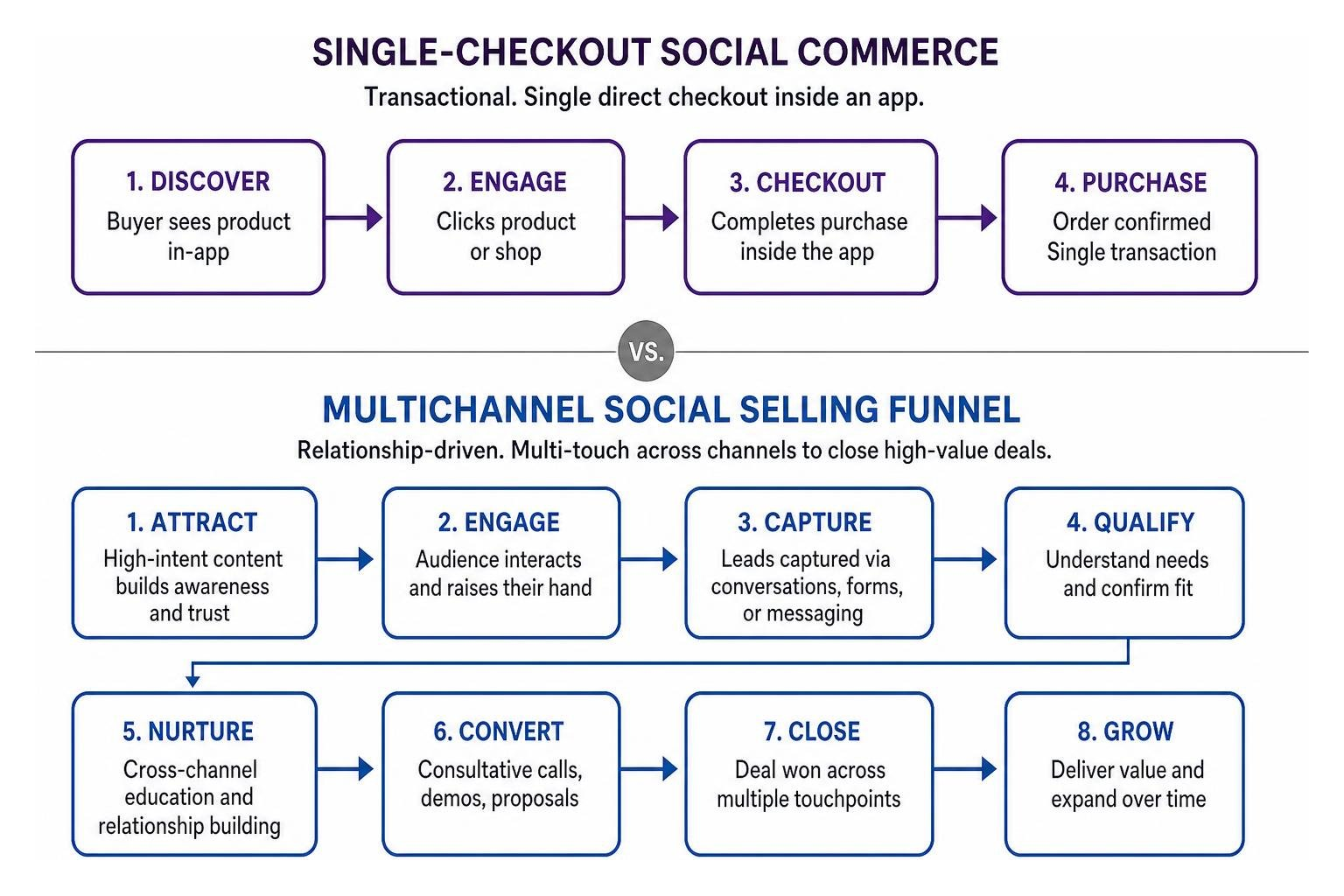
High-value purchases—whether in B2B software, commercial real estate, corporate insurance, or franchise memberships—rarely close in a single spontaneous click. They require multi-touch attribution, consultative conversations, and cross-channel nurturing. If an agency's only framework is driving traffic to an e-commerce checkout page, they will struggle to manage the longer consideration cycles required for high-value services.
Red Flag 4: Zero Attribution by Profile, Location, or Regional Network
Many growing businesses operate across multiple locations, regional branches, or individual representatives. Real estate brokerages manage distinct agents, gym franchises operate local facilities, and travel tour networks rely on regional operators.
If an agency provides only a consolidated, high-level analytics report, you lose critical operational visibility. You cannot see which specific representative, local venue, or geographic territory is generating returns.
A qualified partner implements tracking that attributes lead generation per profile, location, and region. For instance, in distributed networks:
- Real estate brokerages track listing visits and offers generated per licensed agent.
- Gym networks monitor membership sign-ups generated by specific personal trainers.
- Travel operators attribute catalog booking requests directly to individual local tour guides.
Without regional attribution, you cannot reward top-performing teams or fix underperforming locations.
Red Flag 5: Complete AI Autopilot Without Human Review or Strategic Approval
Artificial intelligence has made content creation, audience research, and conversational handling faster and more scalable. However, handing your social accounts over to an unmonitored AI system is a dangerous shortcut.
Fully automated tools often generate generic phrasing, hallucinate factual details, and miss subtle brand nuances. Without human governance, automated comment responders can easily reply inappropriately to sensitive customer complaints.
Sustainable AI adoption pairs automated efficiency with strict human approval. The AI handles operational heavy lifting—such as drafting copy, organizing post schedules, and organizing audience data—while human managers review, refine, and approve every post before publication. You keep strategic control over your brand voice while benefiting from consistent publishing speed.
Red Flag 6: Isolating Social Media from Paid Media and Downstream Funnels
Social media should not exist on an isolated island. If an agency manages your social profiles without coordinating with your broader paid acquisition and retention funnels, prospective leads will slip through the cracks.
A visitor who interacts with an educational social post might search for your brand on Google the next morning, or need direct follow-up after downloading an industry report. When you connect social lead generation with programmatic digital advertising, you can retarget high-intent social visitors with relevant cross-web display placements.
Pairing your social content strategy with a vetted PPC lead generation agency ensures you capture high-intent search volume when buyers evaluate solutions. Similarly, integrating social touchpoints with targeted email marketing automation ensures inbound inquiries are nurtured through structured onboarding workflows until they become paying clients.
Red Flag 7: Inability to Scale Across Decentralized Creator and Employee Profiles
Your brand's central company page is only one part of your overall social footprint. Prospects frequently place higher trust in individual professionals, founders, branch managers, and team members than in faceless corporate logos.
Agencies that rely exclusively on one corporate feed miss out on the compounding reach of employee advocacy. Across distributed networks, modern agencies use dedicated brand voice playbooks to produce tailored posts under individual creators, local coaches, or field agents.
Scaling across dozens of creator profiles requires structured content governance. When managed properly, distributed publishing maintains a consistent tone and compliance standards while driving personal engagement across multiple networks simultaneously.
Core Criteria for Evaluating a Social Media Lead Generation Agency
Finding the right growth partner requires looking beyond slide decks and reviewing how an agency manages day-to-day operations.
How a Top Social Media Lead Generation Agency Executes the Show Up, Talk, Close, Learn Cycle
A high-performing agency structures its social acquisition strategy around a disciplined, four-part execution framework:
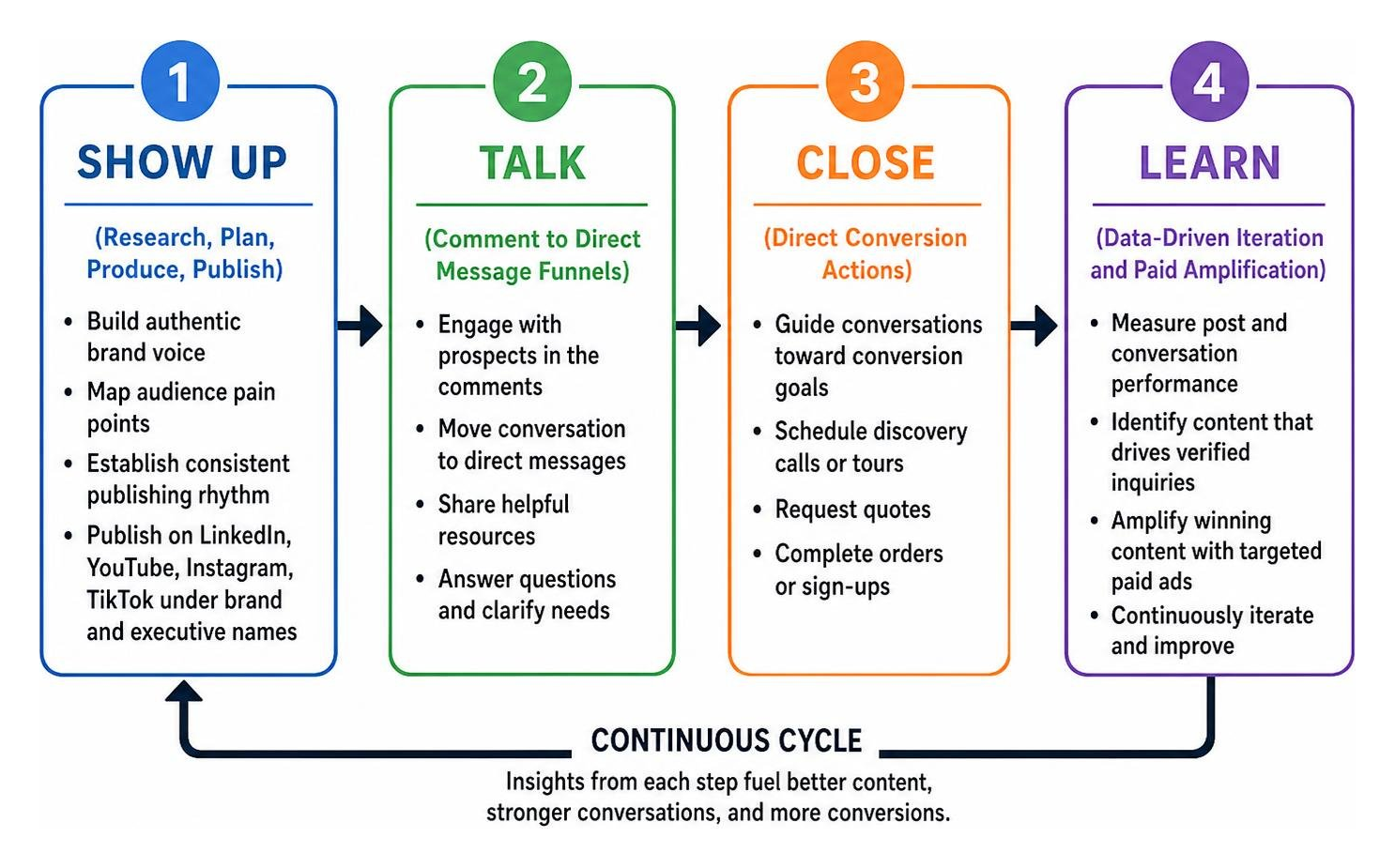
- Show Up (Research, Plan, Produce, Publish): The agency develops an authentic brand voice profile, maps out key audience pain points, and establishes a consistent publishing rhythm. Whether posting across LinkedIn, YouTube, Instagram, or TikTok, content is published directly under brand and executive names to attract qualified inbound traffic.
- Talk (Comment to Direct Message Funnels): When prospective clients comment on posts, the agency transitions the public interaction into a personalized direct-message conversation. Instead of aggressive pitching, these conversations share helpful resources, clarify requirements, and answer questions.
- Close (Direct Conversion Actions): Conversations are directed toward specific conversion goals—such as scheduling an executive discovery call, booking a tour, requesting an insurance quote, or completing an order.
- Learn (Data-Driven Iteration and Paid Amplification): Every post returns measurable performance data. Winning organic posts that generate verified inquiries are amplified using targeted paid ad spend, functioning smoothly alongside your search campaigns and PPC management agency initiatives.
Essential Vetting Checklist Before Signing a Social Media Lead Generation Agency
Before entering into a long-term agreement, run through this practical vetting checklist during candidate interviews:
- Conversion Attribution: How do you track a social interaction through to a closed sale, demo, or appointment?
- Content Governance: Do we have final editorial approval via mobile or dashboard before any asset goes live?
- Multi-Profile Scalability: Can your team scale content production across multiple regional or employee profiles without losing brand voice?
- Channel Integration: How will social lead generation data feed into our existing CRM, email sequences, and paid search funnels?
- Reporting Cadence: Do weekly reports detail bottom-line post-click outcomes, or do they only show vanity metrics like impressions and likes?
- Data Ownership: Do we retain full ownership of all custom audience lists, ad accounts, creative assets, and lead databases?
Frequently Asked Questions About Social Lead Generation
What is the difference between social commerce and social selling for lead gen?
Social commerce centers on an immediate, single-point transactional checkout directly within a social app (like buying retail apparel in a feed). Social selling is a multi-step, relationship-driven methodology where brands publish insightful content, converse with engaged prospects, and guide them through longer sales cycles for high-ticket services, contracts, or subscriptions.
What industries benefit most from profile-driven social lead generation?
Profile-driven social lead generation works especially well for businesses built on trust, consultative expertise, and local presence. Key industries include:
- Real Estate: Real estate brokerages where licensed agents publish listings and host virtual walk-throughs to book on-site viewings.
- Gym and Fitness Networks: Fitness facilities where coaches publish short training videos to drive gym memberships.
- Insurance and Financial Services: Advisory practices where planners establish trust by explaining complex policy terms.
- Travel and Tour Operators: Travel companies sharing itineraries to prompt direct booking requests.
- Franchise and Retail Networks: Multi-location franchises where individual store operators run location-specific promotions.
What key metrics prove ROI for social lead generation campaigns?
To verify true return on investment, focus on concrete conversion metrics:
- Lead Conversion Rate: The percentage of social profile visitors or message conversations that turn into qualified opportunities.
- Sales and Bookings per Profile: The specific revenue generated by each active team member or regional account.
- Cost Per Acquisition (CPA): The total blended spend (agency fees, ad amplification, and software) divided by acquired paying customers.
- Pipeline Value Added: The total dollar value of active opportunities generated through social channels.
Conclusion
Choosing the right agency partner comes down to finding a team that prioritizes business outcomes over surface-level metrics. Agencies relying on cold DM spam, reporting only top-of-funnel reach, or deploying uncontrolled AI without human review will drain your marketing resources without adding to your bottom line.
A modern lead generation strategy relies on authentic content publishing, structured conversational funnels, and clear attribution across all active profiles and locations. By focusing on intent-driven actions and tying marketing spend to verified post-click outcomes, you build an acquisition channel that supports predictable, long-term business growth.
Explore our performance-driven marketing services to see how intent-focused strategies turn your social channels into sustainable revenue engines.