Build a Lead Nurturing Strategy That Moves Buyers Toward Revenue

A lead nurturing strategy is a plan for helping interested buyers take the next step, whether that is learning about a problem, comparing options, or talking to sales. To build one, group leads by buying stage and intent, send content that answers their next question, and use their actions to decide when to follow up or hand them to sales. Measure progress toward qualified opportunities, not just email opens.
That matters across a long B2B sales cycle. Buyers may research on their own, pause, or bring others into the decision. A useful nurture program keeps pace without treating every lead like they are ready for a pitch.
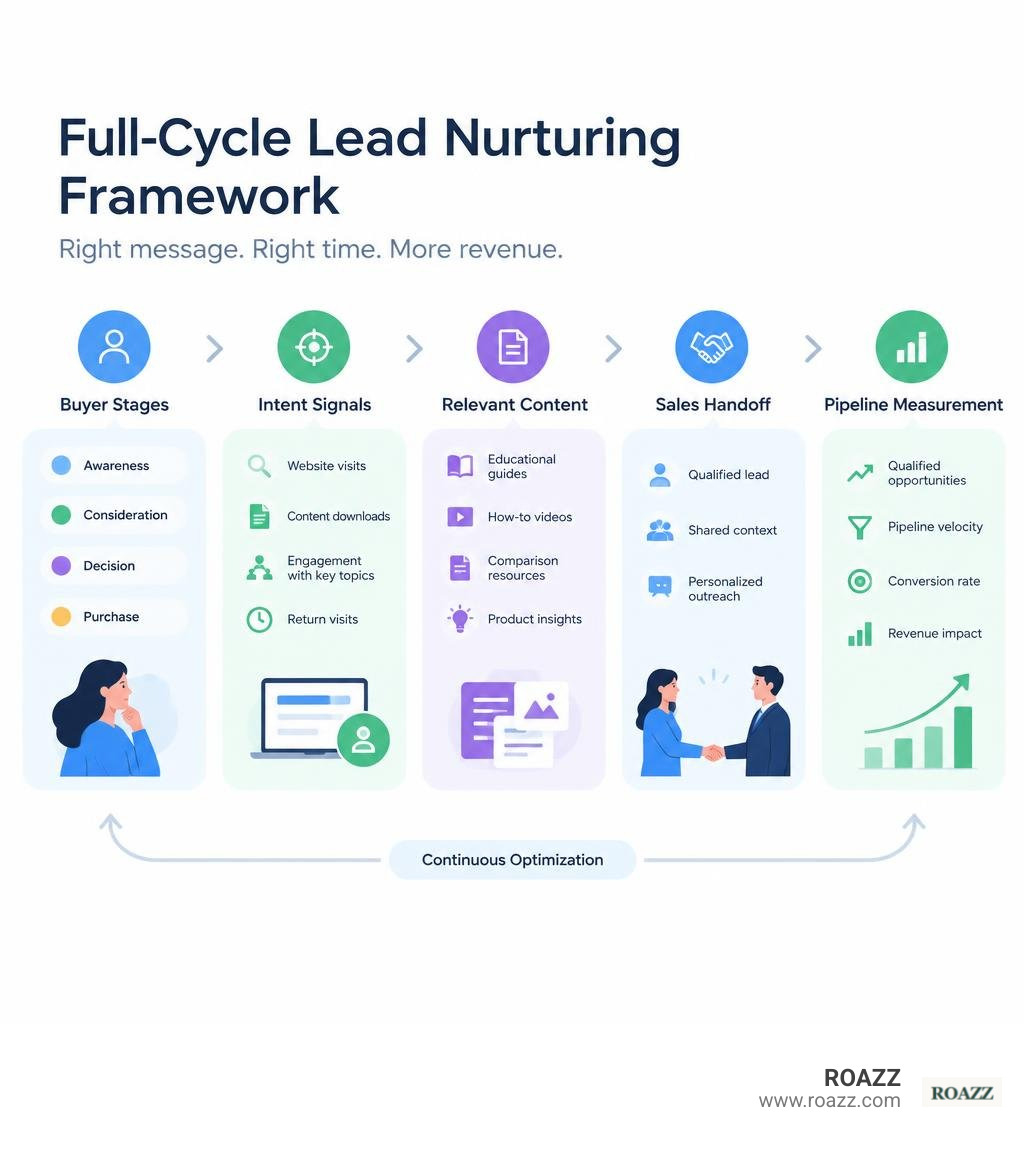
Foundations of a Modern Lead Nurturing Strategy vs. Workflows
Many revenue teams confuse an overarching strategy with the automated workflows that execute it. A lead nurturing strategy defines your overarching commercial roadmap: who you engage, what business outcomes you target, how you position value across distinct journey milestones, and how marketing and sales collaborate to capture pipeline.
In contrast, a lead nurturing workflow represents the tactical wiring inside your marketing automation engine—the specific logic trees, timers, and enrollment conditions that trigger an asset delivery.
| Strategic Dimension | Lead Nurturing Strategy | Lead Nurturing Workflow |
|---|---|---|
| Primary Scope | Holistic revenue architecture and pipeline acceleration | Operational execution logic inside automation systems |
| Core Objective | Moving multi-stakeholder buying groups toward commercial decisions | Delivering the right single message at the right moment |
| Key Inputs | Go-to-market goals, buyer personas, value propositions, handoff SLAs | Behavioral triggers, segmentation tags, time delays, exit rules |
| Governance | Cross-functional alignment between Marketing, Sales, and RevOps | Demand generation and marketing automation managers |
| Success Metric | Pipeline influence, sales cycle velocity, revenue contribution | Delivery rates, message clicks, single-action completion |
Without a coherent strategy, even the most sophisticated workflows merely accelerate bad communications. Setting up a high-converting system requires establishing an end-to-end framework for modern lead nurturing workflows that aligns data triggers directly with overarching commercial goals.
Why Traditional Follow-Up Fails in B2B Demand Generation
Most B2B organizations do not suffer from an acquisition problem; they suffer from a follow-up problem. Businesses fail to convert roughly 79% of the leads that enter their funnel. The root cause is straightforward: only about 5% of leads are sales-ready the moment they convert on a form, while 50% to 70% of inbound prospects are interested but nowhere near ready for a direct sales conversation.
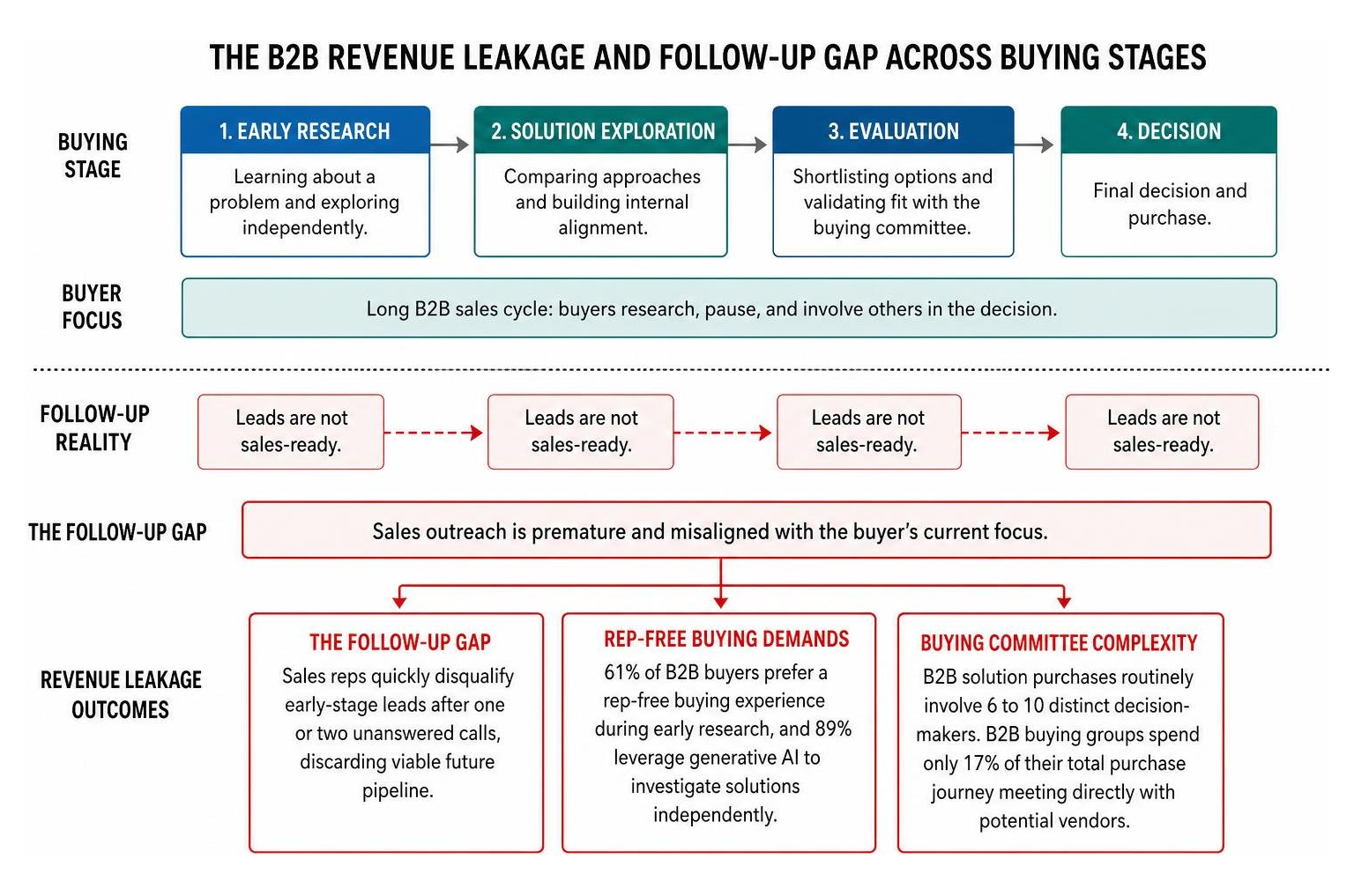
When teams force non-sales-ready leads into standard sales outreach, several breakdowns occur:
- The Follow-Up Gap: Sales reps quickly disqualify early-stage leads after one or two unanswered calls, discarding viable future pipeline.
- Rep-Free Buying Demands: Today, 61% of B2B buyers prefer a rep-free buying experience during early research, and 89% leverage generative AI to investigate solutions independently. Blasting them with sales pitches disrupts their self-guided exploration.
- Buying Committee Complexity: B2B solution purchases routinely involve 6 to 10 distinct decision-makers. B2B buying groups spend only 17% of their total purchase journey meeting directly with potential vendors. Standard single-contact follow-up ignores the rest of the committee.
- The "Blast and Pray" Trap: Generic calendar drips send identical content to engineers, finance leads, and executives alike. Blasting the same email to a CTO and a growth marketer guarantees disengagement.
Core Architecture of an Automated Lead Nurturing Strategy
To systematically progress accounts without annoying buyers, an automated nurture architecture relies on five structural pillars:
- Enrollment Triggers: Real-time behavioral signals (such as accessing a technical calculation sheet, viewing pricing parameters, or searching high-intent topics) that enroll prospects into tailored tracks immediately.
- Dynamic Segmentation: Real-time grouping based on observed intent, buying role, company size, and product interest rather than static job titles alone.
- Responsive Cadence: Message spacing dictated by prospect engagement velocity rather than rigid calendar rules.
- Multichannel Routing: Extending the conversation across inbox touchpoints, social feeds, and web experiences. Coordinating these channels through targeted email marketing automation ensures that touchpoints reinforce each other rather than overwhelming the prospect.
- Exit Rules: Explicit conditions that instantly remove prospects from nurture tracks once they book a meeting, request a demo, become unresponsive, or change accounts.
Mapping Nurture Tracks Across the Entire Buyer Journey
A robust nurturing architecture matches message formats and value propositions to the distinct stages of the purchasing journey.

Top-of-Funnel Welcome and Education Tracks
Top-of-funnel (TOFU) nurturing focuses on establishing trust, diagnosing underlying business friction, and validating the prospect's operational challenges. When high-intent prospects enter your database via targeted campaigns executed by a seasoned PPC lead generation agency, initial outreach should focus purely on education rather than pitching.
- Initial Focus: Deliver the requested resource immediately without friction, providing instant utility.
- Single-Concept CTAs: Every message must feature exactly one focused call to action (e.g., reading a short tear-sheet or reviewing an objective industry benchmark).
- The 3:1 Value Ratio: Deliver three genuine educational assets for every single soft commercial ask you make.
- Educational Formats: Practical frameworks, industry diagnostic tools, and objective trend data.
Mid-Funnel Acceleration and Buying Committee Engagement
Middle-of-funnel (MOFU) nurturing addresses the evaluation stage, where internal teams explore architectural requirements and compare strategic approaches.
- Stakeholder Alignment: Because purchase decisions require internal consensus, equip your champion with internal business case decks, security summaries, and ROI models tailored for their leadership.
- Evidence-Based Content: Deliver detailed customer transformation case studies that outline the baseline problem, technical execution, and verifiable quantitative return.
- Direct Objection Handling: Proactively address common switching costs, migration challenges, and resource requirements before the prospect even brings them up.
Bottom-of-Funnel Conversion and Closed-Lost Reactivation
Bottom-of-funnel (BOFU) sequences focus on reducing decision friction for evaluation-stage prospects and reviving previously stalled opportunities.
- Sales Acceleration: Provide technical implementation blueprints, pricing calculators, and security compliance frameworks to prepare teams for final contract reviews.
- Closed-Lost Deal Recycling: Opportunities marked "closed-lost" due to budget or timing constraints should automatically enroll into low-frequency reactivation sequences. Touching these contacts 6 to 9 months later around contract renewal dates or product enhancements frequently recovers viable deals at near-zero incremental acquisition cost.
Advanced Segmentation, AI Personalization, and Multichannel Execution
Relying solely on basic firmographic demographic data results in disconnected outreach. Modern demand generation teams utilize first-party intent signals and machine intelligence to adapt nurture tracks in real time.

Deploying First-Party Intent Signals and AI Segmentation
With third-party tracking diminishing, high-performing revenue engines leverage first-party behavioral intent to guide their automated messaging:
- Declared Preferences: Collect self-identified primary use cases and immediate project timelines via micro-surveys or onboarding prompts.
- On-Site Activity Tracking: Monitor repeat visits to pricing tables, documentation hubs, and integration directories.
- Dynamic Segment Refreshes: Use AI scoring models to shift prospects into more relevant nurture tracks when their content consumption patterns change.
- Human-in-the-Loop Quality Control: While AI agents can draft highly customized messaging points based on prospect activity, demand generation teams should review high-stakes sales communications to maintain brand integrity.
Optimizing Multichannel Cadence Across Email, Paid Media, and Social
Email serves as an essential channel, but treating lead nurturing as an inbox-only discipline leaves massive pipeline on the table. A true "surround sound" nurture strategy orchestrates touchpoints across multiple channels:
- Email Delivery: Minimalist, text-forward emails sent from individual team members generate higher reply rates than heavily stylized marketing newsletters.
- Paid Social and Search Aircover: Orchestrate matched-audience ad sequences that present relevant client proof points while the prospect is reading nurture emails. Synchronizing these audiences through programmatic digital advertising keeps your core value propositions visible without cluttering the inbox.
- Conversational Touchpoints: Engage active website visitors through contextual chat experiences when they return to review pricing or feature specifications.
- Cadence Calibration: Space top-of-funnel educational messages 4 to 7 days apart. When behavioral intent spikes (such as three high-value page views in 24 hours), tighten the cadence to deliver next-step materials within hours.
Designing Seamless Marketing-to-Sales Handoffs and Lead Scoring
The handoff between marketing automation and sales represents the most common point of pipeline leakage. A disciplined scoring model establishes objective rules for when a contact moves from automated nurturing to direct sales outreach.
| Dimension | Attribute / Behavioral Factor | Point Allocation / Impact | Operational Action Triggered |
|---|---|---|---|
| Explicit Fit | C-Suite / VP in Target ICP Enterprise | +25 Points | Prioritizes account within CRM view |
| Explicit Fit | Non-Target Industry / Student / Personal Email | -50 Points | Disqualifies or routes to self-service flow |
| Implicit Intent | Multiple Pricing Page Visits within 48 Hours | +20 Points | Triggers immediate SDR review |
| Implicit Intent | Downloaded Technical ROI Calculator | +15 Points | Enrolls into Mid-Funnel Acceleration Track |
| Implicit Intent | Unopened Emails for 45+ Consecutive Days | -10 Points / Month | Applies score decay; down-shifts cadence |
To ensure that internal definitions align with revenue operations standards, teams can review the comprehensive B2B lead nurturing playbook to operationalize custom scoring mechanics.
Two-Axis Lead Scoring Models and Intent Thresholds
An effective scoring framework tracks fit and engagement independently across two distinct axes:
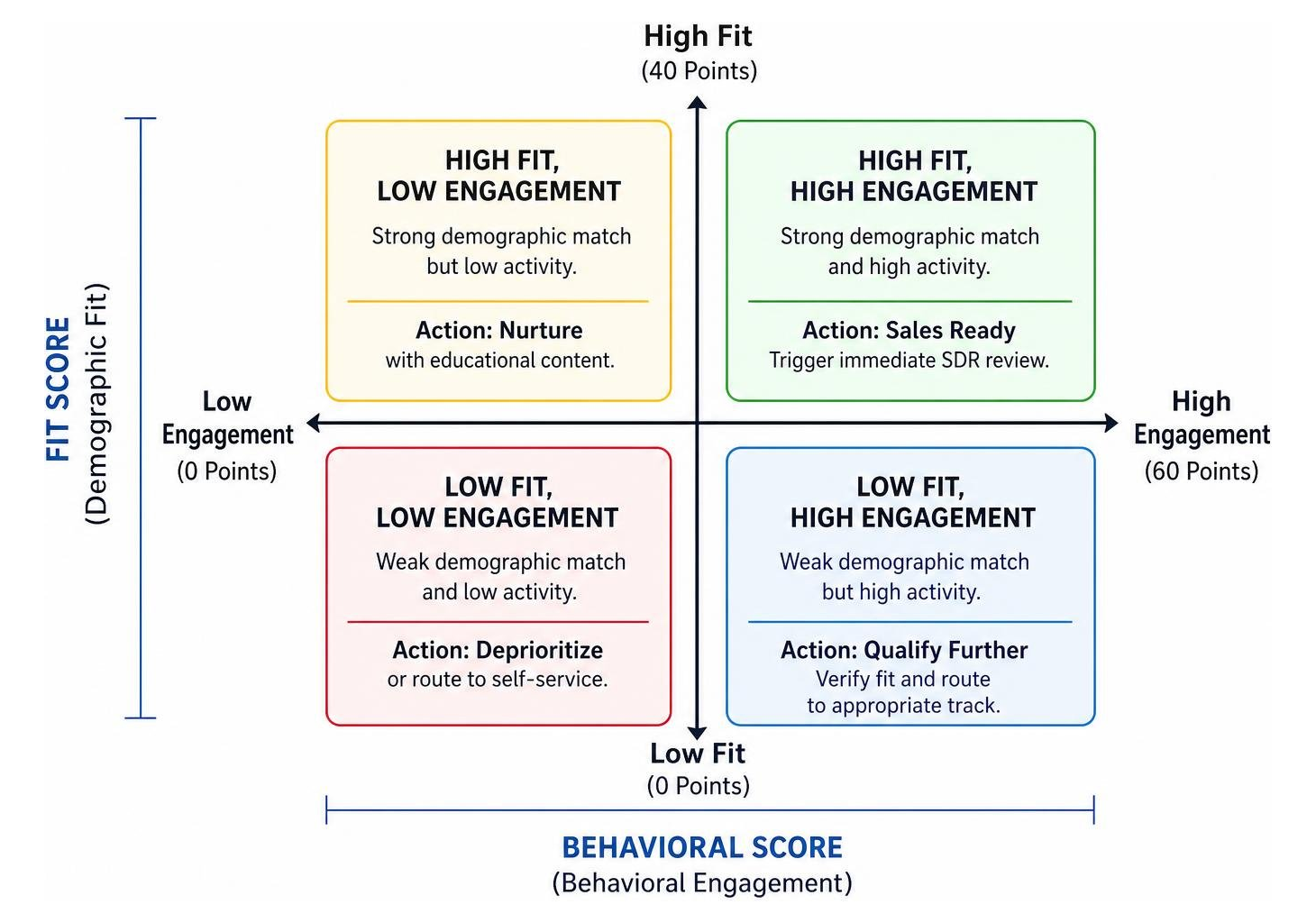
- Fit Score (Maximum 40 Points): Evaluates firmographic data including industry, company headcount, annual revenue, and role seniority.
- Behavioral Score (Maximum 60 Points): Evaluates digital engagement, tracking event attendance, key page visits, content downloads, and interaction frequency.
- Score Decay Rules: Inactive contacts should systematically lose points over time. Deducting points for each 30-day window of inactivity ensures sales reps focus their time on accounts with active commercial intent.
Perfecting the Sales Handoff SLA and Context Transfer
A handoff should never consist of an unadorned email address dropped into a sales queue. Protecting pipeline velocity requires a formalized context transfer:
- The Prospect Context Packet: When a lead reaches Marketing Qualified Lead (MQL) status, the CRM must automatically generate an activity summary detailing the primary pain point selected, specific case studies reviewed, and key web pages visited.
- Service Level Agreements (SLAs): Establish a mandatory follow-up window (e.g., initial sales outreach within 2 to 4 hours of a high-intent threshold trigger).
- Closed-Loop Feedback Loops: If sales disqualifies a lead, require reps to select an explicit reason code (e.g., "timing stalled," "no budget," "evaluating competitors"). This automated status update immediately re-enrolls the contact into the appropriate nurture sequence rather than letting them go cold.
Measuring Pipeline Impact and Refining Your Lead Nurturing Strategy
Evaluating nurture performance solely through email opens provides little insight into actual pipeline health. Open metrics often misrepresent engagement due to automated security filtering, while overall business value depends on qualified pipeline generation.
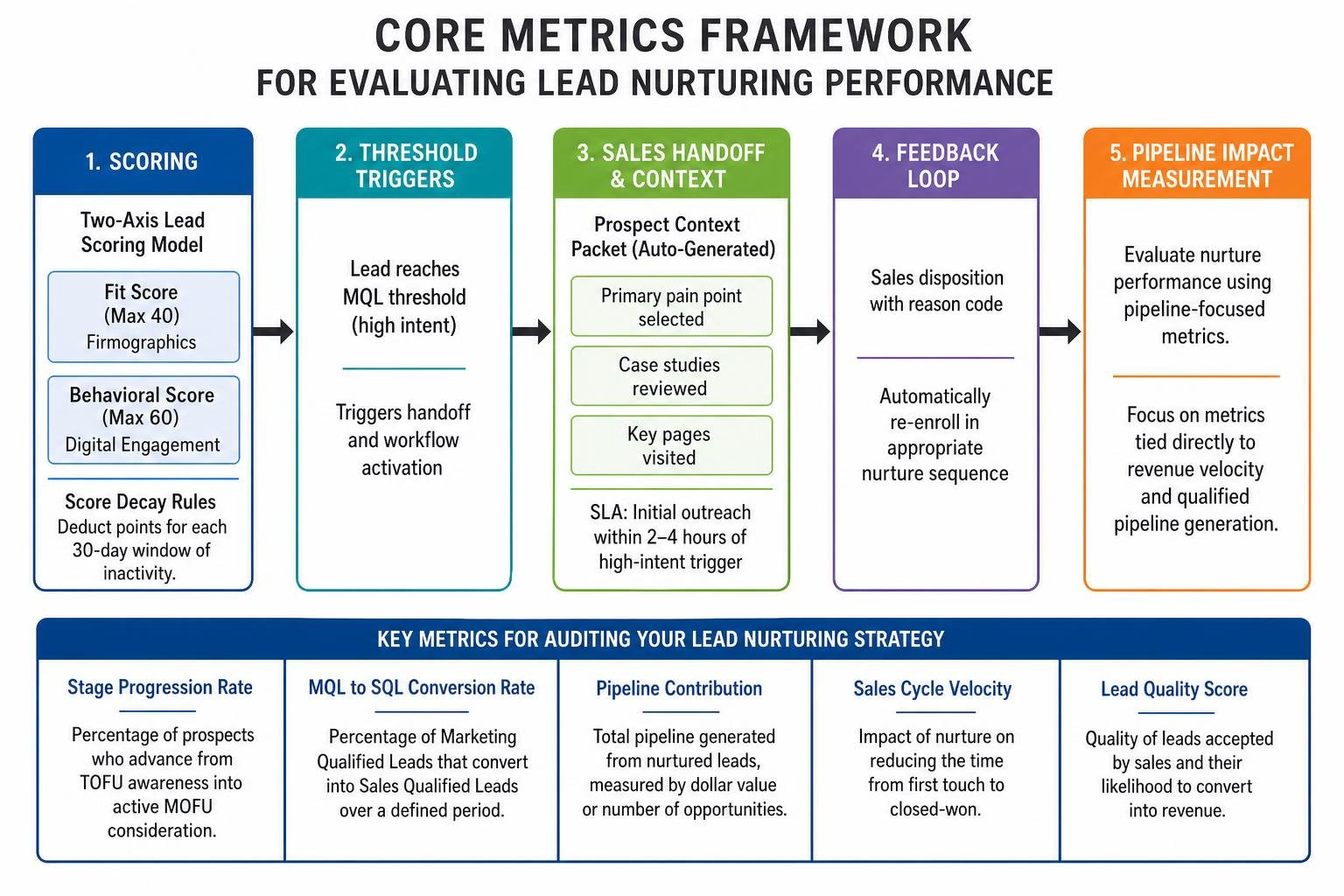
Key Metrics for Auditing Your Lead Nurturing Strategy
Focus your measurement framework on metrics tied directly to revenue velocity:
- Stage Progression Rate: The percentage of prospects who successfully advance from TOFU awareness into active MOFU consideration.
- Nurture Velocity: The average time required for a cold inbound lead to accumulate enough behavioral intent to achieve Sales Qualified Lead (SQL) status. Teams running advanced automation workflows reduce their average sales cycles by 32% compared to organizations relying on manual follow-up.
- Pipeline Influence Rate: The percentage of total closed-won revenue that engaged with at least two nurture touchpoints along their buying path.
- Re-Conversion Rate: The volume of stalled or closed-lost contacts re-engaged and converted back into active pipeline opportunities via long-term sequences.
Common Nurture Pitfalls and How to Correct Them
Even well-designed nurture programs encounter operational snags. Watch for these common issues:
- Missing Exit Rules: Failing to pull leads out of general nurture sequences once they enter active sales negotiations results in conflicting messaging that undermines sales reps.
- Uncapped Send Frequencies: Enrolling a single prospect into multiple workflows simultaneously floods their inbox and drives up unsubscribe rates. Establish global communication limits across your marketing automation platform.
- Static Content Decay: Review and refresh nurture tracks quarterly to remove broken links, update obsolete industry data, and incorporate new product capabilities.
- Siloed Sales and Marketing Systems: When nurture activity data remains trapped in marketing automation platforms without syncing to CRM records, sales reps lose the behavioral context needed for relevant outreach.
Frequently Asked Questions about Lead Nurturing Strategy
How long does an effective lead nurturing campaign take to generate pipeline?
The timeline reflects your natural sales cycle length and deal complexity. Fast-moving transaction cycles may show measurable pipeline lift within 3 to 6 weeks, whereas complex enterprise solutions with 9 to 12-month buying journeys typically require a full financial quarter to demonstrate significant MQL-to-opportunity acceleration.
How often should nurture messages be sent without causing list fatigue?
Touchpoint cadence should mirror real-time buyer signals rather than a rigid calendar. A baseline of one valuable educational message every 7 to 10 days works well for early-stage leads. When prospects show spikes in high-intent behavior, shorten that window to 2 to 3 days to deliver relevant decision-support assets while the problem is top-of-mind.
When should a lead be permanently exited from active nurture tracks?
Prospects should immediately exit active workflows when they:
- Book an initial discovery call or schedule a product demonstration.
- Formally request to opt out or adjust communication preferences.
- Fail to engage with any touchpoint over a designated 90 to 120-day window (at which point they should move to a low-frequency, quarterly re-engagement track).
- Transition to active customer status, shifting into customer onboarding and retention flows.
Conclusion
Building a high-performing lead nurturing engine requires shifting from disjointed email blasts to a responsive, multi-touchpoint communication architecture. When you align your messaging with actual buyer intent, account for multi-stakeholder decision committees, and enforce clear sales handoff standards, you turn early curiosity into reliable, scalable revenue.
At ROAZZ, we engineer full-funnel performance marketing solutions that track and optimize for meaningful post-click business outcomes—driving real demos, qualified appointments, and closed revenue rather than superficial vanity metrics. If you are ready to turn your inbound demand into measurable pipeline, explore our full suite of performance-driven marketing services to build an engine that accelerates your entire sales cycle.