
Core Services Delivered by a Facebook Ads Management Agency
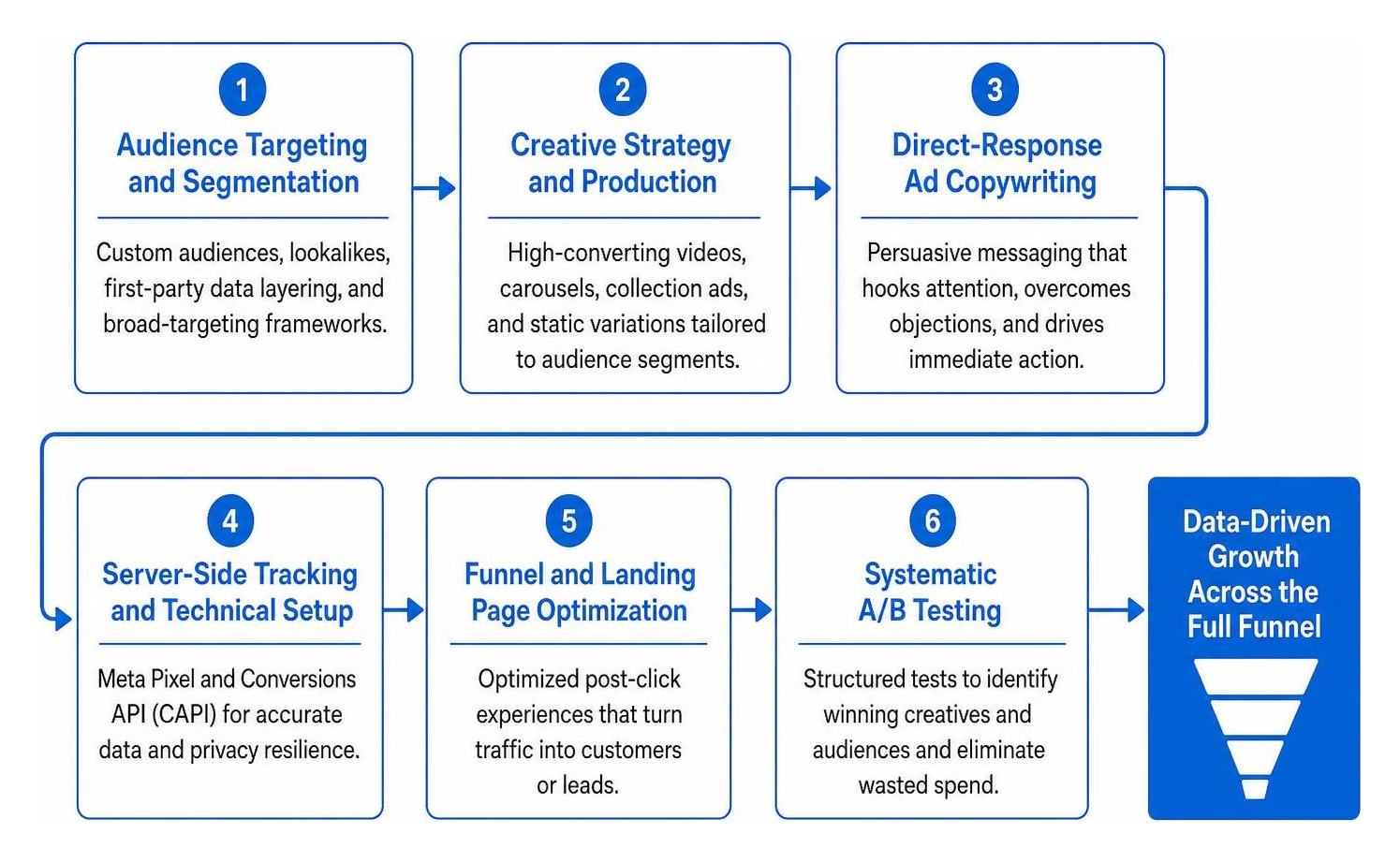
Partnering with a Facebook ads management agency means gaining a full-funnel team that handles audience targeting and segmentation, creative strategy and production, direct-response ad copywriting, server-side tracking and technical setup, funnel and landing page optimization, and systematic A/B testing. The agency manages your Meta advertising ecosystem so daily campaign management stays aligned with revenue, lead quality, and post-click outcomes rather than surface-level engagement. Hiring a specialized partner means moving beyond simply boosting posts and hoping for the best. A professional partner handles every layer of your Meta advertising ecosystem, aligning daily campaign management with your broader commercial goals.
When you explore our comprehensive services, you will find that top-tier ad management encompasses a multifaceted operational structure:
- Audience Targeting and Segmentation: Gone are the days when basic demographic targeting yielded high profits. Today’s landscape requires custom audience architectures, sophisticated lookalikes, first-party data layering, and broad-targeting frameworks that let Meta’s machine-learning algorithms identify high-intent buyers.
- Creative Strategy and Production: High-converting creative is the single most powerful lever for driving performance. Agencies conceptualize, design, and script thumb-stopping video ads, dynamic carousels, collection ads, and static image variations tailored to your specific audience segments.
- Direct-Response Ad Copywriting: Great visuals need persuasive messaging. Expert copywriters draft varied text variations designed to hook attention, overcome consumer objections, and drive immediate action.
- Server-Side Tracking and Technical Setup: Modern paid social demands robust technical plumbing. An agency handles the deployment of the Meta Pixel alongside the Conversions API (CAPI) to preserve data integrity amid evolving privacy regulations and browser limitations.
- Funnel and Landing Page Optimization: Driving qualified traffic is only half the battle. Leading agencies audit post-click experiences, implementing proven e-commerce conversion optimization techniques to ensure the maximum number of clicks convert into paying customers or registered leads.
- Systematic A/B Testing: Rather than relying on guesswork, management teams run structured creative and audience split tests to isolate winning variables and eliminate unprofitable ad spend.
Agency vs. In-House: Cost, Performance, and Scaling
Deciding whether to build an in-house advertising team or partner with an agency is a pivotal strategic decision. While an internal employee provides dedicated brand focus, an agency brings cross-industry perspective, dedicated specialists, and immediate scalability without the overhead of salaries, benefits, and paid social software subscriptions.
| Factor | In-House Team | Specialized Agency |
|---|---|---|
| Talent & Expertise | Often limited to a generalist marketer or small team. | Multi-disciplinary team of copywriters, media buyers, data analysts, and designers. |
| Cost Structure | Fixed annual salaries, benefits, recruiting fees, and software costs. | Flexible monthly retainer or performance-aligned tier tied directly to spend/results. |
| Scalability | Scaling rapidly requires hiring additional staff and extensive training. | Instantly scales ad spend and output using existing infrastructure and resources. |
| Industry Benchmarking | Isolated performance data limited strictly to your own brand. | Broad cross-industry data and early access to emerging platform trends and beta features. |
| Technology & Tools | Brand must purchase dedicated tracking, reporting, and creative tools. | Agency brings proprietary toolkits, enterprise reporting dashboards, and CAPI setups. |
Many growing brands discover that utilizing dedicated PPC management agency partners provides a higher return on investment by eliminating the learning curves and overhead associated with internal hiring.
The Onboarding and Campaign Optimization Process
When you initiate a partnership, a structured agency does not simply launch ads on day one. A rigorous onboarding and testing framework ensures your ad dollars are deployed effectively from the start.
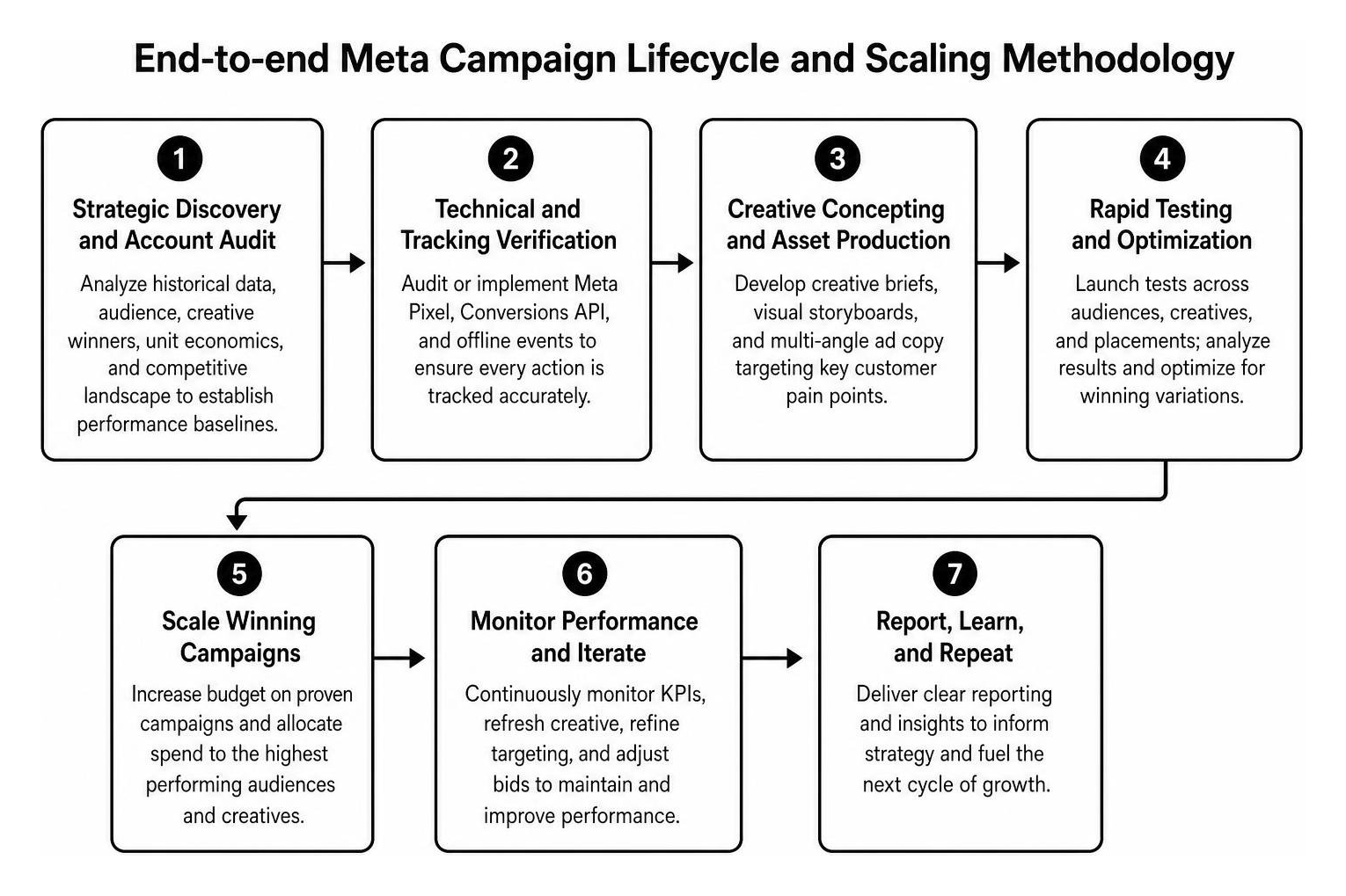
Our team follows a transparent roadmap designed to produce sustainable growth. You can see how this works in practice through our structured onboarding process:
- Strategic Discovery and Account Audit: We examine your historical ad data, target demographics, past creative winners, unit economics, and competitive landscape to establish performance baselines.
- Technical and Tracking Verification: We audit or implement the Meta Pixel, Conversions API, and custom offline event sets to verify that every post-click action—such as sales, booked calls, or subscriptions—is recorded accurately.
- Creative Concepting and Asset Production: We develop creative briefs, visual storyboards, and multi-angle ad copy targeting your key customer pain points.
- Algorithmic Campaign Architecture: We structure your ad account into organized testing and scaling campaigns, taking full advantage of Meta's Advantage+ toolsets and manual segmentation where appropriate.
- Continuous Optimization and Iterative Scaling: We monitor key engagement and post-click indicators daily, reallocating budget toward top-performing creatives and refining bid strategies to scale revenue efficiently.
Key Metrics and Realistic ROI Expectations
Transparent reporting centers on business revenue and post-click outcomes, not vanity metrics like impressions, post likes, or surface-level click-through rates.
When partnering with an agency, your performance reviews should focus on these critical benchmarks:
- Return on Ad Spend (ROAS): Direct revenue generated per dollar spent on advertising.
- Customer Acquisition Cost (CAC) & Cost Per Lead (CPL): The exact cost required to acquire a purchasing customer or qualified prospect.
- Marketing Efficiency Ratio (MER): Total top-line revenue divided by total marketing spend across all channels, giving you a true snapshot of macro profitability.
- Post-Click Conversion Rate: The percentage of ad clickers who complete your intended high-value action.
- Average Order Value (AOV) & Lifetime Value (LTV): Understanding these metrics allows your media buyers to set aggressive, realistic acquisition targets that maintain profitability over time.
Realistic Timelines for ROI
Meta's machine learning requires an initial learning phase (typically 50 conversions per ad set within a 7-day window) to optimize delivery. During the first 30 to 60 days, focus is centered on gathering performance data, testing diverse creative concepts, and calibrating bids. Predictable, sustainable scaling typically accelerates in months two through four once the algorithm identifies winning creative angles and core demographic clusters. For broader context on how paid social fits into a complete acquisition strategy, see Meta's overview of online advertising.
How to Select the Ideal Partner for Your Business
Finding the right Meta advertising partner requires looking past flashy pitch decks and evaluating operational substance.
Criteria for Choosing the Best Facebook Ads Management Agency
- Focus on Business Outcomes: Choose an agency that asks about your margins, lead quality, and fulfillment capacity rather than just how many impressions you want to buy.
- Direct Account Access and Data Ownership: You should always own your ad account, historical pixel data, and creative assets. Never work with an agency that holds your Meta Business Manager hostage.
- Communication Cadence: Look for defined communication channels, regular strategic check-ins, and actionable visual reporting that makes it easy to understand where your money is going.
- Creative Capabilities: Because creative represents the majority of ad performance, ensure the agency has dedicated designers and video editors capable of high-velocity testing.
Common DIY Pitfalls an Agency Helps You Avoid
Many internal teams struggle with costly technical and strategic mistakes:
- Audience Fragmentation and Overlap: Running overlapping ad sets that compete against each other in the Meta ad auction, driving up your own CPMs.
- Creative Exhaustion: Failing to introduce fresh visual concepts weekly, resulting in ad fatigue, declining click-through rates, and higher conversion costs.
- Inaccurate Attribution: Relying solely on default in-platform reporting without accounting for multi-touch attribution or post-iOS data gaps.
- Account Compliance Issues: Inadvertently violating Meta’s advertising standards, leading to rejected ads, restricted assets, or disabled Business Managers.
Frequently Asked Questions About Meta Ad Management
What Is the Typical Cost of a Facebook Ads Management Agency?
Agency pricing models vary based on the scope of work, technical complexity, and total monthly ad spend. Most reputable agencies operate on one of three structures:
- Flat Monthly Retainer: A fixed management fee (typically ranging from $2,500 to $7,500+ per month) covering full strategy, creative, and optimization.
- Base Retainer Plus Percentage of Ad Spend: A baseline monthly fee combined with a sliding percentage (usually 10%–20%) of total ad spend once budgets scale past agreed thresholds.
- Performance-Based Pricing: Compensation tied directly to agreed business milestones or qualified lead volume.
For more details on operational scopes, you can browse through our comprehensive FAQ guide.
How Quickly Can You See Measurable Campaign Results?
Initial engagement and traffic data register within hours of campaign approval. However, achieving stabilized acquisition costs and reliable ROAS metrics generally requires 2 to 4 weeks of continuous machine-learning optimization and creative testing.
How Do Agencies Adapt to Meta Algorithm and Policy Changes?
Agencies maintain performance stability by constantly testing new native formats (such as Advantage+ shopping campaigns and dynamic creative optimization), strictly adhering to Meta’s advertising policies, and deploying diversified creative assets designed to withstand algorithmic shifts.
Conclusion
A modern paid social strategy requires technical precision, compelling direct-response creative, and relentless focus on actual business metrics. Rather than chasing clicks, successful brands prioritize campaigns engineered to capture qualified leads, drive high-margin sales, and sustain long-term growth.
Ready to unlock predictable performance from your paid social campaigns? Partner with ROAZZ to build high-converting Meta advertising strategies tailored to your specific commercial goals.