How lead nurturing email campaigns turn interest into action

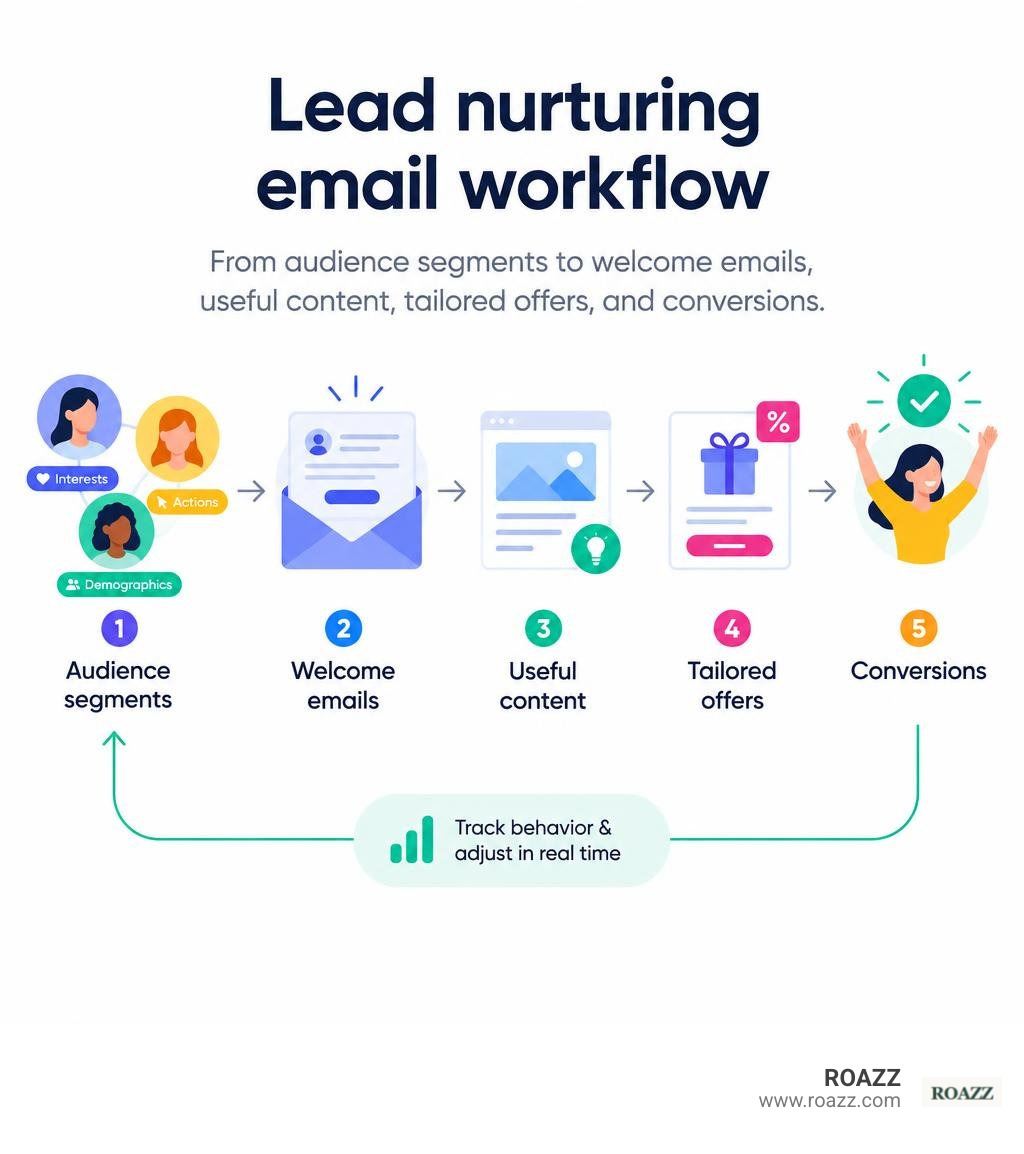
To build a lead nurturing email campaign, start with what each lead needs next. Group contacts by their interests and actions. Send a welcome email, follow with useful advice and proof that your approach works, then offer a clear next step. Use clicks, purchases, or inactivity to change what they receive. Stop sales emails when someone converts.
That structure helps you focus on more than opens. You can see which emails move people toward a qualified lead, a sale, or a donation.
The Strategic Foundation of Lead Nurturing Email Campaigns
Generating traffic is only the first step in digital advertising. Industry data shows that 69% of marketers consider generating leads their primary marketing goal, yet only a tiny fraction of inbound prospects are ready to make a purchase immediately. When potential customers download a resource, submit a form, or subscribe to an update, they enter an evaluation phase.
At ROAZZ, we focus on post-click outcomes rather than vanity metrics like clicks and impressions. When evaluating marketing channels, 55% of marketers report that email initiatives drive their highest overall return on investment. Lead nurturing establishes an automated, data-driven bridge between that initial click and a concrete business action, such as a scheduled consultation, a software trial, or a completed checkout.
Lead nurturing builds measurable trust over time. While direct sales pushes often push early-stage prospects away, 70% of marketers recognize that driving brand awareness and affinity is more critical in the initial stages than an aggressive pitch. Modern email marketing automation platforms allow us to deliver targeted messaging that matches buyer intent, ensuring prospects receive the right context at the exact moment they need it.
B2B vs. B2C Lead Nurturing Email Campaigns: Adapting to Buyer Cycles
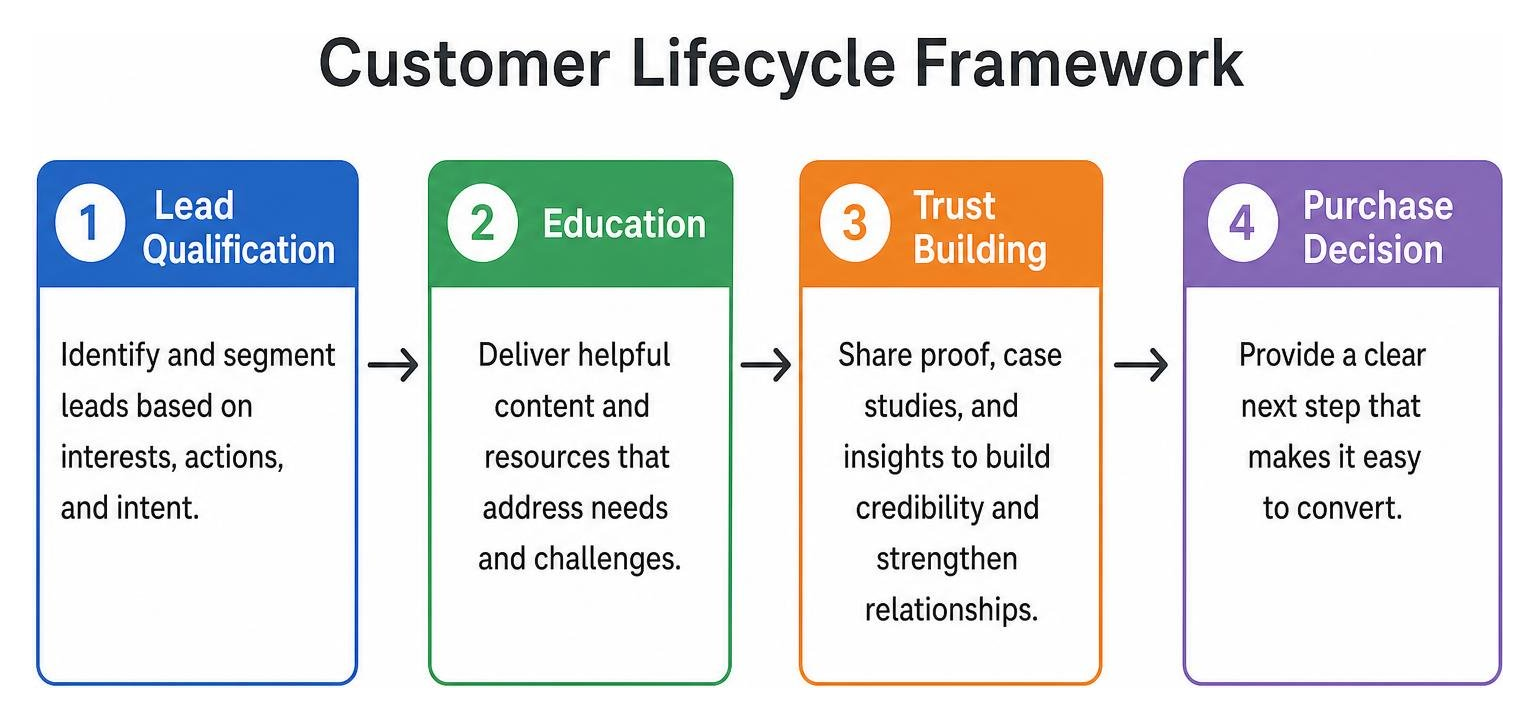
The framework for nurturing leads depends on your business model and target audience. A consumer buying running shoes follows a very different mental journey than an enterprise buying data infrastructure.
- B2B Lead Nurturing: B2B purchases feature extended sales cycles, multiple decision-makers, and high contract values. Email workflows must provide educational content, detailed case studies, technical documentation, and objection-handling resources. The core goal is establishing credibility across an entire buying committee.
- B2C Lead Nurturing: B2C campaigns focus on individual consumers with shorter consideration windows. Emotional engagement, lifestyle alignment, social proof, and limited-time incentives drive these workflows.
| Strategy Attribute | B2B Lead Nurturing | B2C Lead Nurturing |
|---|---|---|
| Sales Cycle Duration | Weeks to several months | Hours to a few weeks |
| Decision Makers | Buying committees and executives | Individual consumers |
| Primary Value Driver | ROI, operational efficiency, risk reduction | Immediate utility, lifestyle, emotional appeal |
| Email Volume & Pace | Steady cadence (e.g., every 5 to 10 days) | Frequent touchpoints (e.g., every 1 to 3 days) |
| Primary Call to Action | Book a demo, download report, speak with sales | Buy now, claim discount, start free trial |
Core Email Types: From Welcome Series to Retention
A robust nurturing strategy relies on distinct email formats designed for specific customer milestones. Implementing these programs ensures you guide prospects seamlessly from discovery to brand advocacy. Marketers often reference foundational frameworks like the 7 essential lifecycle programs for email marketers to plan these touchpoints:
- The Welcome Series: The first impression sets the tone for your subscriber relationship. A strong welcome sequence confirms the subscription, sets clear expectations, delivers promised assets, and introduces brand values.
- Educational & Problem-Solving Emails: These emails break down common industry challenges, bust prevalent myths, and provide actionable tips without pitching a product directly.
- Social Proof and Case Studies: These messages highlight real customer transformations, reviews, and community milestones to eliminate buyer hesitation.
- Cart and Browse Abandonment Messages: As many as 80% of online shoppers abandon their carts during checkout. Automated recovery emails remind users of items left behind, address security or shipping concerns, and recapture lost revenue.
- Post-Purchase and Cross-Sell Sequences: Retaining customers is just as vital as acquiring them. Nurturing buyers with product tutorials, review requests, and personalized recommendations drives ongoing customer lifetime value.

Designing High-Performing Nurture Sequences and Drip Workflows
An email nurture sequence should never function as a rigid batch-and-blast broadcast. High-converting campaigns run on intelligent workflows where each recipient's engagement history dictates their next message.
When building workflows with customer journey email automation, we define clear entry criteria, logical branching rules, and strict stop conditions. If a contact books a product demonstration during step two of an email sequence, the system must immediately pull them out of early-stage awareness drips and move them into a pre-meeting briefing track. Over-emailing an active sales lead with generic introductory material disrupts the sales conversation and harms your credibility. Detailed implementation strategies are outlined in The Complete Guide to Lead Nurturing.
Structuring 5-Stage Lead Nurturing Email Campaigns for Maximum Conversion
For most marketing programs, a 5-stage sequential framework moves prospects from basic awareness to closed-won revenue smoothly:
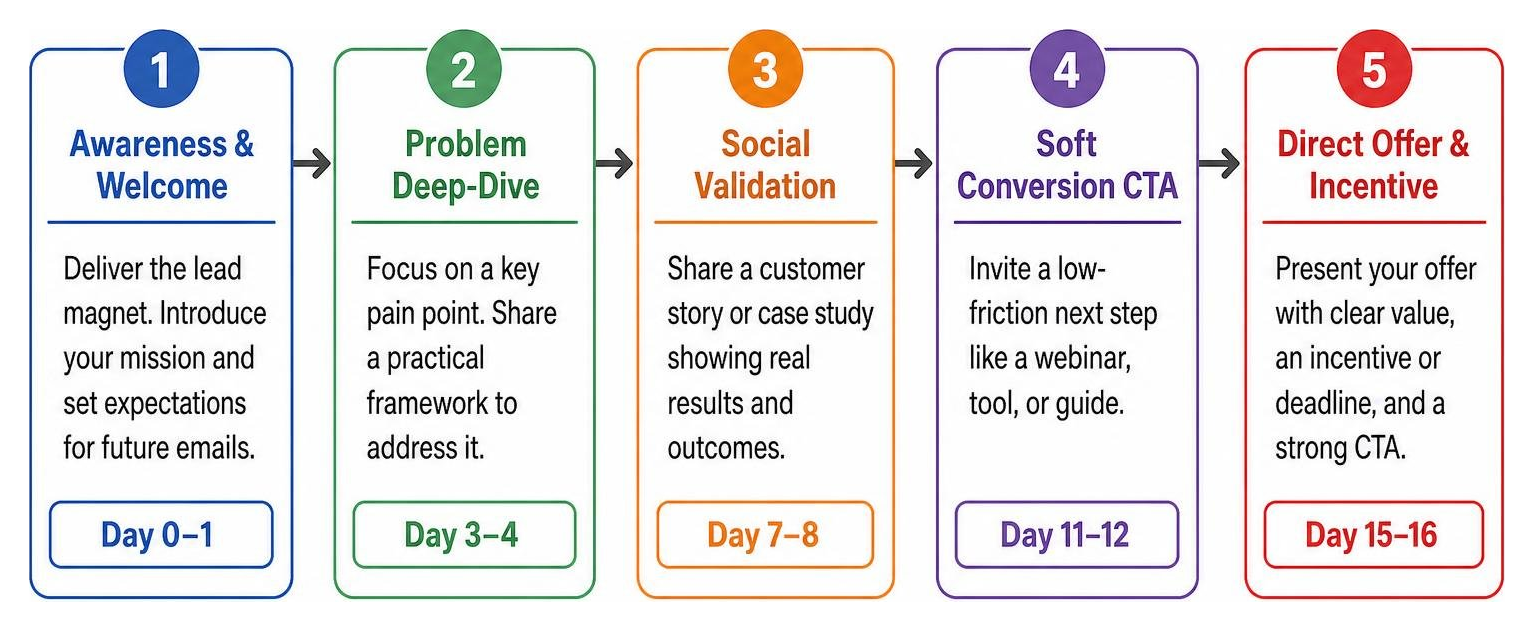
- Stage 1: Awareness and Welcome (Day 0–1): Deliver the lead magnet immediately. Introduce your core mission and set clear expectations for future emails.
- Stage 2: The Problem/Solution Spotlight (Day 3–4): Isolate a primary pain point your audience struggles with daily. Provide a practical framework to address that friction without demanding a purchase.
- Stage 3: Social Validation (Day 7–8): Share a detailed customer story or data-backed case study demonstrating how a peer solved that exact problem using your approach.
- Stage 4: The Soft Call to Action (Day 11–12): Invite the reader to take an incremental, low-friction step, such as joining a live webinar, checking out an interactive tool, or exploring a product comparison guide.
- Stage 5: The Direct Offer (Day 15–16): Present your primary commercial proposal. Include a clear value proposition, an incentive or deadline where appropriate, and a prominent call to action.
Marketers looking to sustain engagement across multi-month sales windows can adopt extended drip sequences outlined in SmartMails: Long Term Lead Nurturing Drip Campaign Ideas.
Audience Segmentation and Behavioral Triggers
Sending relevant emails requires thorough audience segmentation. About 90% of marketers view personalization as critical to their business strategy, and 80% of buyers are more likely to purchase from brands that deliver tailored experiences.
You can segment incoming contacts using several data layers:
- Acquisition Source & Campaign: Leads acquired through targeted Facebook lead generation strategies often respond best to bite-sized, visual email content that mirrors their initial ad creative.
- Expressed Intent & Role: Segment contacts by job title, department size, or stated goals collected via initial form fields and interactive surveys.
- Behavioral Tracking: Track which links subscribers click, which site pages they visit, and which webinars they attend. If a contact repeatedly visits your pricing page, your automation platform should instantly increase their lead score and trigger high-intent messaging.

Personalization, Copywriting, and Optimization Best Practices
Writing high-converting nurture emails requires balancing concise copy, visual clarity, and conversational language.
- Write Compelling, Authentic Subject Lines: Avoid misleading clickbait that damages long-term trust. Focus on clear value propositions or direct, curious questions.
- Maintain One Primary Call to Action: Every email should guide the reader toward one distinct action. Giving a reader four competing links leads to decision fatigue and lowers click-through rates.
- Prioritize Clean, Mobile-First Visual Hierarchy: Use plenty of white space, readable typography, and bold headers so readers can easily scan your message on mobile devices.
- Balance Plain-Text and Rich HTML: Overly designed emails often resemble promotional flyers that get sorted into secondary inbox tabs. A personal, clean, text-forward format feels like a 1-to-1 conversation and frequently earns higher reply rates.
Re-Engaging Dormant Contacts and List Hygiene
Over time, an email database naturally experiences subscriber decay. When contacts stop opening messages, sending them regular promotions damages your sender domain reputation and hurts overall inbox deliverability.
Before scrubbing disengaged leads, run an automated win-back campaign. Deliver high-value assets with zero sales pressure, such as an updated industry report, an exclusive tool, or a quick preference check-in. If leads generated from your paid media or PPC lead generation campaigns remain inactive after a dedicated re-engagement series, remove them from your active sending lists to protect your delivery rates.
Common Template Pitfalls to Avoid
When building email campaigns from standard templates, avoid these common mistakes:
- Pushing for the Sale Too Soon: Pitching a high-ticket contract or demo in your first email alienates prospects who are still defining their core problem.
- Ignoring Engagement Signals: Continuing to send basic introductory emails to a prospect who is actively downloading advanced pricing calculators shows a lack of personalization.
- Inconsistent Cadence: Sending five emails in four days and then vanishing for two months breaks familiarity and triggers spam complaints.
- Neglecting Preference Centers: Failing to offer clear unsubscribe and frequency options frustrates users and leads to domain blacklisting.
Tracking Performance: Essential Metrics and Conversion Attribution
Tracking email marketing success means looking beyond basic open rates. Because automated privacy protections and image pre-fetching can inflate open metrics, marketing teams need deeper signals of prospect engagement and business impact.
- Click-to-Open Rate (CTOR): Measures how compelling and relevant your email copy is to the subscribers who actually view it.
- Lead Velocity & Score Progression: Tracks how quickly an inbound lead moves from low-intent subscriber to sales-qualified prospect inside your CRM.
- Conversion Rate on Target Actions: Measures the percentage of recipients who complete primary business goals, such as scheduling a demo, starting a trial, or completing a purchase.
- Revenue Attribution: Connects closed-won sales back to specific email touchpoints across the customer lifecycle.
Frequently Asked Questions About Lead Nurturing
How often should you send lead nurturing emails?
Send emails every 3 to 6 days for standard consideration cycles. For fast-moving B2C products, follow-ups within 24 to 48 hours work well, while complex B2B sales cycles benefit from touches spaced 7 to 10 days apart to prevent audience fatigue.
What is the difference between a drip campaign and a lead nurturing campaign?
A drip campaign sends a pre-written, linear series of emails at set time intervals regardless of user behavior. A lead nurturing campaign uses dynamic branching, lead scoring, and behavioral triggers to tailor each message to the recipient's real-time actions.
How do you measure the ROI of email lead nurturing?
Calculate ROI by tracking pipeline revenue generated from nurtured contacts against your total software and creation costs. Reviewing documented case studies helps set baseline conversion targets across your specific industry.
Conclusion: Building Scalable Lead Nurture Engines
High-performing email nurture programs do not rely on aggressive sales pitches. They succeed by delivering consistent value, understanding buyer intent, and guiding prospects smoothly toward their next business milestone.
By setting up behavioral triggers, maintaining clean lists, and tracking real business outcomes, your team can turn passive subscribers into loyal, high-value customers. Learn how our performance marketing services can help you build intent-driven campaigns that drive measurable revenue.