Build an Email Drip Campaign That Drives Results

To build an email drip campaign, pick one goal, such as a purchase, demo booking, or donation. Group contacts by what they have done, then write a short series that helps them take the next step. Set the first email to send after a clear trigger, such as a signup or abandoned cart. Add delays, and stop the series when someone converts or opts out.
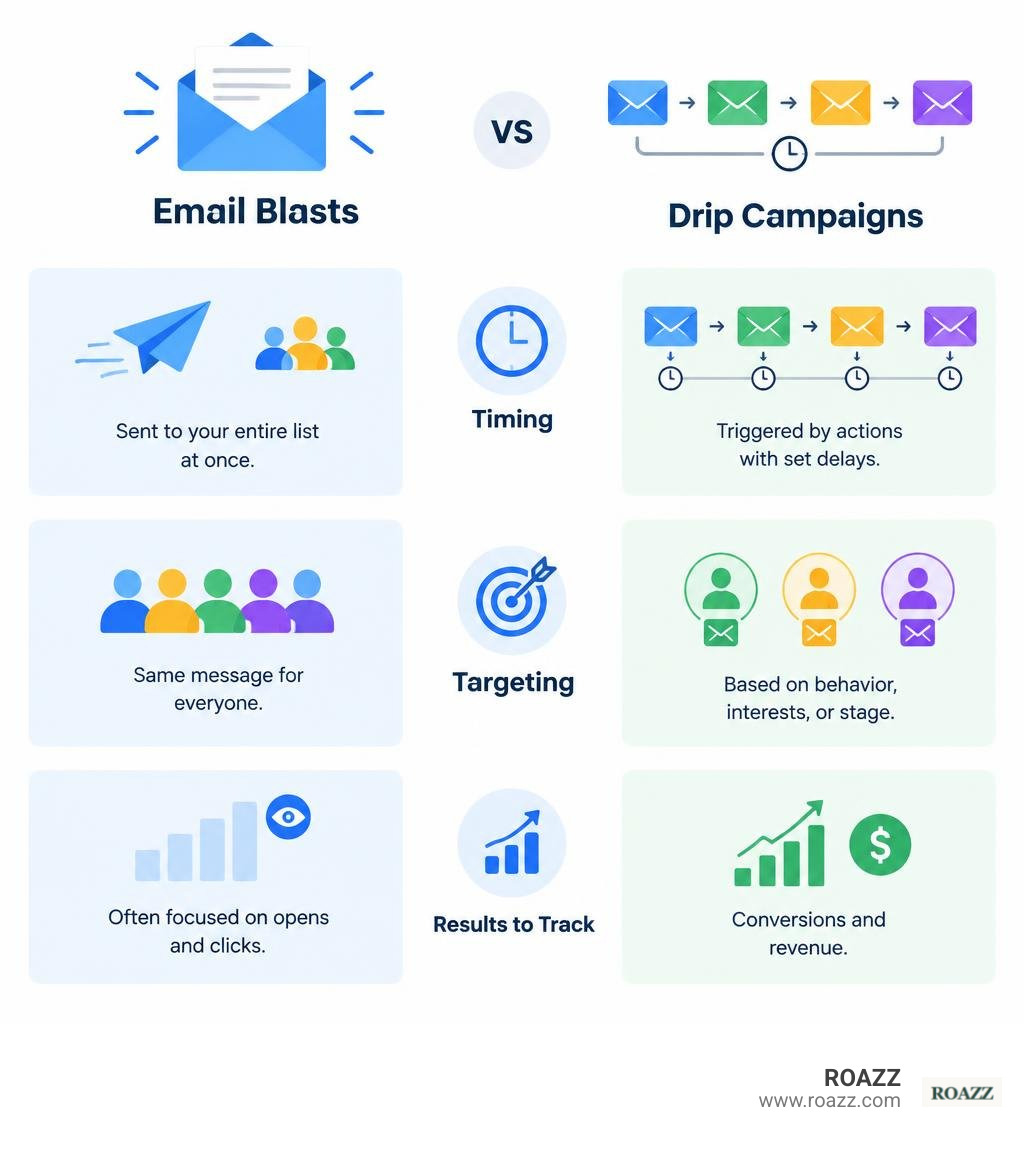
Unlike a blast sent to your whole list at once, a drip responds to each person’s timing and actions. That makes it easier to send useful emails without wearing out your list. Track conversions and revenue, not just opens, to see whether the campaign is working.
What Is an Email Drip Campaign and Why Does It Outperform Blasts?
An email drip campaign is an automated sequence of pre-written messages sent on a strategic schedule or triggered by specific user actions. Rather than sending a single broadcast to everyone at the same time, drip marketing meets prospects where they are in their unique customer journey.
Traditional email blasts treat your database as a monolith. When you blast your entire list, subscribers who signed up five minutes ago receive the exact same message as loyal clients who have bought from you for five years. This lack of context creates list fatigue, drives up unsubscribes, and tanks deliverability.
Modern lifecycle marketing requires precision. Automated drips align directly with subscriber intent. Implementing structured email marketing automation ensures that each subscriber receives relevant, timely communications that guide them toward concrete actions.
| Campaign Type | Send Trigger | Audience Targeting | Primary Objective |
|---|---|---|---|
| Email Blast | Manual, one-time broadcast | Entire subscriber list | Broad announcements, company news |
| Drip Sequence | User action or preset timeline | Segmented groups by intent/behavior | Conversions, onboarding, pipeline advancement |
| Broadcast Newsletter | Fixed recurring schedule | Broad or loosely segmented list | Ongoing brand awareness, content distribution |
Drip Campaigns vs. Newsletters and Nurture Flows
Marketers often confuse drip campaigns, newsletters, and nurture flows. Understanding how they differ helps us structure better automations:
- Broadcast Newsletters: Recurring messages sent on set dates (e.g., every Tuesday morning). They provide educational content or company updates to a broad audience, regardless of where individual subscribers are in the sales cycle.
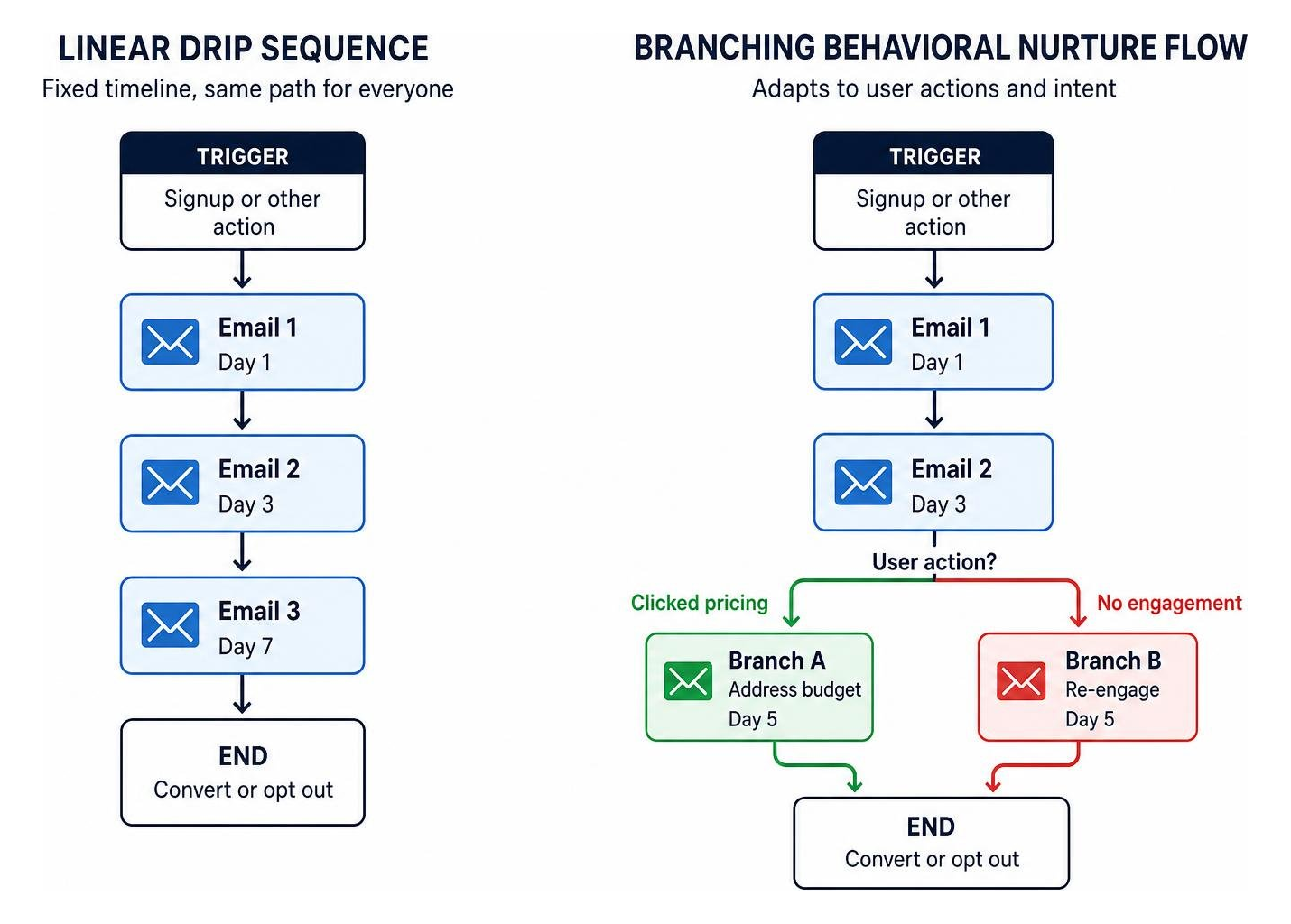
- Linear Drip Sequences: Automated chains of messages sent at fixed intervals (e.g., Day 1, Day 3, Day 7). These follow a predetermined timeline designed to walk a user through a specific set of steps.
- Behavioral Nurture Flows: Dynamic sequences that utilize branching logic and lead scoring. If a user clicks a pricing link in Email 2, the flow branches to address budget objections instead of sending generic product tips.
The Revenue Impact of Behavioral Triggers
Sending messages aligned with user intent generates superior returns. Automated messages represented just 2% of total email sends, yet they drove 30% of all email revenue. Even more striking, automated emails earned $2.87 per send compared to just $0.18 per send for standard promotional blasts—a 16-fold revenue advantage.
When you segment drip communications based on user data, the impact compounds:
- Segmented drip campaigns generate up to 80% more sales at a third of the acquisition cost of traditional mailings.
- Segmented messages achieve 50% more click-throughs and 30% higher open rates than unsegmented broadcasts.
- Welcome emails consistently achieve open rates topping 83%.
- With over 70% of digital shopping carts abandoned before checkout, automated recovery flows capture substantial revenue that would otherwise be permanently lost.
High-Converting Sequences Across the Customer Lifecycle
To build high-performing automated pipelines, we map targeted messages to key transition points throughout the customer lifecycle.
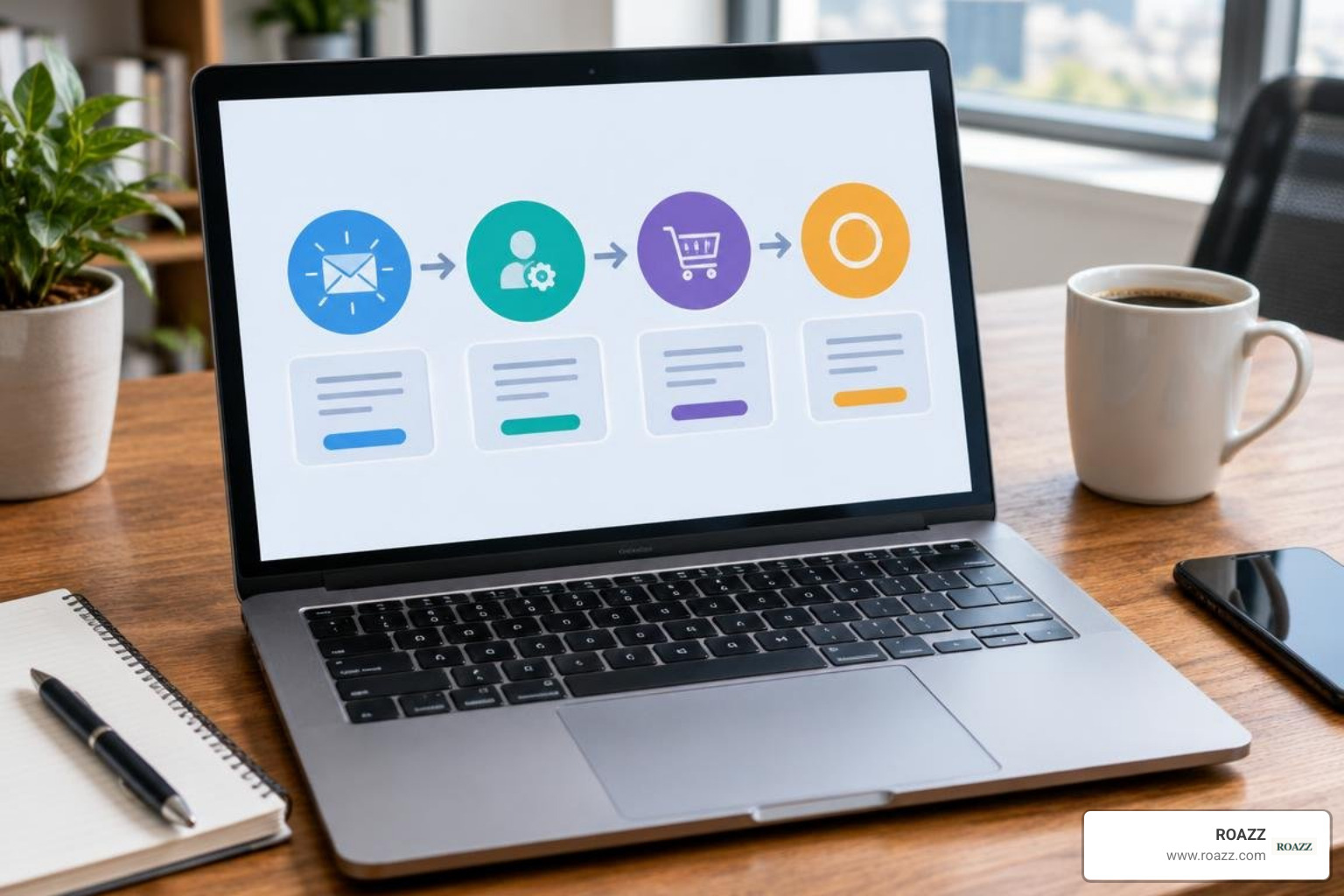
By activating first-party data, customer journey email automation allows us to deliver personalized touchpoints that turn cold signups into repeat buyers.
Welcome and Onboarding Series
The welcome sequence is your most valuable real estate. When someone joins your community, their intent is at its absolute peak.
A high-converting welcome and onboarding flow should:
- Deliver Immediate Gratification: Provide the lead magnet, coupon, or account access within seconds of sign-up.
- Set Clear Expectations: Explain what content you send, how often you send it, and how it benefits them.
- Drive Early Activation: Guide new users to their first "aha!" moment or milestone step.
- Introduce Brand Values: Share what sets your approach apart from standard market alternatives.
For developers and technical teams looking to build custom, event-driven onboarding logic from scratch, frameworks like Temporal offer robust state management. You can explore how to build an email drip campaign with Python or build an email drip campaign with Java and Spring Boot to manage durable, long-running workflow executions.
Abandoned Cart and Win-Back Recovery
Cart abandonment is a natural part of modern digital commerce, not an outright rejection. Prospective customers abandon carts due to unexpected shipping costs, simple distractions, or comparison shopping.
A proven three-part abandoned cart recovery sequence looks like this:
- Email 1 (Sent within 1–2 hours): Helpful reminder featuring clear product visuals and checkout links. Frame the message as customer support: "Did something go wrong with your order?"
- Email 2 (Sent 22–24 hours later): Social proof, verified customer reviews, and answers to common objections. Testing reveals that sending this second reminder around 22 hours after abandonment improves recovery rates by up to 52% compared to waiting a full day.
- Email 3 (Sent 48–72 hours later): Urgency trigger or time-sensitive incentive. Let them know their cart reservation is expiring soon.
Win-back series follow a similar psychological trajectory for subscribers who haven't opened an email or logged into their account for 60 to 90 days. Offer an exclusive return discount, showcase top updates, or provide an easy one-click opt-out to keep your list clean.
Lead Nurturing and Post-Purchase Retention
Post-click engagement should never stop when a transaction occurs. Nurturing relationships after the initial conversion is where long-term customer lifetime value is built.
- Educational Lead Nurturing: If a prospect downloads a whitepaper, follow up over two weeks with case studies, ROI breakdowns, and invitations to book a live demo.
- Post-Purchase Onboarding: Send product care instructions, usage tips, and video tutorials that reduce support tickets and buyer's remorse.
- Review and Referral Requests: Trigger a review prompt 7 to 14 days after product delivery or milestone completion, followed by an incentive to refer colleagues.
How to Build and Automate Your Sequence Step-by-Step
Building an automated pipeline requires aligning technical triggers with strategic messaging. Understanding how performance marketing workflows work ensures that every email in your sequence moves contacts closer to a measurable business outcome.
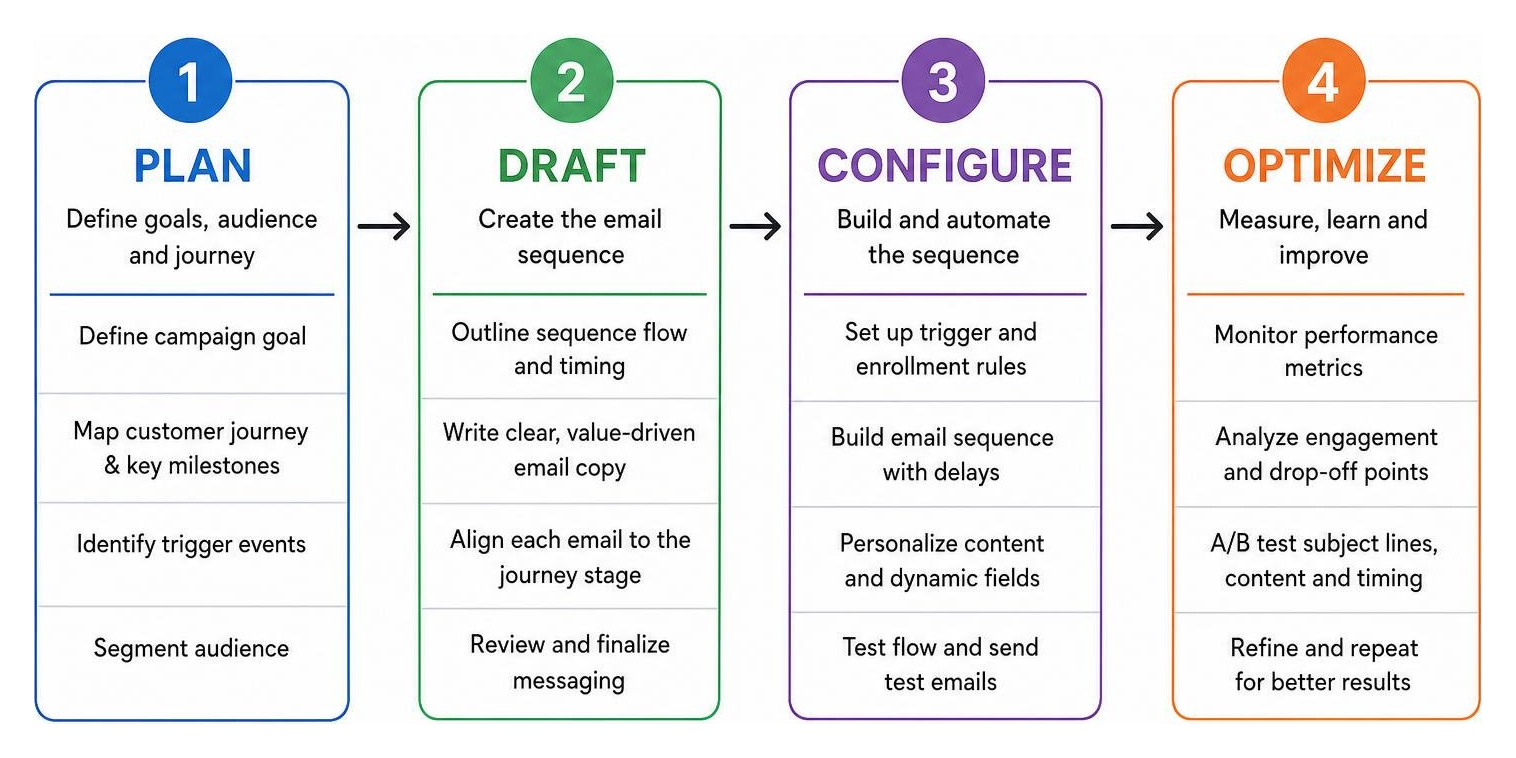
Step 1: Mapping Triggers and Audience Segmentation
Every drip begins with a trigger—the exact event or condition that enrolls a contact into the sequence.
Common triggers include:
- Action-Based Triggers: Form submission, free trial creation, resource download, webinar attendance, or link clicks.
- Criteria-Based Triggers: Property changes in your CRM, such as lead status shifting to "Qualified" or a renewal date approaching in 30 days.
Pair your triggers with dynamic segmentation. Instead of sending one generic sequence to all trial users, split your audience by business size, vertical, or product tier.
Step 2: Writing Copy and Configuring Exit Conditions
When writing drip emails, adhere to three core copywriting principles:
- One Core Objective Per Email: Every message should have a single, unambiguous call-to-action (CTA). Do not ask a contact to read a blog post, book a call, and follow your social channels in the same message.
- Put the Value Above the Fold: Keep key takeaways visible immediately without requiring endless scrolling.
- Write for Skimmers: Use concise paragraphs, descriptive subheaders, and bullet points.
Crucially, you must configure exit conditions. If a prospect books a demo after Email 1, they must automatically unenroll from the remainder of the lead nurture sequence. Failing to set up auto-stop conditions frustrates leads and damages brand credibility.
For specialized B2B CRM workflows, you can learn how to nurture new leads with automated email sequences using built-in branch stops and lead stage criteria.
How to Set Up an Email Drip Campaign Workflow
Once your strategy and copy are ready, configure the sequence inside your marketing automation engine:
- Define the Entry Rules: Set the trigger event and apply initial segment filters.
- Add Time Delays: Space emails appropriately (e.g., immediate welcome, 2-day delay for follow-up).
- Insert Decision Branches: Check whether a user completed the desired action before sending the next message.
- Activate and Test: Run end-to-end test contacts through the flow to verify that tokens, timing delays, and unenrollment rules function seamlessly.
To see step-by-step technical execution across different platforms, review how to set up an email drip campaign for product onboarding or check out how to create a drip campaign in Mautic for open-source marketing automation. You can also explore an email drip campaign how-to guide with 30+ real-world examples to see various complex branching designs in action.
Optimization, Tracking, and Common Mistakes to Avoid
A drip campaign is not a "set-it-and-forget-it" asset. Systematic optimization is essential to maximize return on ad spend and organic list performance.

Key Performance Metrics Beyond Open Rates
Privacy protections and automated image caching have made open rates less reliable as standalone health metrics. We focus on business metrics that tie directly to revenue:
- Click-to-Open Rate (CTOR): Measures message relevance by comparing unique clicks to unique opens.
- Reply Rate: The gold standard for B2B sales development sequences. A high reply rate indicates authentic messaging that resonates with prospects.
- Post-Click Conversion Rate: The percentage of email clickers who complete the target outcome (purchases, demo bookings, form fills).
- Revenue Per Email (RPE): Total attributed revenue divided by the total number of emails delivered.
- Unsubscribe and Spam Complaint Rates: Early warning indicators of audience fatigue or misaligned targeting. Keep spam complaints well below 0.1%.
Best Practices for Every Email Drip Campaign
- Test One Variable at a Time: A/B test subject lines, send delays, or CTA button copy independently so you know exactly what drove performance changes.
- Protect Mobile Readability: Over half of all emails are read on mobile devices. Use responsive templates, concise subject lines (40–50 characters), and thumb-friendly CTA buttons.
- Maintain List Hygiene: Regularly scrub hard bounces and suppress unengaged contacts who ignore re-engagement sequences.
- Vary Your Angles: Do not repeat the exact same sales pitch across five emails. Rotate between educational content, social proof, addressing objections, and direct offers.
Critical Automation Pitfalls to Eliminate
Avoid these common traps when launching automated sequences:
- Overlapping Workflows: Enrolling contacts in multiple active drips simultaneously, inundating them with competing messages.
- Ignoring Reply Auto-Stops: Continuing to send automated sales pitches after a prospect has already replied manually.
- Over-Communicating Too Quickly: Sending daily emails without sufficient value or behavioral justification, driving up unsubscribes.
- Static Cadences: Failing to adjust send timing to match your audience's typical buying cycles.
Frequently Asked Questions About Drip Marketing
How Many Emails Should Be in a Drip Sequence?
Most high-performing drip sequences contain between 3 and 7 emails. Simple flows like abandoned cart recoveries perform best with 3 targeted messages, while complex B2B lead nurturing or product onboarding sequences often require 5 to 7 emails to educate prospects and address objections without causing message fatigue.
What Is the Difference Between Drip and Nurture Campaigns?
Drip campaigns generally follow a structured, pre-written sequence delivered over time based on a trigger. Nurture campaigns represent a broader strategy that dynamically adapts content based on ongoing lead scoring, content consumption, and behavioral branching across multiple channels.
How Often Should Drip Emails Be Sent?
For B2B sequences, spacing messages 2 to 4 days apart maintains momentum without overwhelming recipients. For e-commerce welcome or cart abandonment sequences, the first email should deploy immediately, followed by follow-ups spaced 22 to 48 hours apart.
Conclusion
Blasting your entire list with generic messages drains marketing resources and exhausts your subscriber base. Moving to smart, automated drip campaigns allows you to engage prospects at the exact moment their purchase intent is highest.
At ROAZZ, our performance marketing philosophy is simple: we measure success by actual business results—sales, booked appointments, subscriptions, and revenue—rather than vanity metrics like raw impressions or clicks. We allocate resources to high-intent, intent-driven actions that produce sustainable bottom-line growth.
Explore our performance-marketing services to see how our team plans, builds, and scales revenue-focused automated campaigns tailored to your business goals. Check out our marketing blog for more growth strategies, or contact our specialists today to start optimizing your customer acquisition funnel.