The Mechanics of High-Converting Lead Follow Up Automation

Modern B2B teams automate lead follow-up by replacing static time delays with real-time, event-driven multi-channel triggers. Instead of waiting for a scheduled drip email, the system responds the moment a prospect submits a form, revisits pricing, stalls in a pipeline stage, goes silent across channels, or disengages after a demo. Each trigger enriches the lead, validates contact data, and routes the next action across email, SMS, WhatsApp, or voice based on the buyer’s demonstrated intent.
This shift matters because most pipeline failure happens in the structural gap between initial acquisition and active sales conversations. Approximately 80% of new leads never convert into paying customers, primarily because the subsequent engagement is slow, shallow, or omitted entirely. Furthermore, industry data shows that 44% of sales representatives never make a single follow-up attempt after an initial point of friction.
Traditional marketing automation attempted to solve this with static drip sequences—rigid schedules that blasted standardized email templates regardless of buyer behavior. Today, the global AI automation market is projected to reach $19.6 billion by 2026, driven by a compound annual growth rate of 23.4%. Meanwhile, the lead capture software market is growing from $2.87 billion in 2025 to $3.2 billion in 2026. This shift reflects a move away from linear timers toward adaptive, context-aware systems. Understanding how performance marketing workflows bridge lead capture to conversion reveals that modern follow-up relies on persistent cross-channel memory, real-time data enrichment, and behavioral synchronization.
| System Attribute | Static Email Drip Campaigns | Adaptive AI Follow-Up Systems |
|---|---|---|
| Trigger Mechanism | Fixed time intervals (e.g., Day 1, Day 3) | Real-time buyer intent signals & pipeline stage changes |
| Personalization Depth | Basic contact fields (First Name, Company) | Full conversational history, tech stack, & recent activity |
| Channel Coverage | Single channel (predominantly email) | Omnichannel orchestration (Email, SMS, WhatsApp, Voice) |
| Data Hygiene & Sync | Periodic, manual CRM data entry | Instant enrichment, deduplication, & live webhook updates |
| Response Handling | Requires manual review to stop campaign | Instant intent detection, auto-pause, & human handoff |
| Context Retention | Isolated per campaign thread | Persistent cross-session and cross-channel memory |
An adaptive setup does not treat every lead as an identical record. It uses real-time validation to scrub bad phone numbers, remove duplicate company entries, and route prospects based on explicit buying signals. Gartner predicts that 40% of enterprise applications will include task-specific AI agents by 2026, up from under 5% in 2025. By implementing a responsive AI lead management workflow automation, organizations can reduce manual administrative tasks by up to 70%, achieve a 3x higher response rate, and drive 45% more revenue pipeline from existing inbound volume.
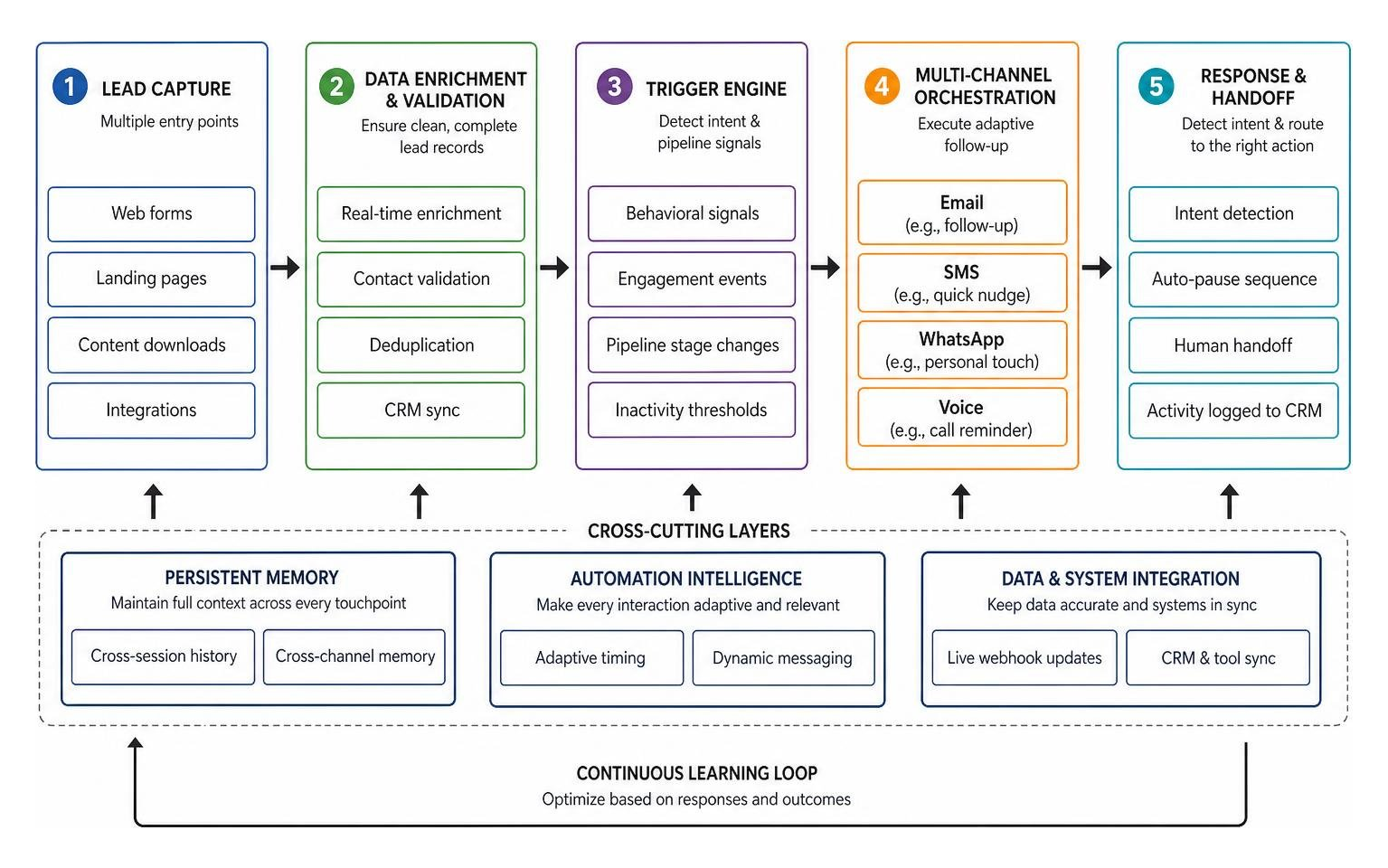
5 Critical Triggers to Automate B2B Follow-Up Workflows
Building a resilient pipeline requires transitioning from time-based broadcasts to event-driven logic. Rather than sending arbitrary weekly check-ins, automated workflows should fire exclusively when a buyer demonstrates a specific intent state or reaches a verified stage of inactivity.
Trigger 1: Immediate Inbound Form Submission and Rapid Response
The probability of qualifying a lead drops exponentially with every minute of silence. When an inbound prospect submits a demo request, pricing inquiry, or consultation form, waiting an hour often means losing the deal to a faster competitor.
Connecting inbound forms directly to your pipeline engine via webhooks enables real-time enrichment—pulling verified firmographic details such as headcount, current tech stack, and annual revenue. If the lead matches your Ideal Customer Profile (ICP), the system immediately issues a personalized SMS or email offering a direct booking link, while firing an internal Slack notification to the assigned account executive. Deploying a structured lead follow-up system with automated reminders guarantees that initial response times drop from hours to under 60 seconds.
Trigger 2: High-Intent Content Engagement and Lead Follow Up Automation
Not all pipeline opportunities originate from explicit "Contact Us" forms. Prospects actively evaluating your solution often revisit key pages, review pricing structures, or download technical assets. When a tracked prospect visits your pricing tier page multiple times in 48 hours or consumes a bottom-of-funnel case study, their intent score spikes.
Triggering lead follow up automation off behavioral milestones prevents cold outreach disconnects. Instead of sending a generic "Just checking in" email, the system references the exact business challenge the prospect researched. Executing an AI follow-up playbook ensures that communication highlights specific use cases, implementation timelines, and measurable outcomes tailored to that prospect's demonstrated interests.
Trigger 3: Stage-Stalled Opportunities and Pipeline Re-Engagement
Deals often stall after initial discovery calls or proposal deliveries. Sales representatives get busy pursuing newer leads, leaving open proposals unaddressed.
When an opportunity lingers in a specific pipeline stage without activity past a set threshold (e.g., seven consecutive days), the workflow activates a revival cadence. Using a platform like LeadFollow AI helps identify hidden objections, automatically generating contextual follow-up sequences that reframe pricing concerns into quantifiable return on investment. The moment the contact responds, the sequence stops immediately, returning conversational control to the deal owner.
Trigger 4: Multi-Channel Cross-Platform Inactivity and AI Fallbacks
Relying exclusively on a single channel creates blind spots. An executive who misses an email may actively monitor professional SMS, while international buyers may prefer messaging platforms. When an initial outreach channel yields zero engagement after three attempts, automated fallbacks prevent the lead from going cold.
A dedicated AI lead follow-up safety net steps in when primary communication stalls, deploying a balanced sequence across alternative verified channels. By validating phone records and scrubbing outdated information before dispatching messages, the system engages silent prospects on their preferred platform without sounding repetitive.
Trigger 5: Post-Demo Silence and Context-Aware Lead Follow Up Automation
The 72-hour window following a product demonstration is critical. If a prospect goes dark after seeing a demo, sending broad product marketing material weakens your position.
Deploying sales follow-up software that writes and sends contextual messages allows your team to auto-draft recaps using actual call transcripts. By referencing specific integration requirements, timeline constraints, or workflow bottlenecks raised during the call, the follow-up addresses the buyer's exact decision criteria rather than relying on generic product brochures.
Designing Multi-Channel Cadences That Prevent Leads From Going Cold
A multi-channel follow-up workflow should balance persistence with relevance. Bombarding a prospect with simultaneous emails, phone calls, and text messages creates frustration and burns pipeline value. A well-orchestrated cadence spaces interactions intelligently across verified touchpoints, adjusting timing based on real-time engagement data.
To maintain message quality across touchpoints, follow these core operational principles:
- Data Hygiene First: Clean, deduplicate, and verify email syntax and mobile numbers before any outreach begins.
- Dynamic Conditional Branching: If a lead opens an email three times, trigger a phone task for the rep; if an email bounces, switch to verified messaging channels automatically.
- Conversational Brevity: Keep written messages focused and under 80 words. Reference specific problems rather than reciting comprehensive feature lists.
- Instant Sequence Termination: Ensure the entire automation sequence halts the moment a prospect replies, books a meeting, or requests to opt out.
- Escalation Rules: If an assigned sales representative fails to action an assigned task within four hours, escalate the record to an active team queue.
For deeper insights on integrating automated workflows with full-funnel marketing campaigns, explore our frequently asked questions about full-funnel integration.
Key Metrics and Continuous Optimization for Automated Follow-Up
Measuring the impact of follow-up automation requires looking beyond vanity vanity metrics like open rates. Real optimization focuses on speed-to-contact, pipeline progression, and down-funnel conversions.

To ensure your automated triggers generate measurable business outcomes, monitor these primary key performance indicators (KPIs):
- Speed to First Touch: Measure the exact latency between form submission and the initial automated or human outreach. Target under two minutes for inbound inquiries.
- Contact Rate: Track the percentage of total captured leads that successfully engage in a two-way dialogue across any channel.
- Lead-to-Meeting Conversion Rate: Calculate the proportion of inbound inquiries that translate into completed discovery calls or product demonstrations.
- Pipeline Velocity: Track how quickly an opportunity transitions from initial capture to closed-won status once automated stage triggers are active.
- Channel-Specific Attribution: Compare response and meeting rates across Email, SMS, WhatsApp, and Voice to allocate future marketing and follow-up resources effectively.
Regularly run A/B tests on message angles—such as direct return-on-investment calculations versus peer case studies—to continuously refine response rates across all automated sequences.
Frequently Asked Questions About Automated Lead Management
How quickly should automated follow-ups trigger after lead capture?
High-intent inbound leads should receive an initial automated response within 60 seconds. Research consistently shows that contacting a prospect within the first five minutes yields significantly higher qualification rates than waiting even 30 minutes.
Can multi-channel follow-ups feel personalized rather than robotic?
Yes. Effective personalization uses conversational context, industry-specific pain points, and behavioral data (such as specific pages viewed or topics discussed during calls) rather than just inserting first-name variables into static templates.
When should automation hand off a prospect to a human sales rep?
Automation should hand off immediately when a prospect replies to an outreach touchpoint, requests a direct conversation, books a calendar slot, or crosses an established lead-scoring threshold.
Conclusion: Turning Inbound Clicks into Revenue
Generating inbound B2B traffic is only the first step in building a predictable sales pipeline. When leads go unanswered or follow-up cadences rely solely on manual reminders, marketing spend is wasted and conversions drop.
By implementing smart automation triggers tied to real-time buyer intent, organizations eliminate latency, maintain consistent contact across channels, and ensure no qualified deal stalls unnoticed. We specialize in building measurable post-click systems that turn paid and organic demand into confirmed sales pipeline. Discover our performance-driven marketing services focused on actual conversions to build an efficient, revenue-focused conversion engine.