How to Use Retargeting Ads for B2B Lead Generation

To generate leads with retargeting ads, focus on prospects who have shown intent. Build audiences from pricing-page visits, demo-page visits, or engaged contacts. Show each group an ad that answers its likely next question, then send clicks to a matching landing page. Exclude people who have already converted.
For B2B teams, the goal is not more clicks. It is more qualified demo requests and sales opportunities. Track those outcomes in your CRM so you can see whether retargeting earns its budget.
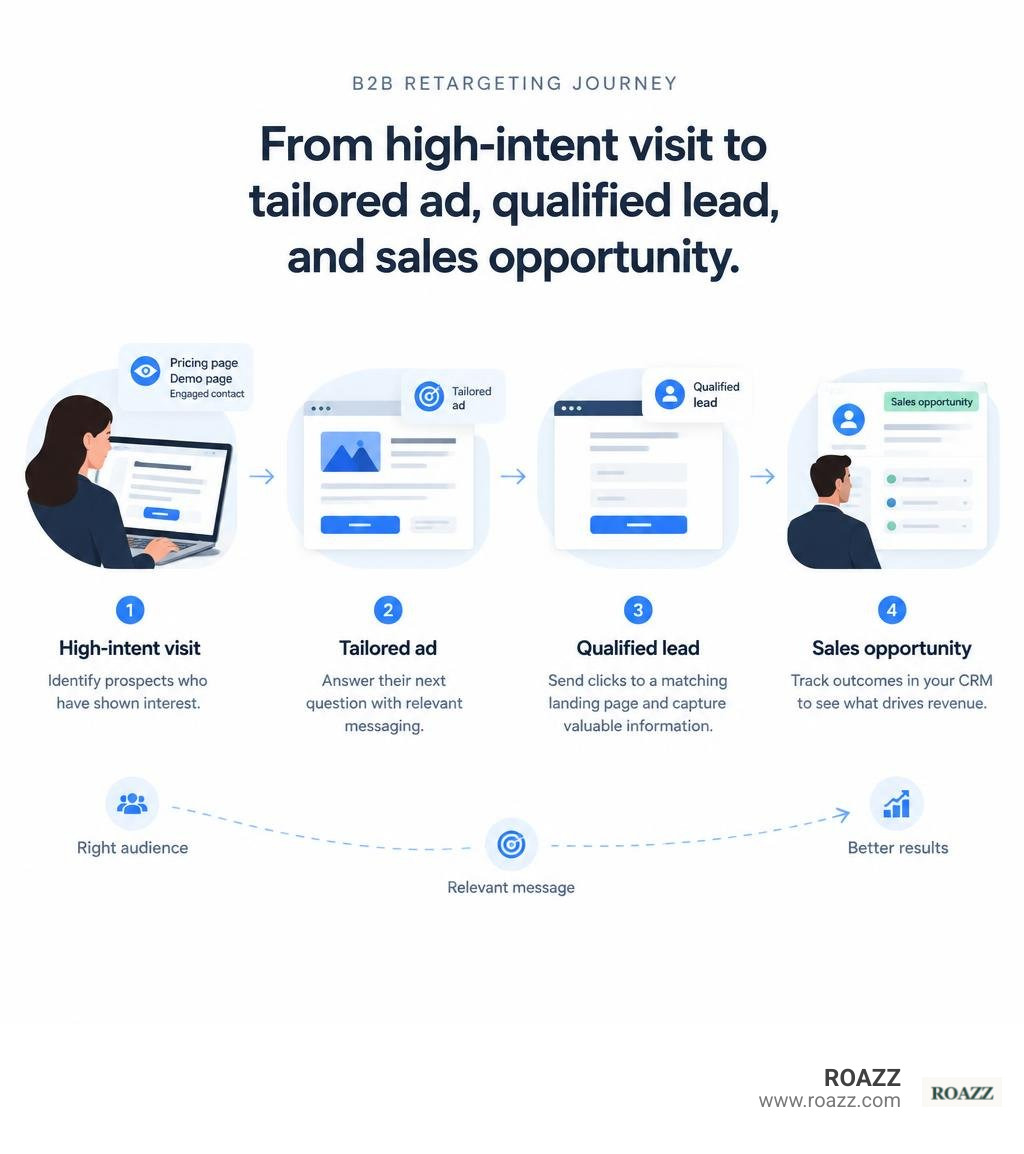
Approximately 97% of first-time website visitors leave without converting. In complex B2B buying environments, driving traffic to a landing page is only step one. It takes roughly seven touchpoints to convert a cold lead, and expecting an enterprise decision-maker to book a sales demo on their very first visit ignores how modern purchasing decisions happen.
When applied strategically, deploying dedicated campaigns can capture that lost interest. Done right, retargeting delivers 2–5x the ROAS of cold acquisition campaigns, giving your sales pipeline a reliable, automated follow-up engine.
Foundations of Retargeting vs Remarketing in Modern B2B Pipelines
Many marketers use the terms "retargeting" and "remarketing" interchangeably, but distinguishing between the two is vital for building an efficient B2B lead generation architecture.
Historically, retargeting refers to serving paid display, social, or search ads to anonymous or known prospects on third-party networks after they interact with your digital assets. Remarketing traditionally focuses on direct, owned-channel communication—primarily automated email sequences, SMS, or direct outreach to re-engage existing contacts or past customers.
Modern pipelines bring both strategies together. Retargeting bridges the gap between initial anonymous discovery and owned-channel nurturing.
| Dimension | Pixel-Based Retargeting | List-Based Retargeting |
|---|---|---|
| Data Source | Web browser cookies & first-party tracking tags | Uploaded CRM lists, email contacts, or offline IDs |
| Target Audience | Anonymous website visitors & page-level interactors | Known leads, existing pipeline accounts, webinar attendees |
| Delivery Speed | Instantaneous once tracking thresholds are reached | Requires 24–48 hours for platform identity matching |
| Match Rates | High on active browsers; impacted by browser privacy | Typically 50–80% depending on email domain alignment |
| Primary Objective | Initial re-engagement and lead capture | Account acceleration, multi-threading, and pipeline velocity |
Technical Tracking Mechanics and Privacy Infrastructure
Modern retargeting relies on a hybrid framework combining browser-side tags and server-side APIs. Standard browser-based tracking pixels (such as the Meta Pixel, LinkedIn Insight Tag, and Google tag) drop first-party identifiers when a user accepts tracking through your consent management platform.
However, browser-level privacy constraints, ad blockers, and cookie expiration policies can degrade traditional pixel signals. To maintain data integrity:
- Implement Server-Side Tracking: Configure server-side tracking, such as the Meta Conversions API (CAPI) and Google Ads server-side tagging. Passing conversion events directly from your web server back to ad networks can restore 15–25% of lost conversion data.
- Maximize Event Match Quality (EMQ): Pass secure, hashed parameters (such as business email, phone number, city, and first-party click IDs) with your event payloads. Aim for an EMQ score above 7.0 on Meta and comparable health metrics on other platforms.
- Establish First-Party Data Foundations: Gather verified business identifiers early in the visit through gated whitepapers, calculators, or newsletter opt-ins.
Strategic Differences Between Retargeting and Remarketing
Because retargeting requires paid distribution and remarketing relies on owned media, their economics and roles differ:
- Retargeting Ads: Target warm, non-converting prospects browsing external networks (such as LinkedIn or Instagram). They address unanswered questions, highlight differentiators, and offer low-friction entry points (such as benchmark reports or interactive demos).
- Remarketing Workflows: Target opted-in contacts sitting in your CRM. These automated emails provide long-form case studies, customer onboarding details, or direct outreach from sales reps.
When your paid retargeting ads and marketing automation talk to each other, you eliminate duplicate messaging and create a seamless buyer journey.
High-Intent Audience Segmentation and Account-Based Targeting
Broad retargeting campaigns that serve a generic ad to every visitor from the last 90 days waste significant ad spend. Serving the same high-level brand awareness ad to a pricing-page abandoner that you show to a 5-second blog skimmer is a missed opportunity.
Understanding how it works across custom audiences lets you allocate your budget based on proven user intent.
Segmenting Visitors by Funnel Depth and Intent Signals
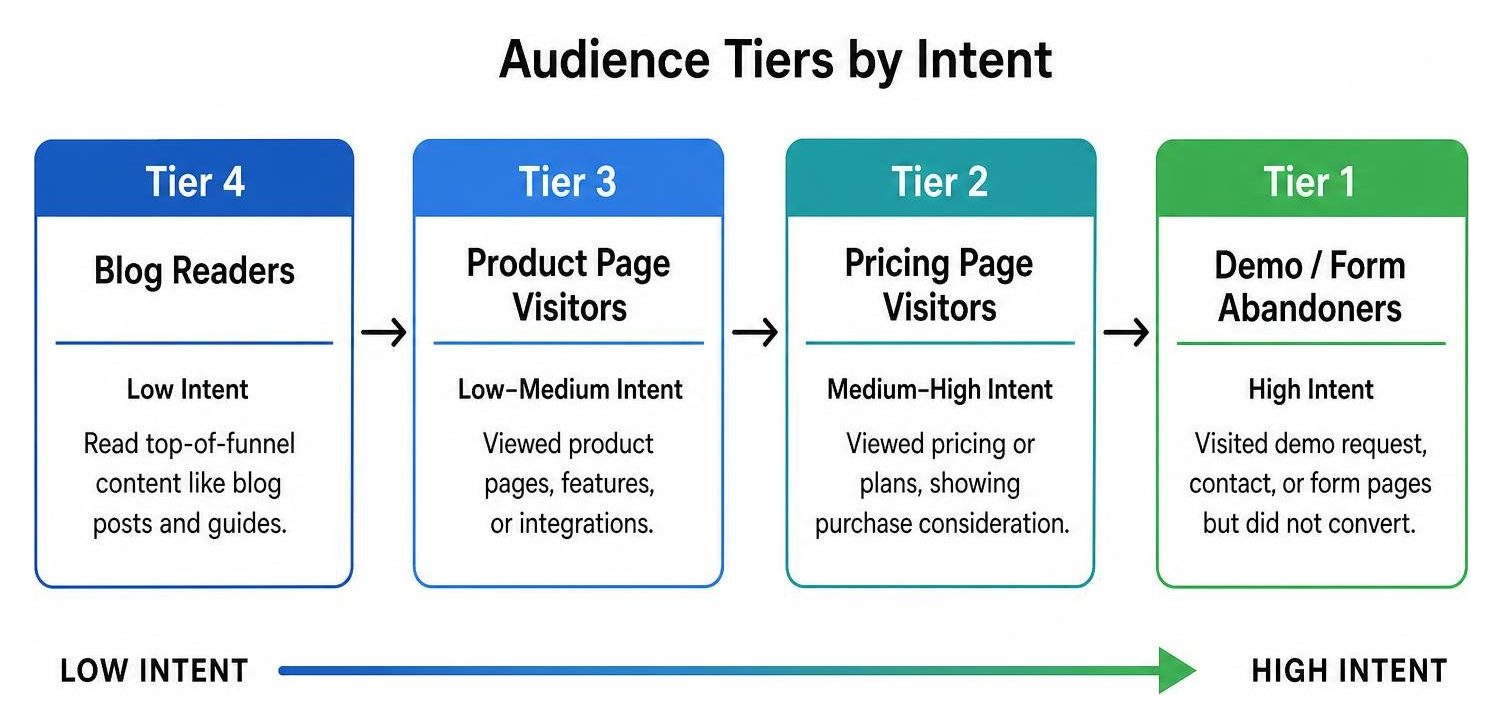
To optimize your ad spend, group your web audience into distinct intent tiers:
- Tier 1: High-Intent Form & Demo Abandoners (Recency: 1–14 Days): Prospects who visited your contact page, pricing table, or demo request screen without submitting. These users have high buying intent and need immediate reassurance, objection handling, or simplified scheduling.
- Tier 2: Specific Product/Solutions Page Visitors (Recency: 14–30 Days): Visitors who evaluated specific feature sets or use cases. They benefit from customer success stories and deep-dive comparisons relevant to those specific pages.
- Tier 3: Top-of-Funnel Content Consumers (Recency: 30–60 Days): Readers of blog articles or resource libraries who spent more than 60 seconds on site. Retarget them with mid-funnel lead magnets, such as gated industry reports or live webinars, to capture their contact details.
B2B organizations can also use account-based retargeting strategies to identify company domains visiting high-value pages. By targeting entire buying committees from visiting accounts, you influence multiple decision-makers rather than relying on a single champion.
Suppressing Converted Leads and Existing CRM Accounts
Suppression lists are critical for campaign efficiency. Most B2B companies waste 15–25% of their ad budget showing top-of-funnel conversion ads to people who have already registered, booked a call, or entered an active sales negotiation.
- Sync Active Deals Hourly: Connect your CRM directly to your ad platforms to automatically exclude contacts in active deal stages.
- Exclude Closed-Won Accounts: Move active clients into dedicated cross-sell or retention audiences rather than acquisition campaigns.
- Filter Out Internal Traffic: Exclude company employees, job seekers viewing careers pages, and support-ticket users to protect your ad budget.
How to Build Retargeting Ads for Lead Generation Across Key Platforms
Each paid advertising network offers unique targeting strengths and user mindsets. A balanced B2B strategy distributes spend across platforms based on cost and context.

Deploying strategic retargeting ads for lead generation allows you to re-engage warm audiences across platforms like Meta, LinkedIn, and Google, capturing conversions that cold traffic campaigns often miss.
Platform Implementation for Meta, LinkedIn, and Google Display
- LinkedIn Ads: Essential for account-based and role-specific campaigns. Standard LinkedIn Insight Tag retargeting can have lower match rates (5–10%), but using matched lists and account feeds can push match rates to 30–40% while reducing Cost Per Lead (CPL) from $150–$300 down to $60–$150. LinkedIn Matched Audiences require at least 300 active members to run.
- Meta Ads (Facebook & Instagram): Highly cost-effective for engagement and follow-up. US businesses that implement strategic Meta retargeting often see 2–4x higher conversion rates and 40–60% lower CPL compared to cold traffic. Target custom audiences of video viewers and recent site visitors, keeping audience sizes above 1,000 for consistent delivery.
- Google Display Network & YouTube: Google Display offers affordable, widespread visibility to keep your brand top-of-mind across millions of websites. Combine it with YouTube video ads to present in-depth customer testimonials and product walk-throughs to prospects who previously visited your product pages.
Designing High-Converting Creatives for Retargeting Ads for Lead Generation
When writing and designing retargeting creative, avoid recycling the same ad the prospect bypassed earlier. If a prospect did not convert the first time, repeating the exact same message rarely changes their mind. Instead, shift your angle:
- Address Concrete Objections: Directly tackle concerns around implementation timelines, pricing transparency, or migration friction. A 30-second founder video or a side-by-side comparison chart works well here.
- Showcase Quantifiable Social Proof: Highlight specific customer metrics using carousel formats (e.g., "How Company X Reduced Overhead by 34% in 90 Days").
- Personalize the Call to Action: Dynamic, personalized CTAs convert 42% better than generic ones. Tailor the CTA to the visitor's past behavior—invite high-intent pricing visitors to "Schedule a Personalized Walkthrough" while offering blog readers an "Interactive Industry Benchmark Report."
Sequential Nurturing, Budget Allocation, and Frequency Control
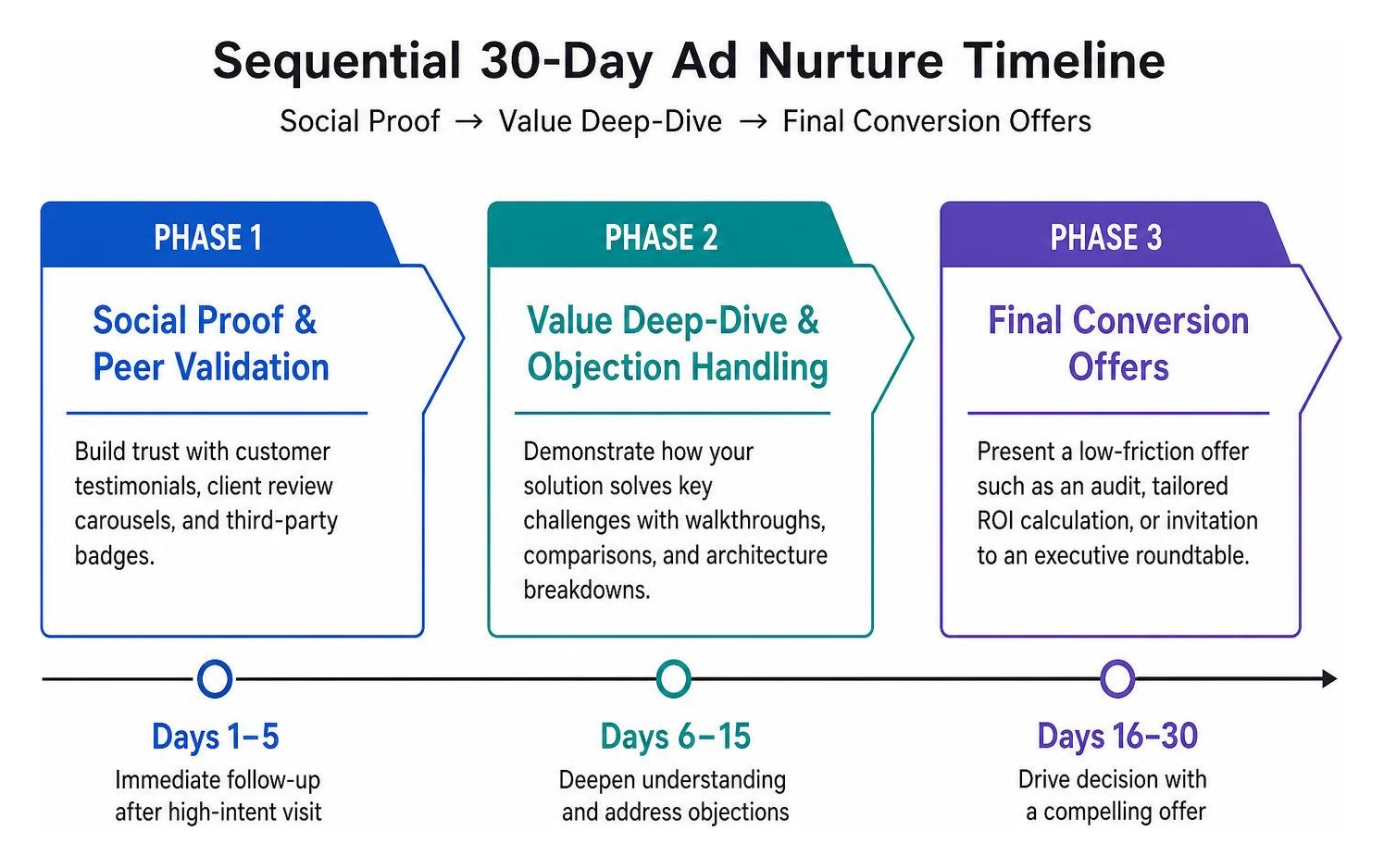
Prospects need different information as they move closer to a purchasing decision. Sequential retargeting serves a planned series of distinct messages over time, achieving 35–50% higher conversion rates than showing the same ad on repeat.
Sequential 3-Ad Nurture Sequences Over 30-Day Cycles
- Days 1–5: Social Proof and Peer Validation: Immediately after a high-intent visit, serve short customer testimonial videos, third-party badges, or client review carousels. This reassures prospects that your solution is established and trusted.
- Days 6–15: Overcoming Objections & Feature Value: Show how your product solves their primary operational bottlenecks. Use product walkthrough GIFs, feature comparisons, or architecture breakdowns.
- Days 16–30: The Low-Friction Offer: Introduce an engaging, direct offer. This could be a 1-on-1 audit, a tailored ROI calculation, or an invitation to an upcoming executive roundtable.
Frequency Capping and Preventing Audience Ad Fatigue
Ad fatigue quickly drains campaign performance. If a prospect sees your ad dozens of times without clicking, their reaction shifts from interest to annoyance.
- Implement Strict Frequency Caps: Limit exposure to 3–5 impressions per user per week on display networks and social feeds.
- Rotate Creative Regularly: Refresh ad visuals, headlines, and formats every 14–21 days.
- Set Time-Based Windows: Match your retargeting window to your typical sales cycle. Fast-moving SaaS tools can use 14–30 day windows, whereas enterprise sales with 6-month cycles can extend to 60–90 days with lowered weekly impression caps.
Measuring Incremental ROAS and Optimizing Post-Click Conversions
A common pitfall in digital marketing is relying solely on platform-reported ROAS. Standard retargeting metrics can over-attribute value to ads that merely sat in front of prospects who were already intending to convert.
Understanding how to measure true incremental retargeting lift ensures you invest in campaigns that generate net-new revenue.
Measuring Incrementality and Lift in Retargeting Ads for Lead Generation
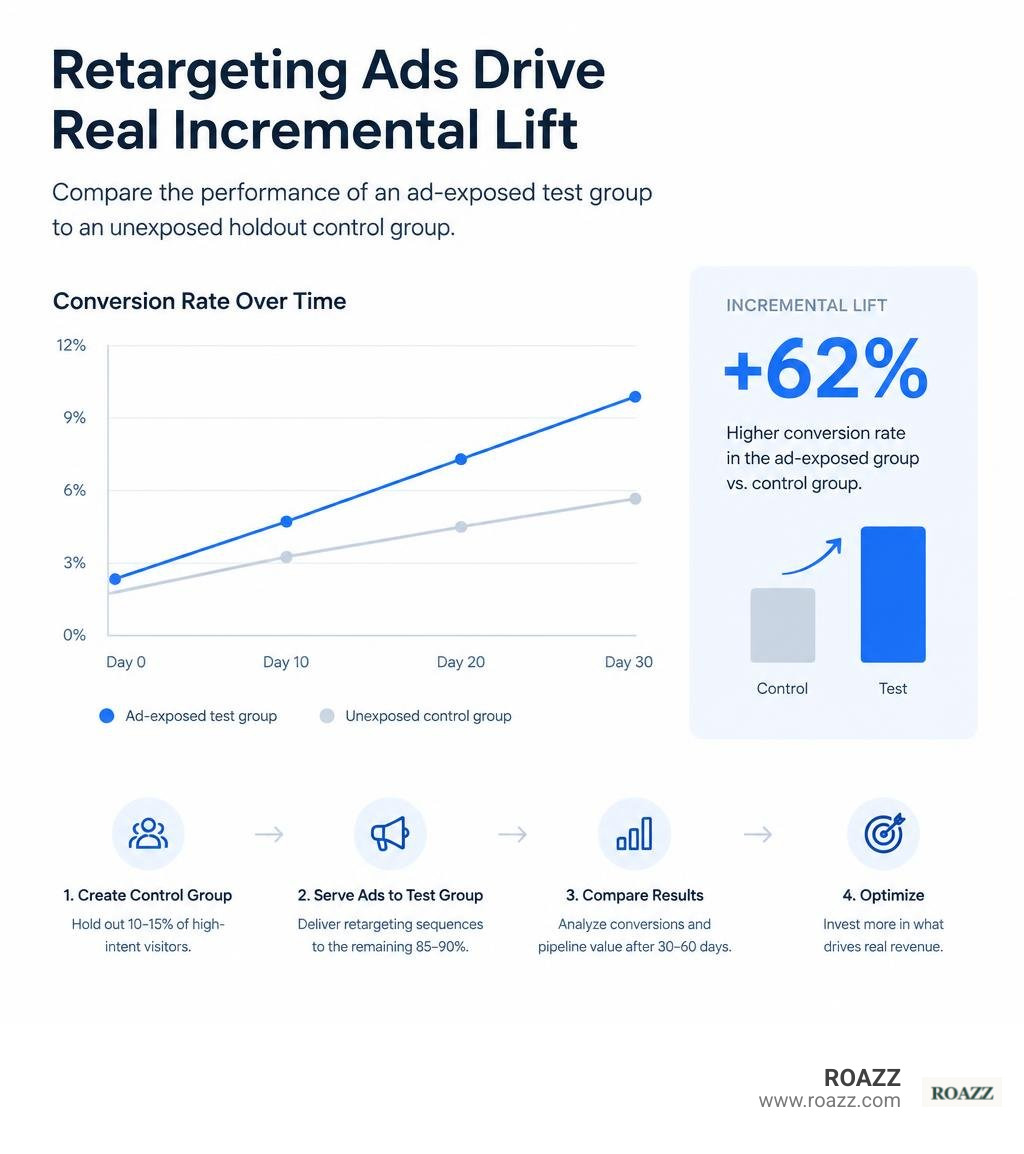
To find your true incremental lift, set up a simple hold-out experiment:
- Create a Control Group: When building an audience of high-intent visitors (e.g., 20,000 users), randomly hold out 10–15% from seeing your retargeting ads.
- Serve Ads to the Test Group: Deliver your retargeting sequences exclusively to the remaining 85–90%.
- Compare Baseline Conversions: After 30–60 days, compare the conversion rate and pipeline value generated by the exposed test group against the unexposed control group. The difference represents your true incremental conversion lift.
Conversion Tracking for High-Value Post-Click Outcomes
At ROAZZ, we focus on real business outcomes rather than vanity metrics like impressions or surface-level clicks. We optimize campaigns around post-click results—such as qualified sales meetings, pipeline progression, and closed deals—by allocating budget to the highest-performing, intent-driven actions.
To build an accurate conversion model:
- Track Downstream Pipeline Stages: Connect your advertising platforms directly to your CRM using unique lead IDs and offline conversion imports.
- Attribute Qualified Pipeline (SQLs): Evaluate campaigns based on Cost Per Sales Qualified Opportunity rather than simple form-fill rates.
- Review Common Measurement Queries: Check our answers to performance measurement FAQs to explore attribution models that account for multi-stakeholder B2B sales cycles.
Frequently Asked Questions About B2B Retargeting
How much budget should B2B companies allocate to retargeting?
Most B2B organizations find success allocating 15–30% of their total digital ad spend to retargeting, dedicating the remaining 70–85% to top-of-funnel prospecting. If your monthly website traffic is still modest (under 2,000 monthly unique visitors), keep retargeting spend lower until your top-of-funnel campaigns build a larger pool of qualified visitors.
How do privacy updates and cookie loss impact retargeting?
Browser privacy changes and cookie restrictions make traditional third-party tracking less reliable on its own. B2B teams can adapt by using first-party data capture, setting up server-to-server tracking (such as Meta CAPI and Google Server-Side Tagging), and building direct CRM integrations to reach audiences reliably across platforms.
What is an optimal frequency cap for retargeting ads?
A reliable benchmark is 3–5 impressions per user per week across social feeds and 4–7 impressions per week on display networks. Setting clear frequency caps protects your brand reputation, prevents ad fatigue, and preserves your budget for genuinely interested buyers.
Conclusion
Retargeting is not an isolated tactic—it is the strategic bridge that turns warm interest into qualified sales opportunities. By replacing generic ad blasts with intent-based segmentation, sequential messaging, and server-side tracking, you can engage enterprise buyers with the exact context they need to take the next step.
When you measure real incremental lift and track pipeline milestones rather than surface-level metrics, retargeting becomes one of the most profitable engines in your growth strategy. Explore our full suite of performance marketing services for lead generation to see how our team designs, launches, and optimizes campaigns focused on measurable business outcomes. If you are ready to evaluate your current setup, contact us today to plan a data-driven follow-up strategy for your pipeline.