Which email marketing automation service fits your business?

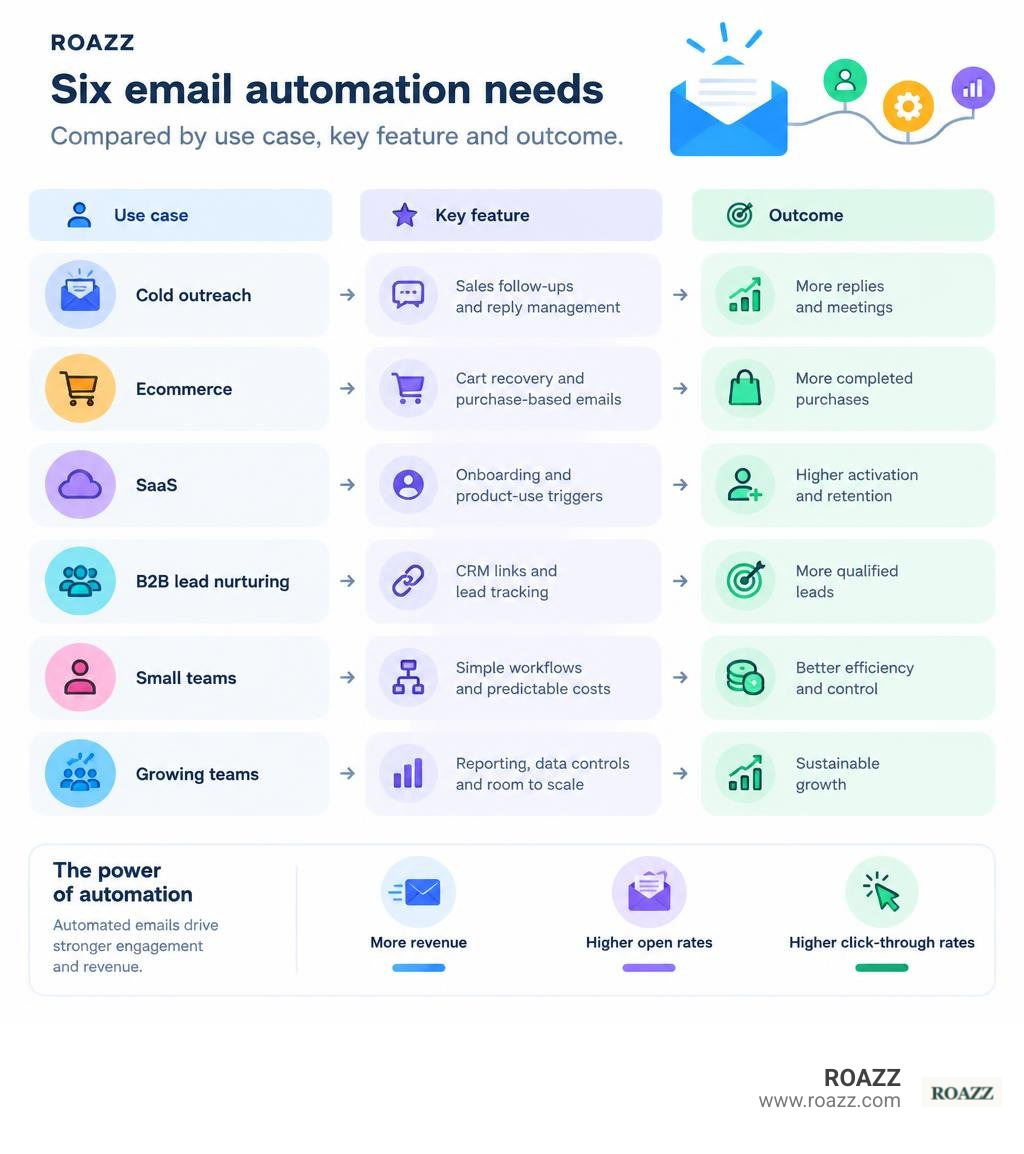
The best email marketing automation service depends on what you need it to do. Compare options by the result you want, not the length of the feature list:
- Cold outreach: Find a tool built for sales follow-ups and reply management.
- Ecommerce: Look for cart recovery and purchase-based emails.
- SaaS: Prioritize onboarding and product-use triggers.
- B2B lead nurturing: Choose strong CRM links and lead tracking.
- Small teams: Start with simple workflows and costs you can predict.
- Growing teams: Check reporting, data controls, and room to scale.
This roundup looks at six services through those needs, so you can find a fit for your team and measure outcomes such as sales, qualified leads, or donations.
Core Categories of Modern Email Marketing Automation Services

Email marketing automation is no longer just about scheduling a weekly newsletter. At its core, automation uses behavioral triggers, customer data, and conditional logic to deliver hyper-relevant messages without manual intervention. The business impact is massive: automated emails generate 320% more revenue than non-automated broadcasts. Furthermore, triggered emails achieve a 70.5% higher open rate and 152% higher click-through rate compared to generic newsletters.
With 51% of companies using marketing automation and more than 44% of professionals spending over five hours weekly managing email communication, selecting the right platform category saves time and accelerates post-click conversions.
| Service Category | Primary Focus | Best For | Key Differentiators |
|---|---|---|---|
| Cold Outreach Platforms | Outbound prospecting & sales pipeline generation | B2B sales teams & agencies | Inbox rotation, mailbox warmup, unified inbox |
| Ecommerce Retention Engines | Customer lifetime value & purchase recovery | Online storefronts & DTC brands | Deep cart integration, zero-party data, predictive LTV |
| Integrated CRM Suites | End-to-end lifecycle nurturing & deal tracking | B2B, SaaS, & complex sales cycles | Granular page-view triggers, pipeline sync, lead scoring |
| AI-Native Sending Engines | Conversational prompt-based design & agility | Developers, agencies, & lean startups | Natural language flow generation, human approval gates |
Essential Features in Modern Email Marketing Automation Services
When assessing modern email marketing automation services, look past surface-level vanity metrics and evaluate the technical core:
- Visual Workflow Builders: Drag-and-drop canvases that support multi-branch conditional paths based on user behavior.
- Event-Based Triggers: Granular triggers capable of responding to on-page views, dynamic link clicks, form fills, or inactivity.
- Dynamic Content Personalization: Content blocks that swap images, copy, and product recommendations tailored to past purchase behavior or zero-party preference data.
- Behavioral Segmentation: Real-time audience filtering that segments users dynamically without requiring manual list cleaning.
- Deliverability Infrastructure: Automated IP warming, authentication configuration, and split transactional/marketing routing.
AI-Powered Optimization and Inbox Placement Tools
Modern email systems leverage machine learning to optimize the entire sending pipeline. Instead of guessing send times, AI algorithms evaluate past engagement patterns to deliver messages when individual subscribers are most likely to open.
Predictive analytics forecast customer churn risk, lifetime value, and repurchase cycles, while automated spam scoring ensures your message code adheres to evolving mailbox provider standards before you press send.
Top Email Automation Platforms and Service Models Reviewed
To help you determine which software architecture matches your specific operational requirements, we evaluated the leading platforms across key business models.
Cold Outreach and B2B Lead Generation Platforms
Outbound sales prospecting requires an entirely distinct technology stack from inbound newsletter delivery. Outbound engines focus on inbox deliverability across multiple sending accounts rather than flashy visual templates.
1. Smartlead
Smartlead is built specifically for high-volume, automated cold outreach. It eliminates the risk of burning your primary domain reputation by utilizing unlimited mailbox connections and automated deliverability warmup algorithms.
- Pros: Native inbox rotation, unified "Unibox" for managing replies across all accounts, multi-channel outreach options (email and LinkedIn), and robust API capabilities.
- Cons: Not designed for inbound newsletter design or visual drag-and-drop marketing templates.
- Pricing: Tiered monthly subscriptions starting around $39/month, scaling based on active lead volume and email limits.
2. HubSpot Marketing Hub
HubSpot represents the industry benchmark for inbound B2B marketing, combining enterprise-grade email automation with a world-class customer relationship management (CRM) database.
- Pros: Over 1,000 native integrations, granular behavioral triggers (e.g., page views, asset downloads), built-in lead scoring, and comprehensive lifecycle reporting.
- Cons: High pricing tiers that increase steeply as your contact database expands; onboarding fees often apply for professional tiers.
- Pricing: Free tier available; paid Starter plans begin around $20/month, while Professional suites for advanced automation start around $800/month.
Ecommerce and Direct-to-Consumer Retention Engines
For online storefronts, email automation acts as an automated sales rep that drives repeat purchases and saves abandoned carts.
3. Klaviyo
Klaviyo is a premier data platform engineered for high-growth online retailers and Direct To Consumer brands looking to turn real-time consumer data into scalable revenue.
- Pros: Deep integrations with major ecommerce platforms, exceptional dynamic segmentation, predictive lifetime value metrics, and combined SMS/email journeys.
- Cons: Premium pricing curve as contact lists scale; steep learning curve for advanced custom properties.
- Pricing: Free tier up to 250 contacts; paid tiers scale based on active profiles, starting at $20–$60/month.
- Learn more: Email Marketing Platform for Automation & Personalization - Klaviyo
4. Drip
Drip provides ecommerce brands with behavioral automation that simplifies complex customer journeys without the technical bloat of enterprise systems.
- Pros: Intuitive visual journey builder, pre-made revenue workflows (abandoned cart, post-purchase follow-up, browse recovery), and simple list management.
- Cons: Limited CRM capability outside of standard ecommerce transaction data.
- Pricing: Starts at $39/month for up to 2,500 contacts, scaling with list size.
Integrated CRM and Lifecycle Automation Software
These platforms bridge the gap between marketing engagement and sales pipeline execution, ensuring your sales team steps in right when subscriber intent peaks. Learn how our team approaches full-funnel customer acquisition by exploring How It Works.
5. ActiveCampaign
ActiveCampaign is a market leader in advanced logic automation, offering built-in sales CRM capabilities alongside deep email tracking.
- Pros: Incredible conditional workflow flexibility, split testing inside automations, predictive content delivery, and integrated sales pipelines.
- Cons: The breadth of features creates an initial learning curve for beginners.
- Pricing: Plans start around $29/month for starter automation, scaling based on contacts and advanced CRM features.
6. Nitrosend
Nitrosend is an AI-native email engine built for forward-thinking builders and agencies wanting to streamline production by connecting directly with AI agent workflows.
- Pros: Natural-language email creation via AI prompting, enterprise deliverability routing, clean brand kit application, and human approval gates.
- Cons: Built primarily for agile teams comfortable with AI workflows rather than traditional legacy dashboards.
- Pricing: Simple pricing models based on sending volume with unlimited contact storage.
- Learn more: Nitrosend - AI-native email for agencies and builders
Strategic Execution and Best Practices for Automated Workflows

Implementing email marketing automation requires a balance of technical configuration and customer journey mapping. When orchestrating automated sequences, prioritizing high-impact customer touchpoints produces the fastest post-click return:
- Welcome & Onboarding Series: Greet new subscribers immediately, set expectations, and guide them to their first valuable interaction.
- Cart & Browse Abandonment Sequences: Nudge high-intent shoppers with dynamic product displays and time-sensitive reminders.
- Post-Purchase Nurturing: Deliver onboarding guides, collect zero-party reviews, and recommend complementary items based on order history.
- Re-Engagement & List Pruning: Identify inactive subscribers after 60–90 days, provide a re-opt-in incentive, and automatically prune non-responders to protect sender health.
Evaluating Enterprise vs Startup Email Marketing Automation Services
Selecting between startup-friendly tools and enterprise systems comes down to operational scale, integration requirements, and budget predictability:
- Startup & Small Business Considerations: Prioritize platforms that offer flat-rate pricing, pre-built workflow templates, and straightforward user interfaces so your team can deploy revenue campaigns without engineering overhead.
- Enterprise Scaling Considerations: Ensure the platform supports strict data privacy frameworks (such as GDPR, CCPA, and HIPAA compliance where necessary), single sign-on (SSO), custom role-based permissions, and dedicated IP pools.
Deliverability, Authentication, and Technical Inbox Integrity
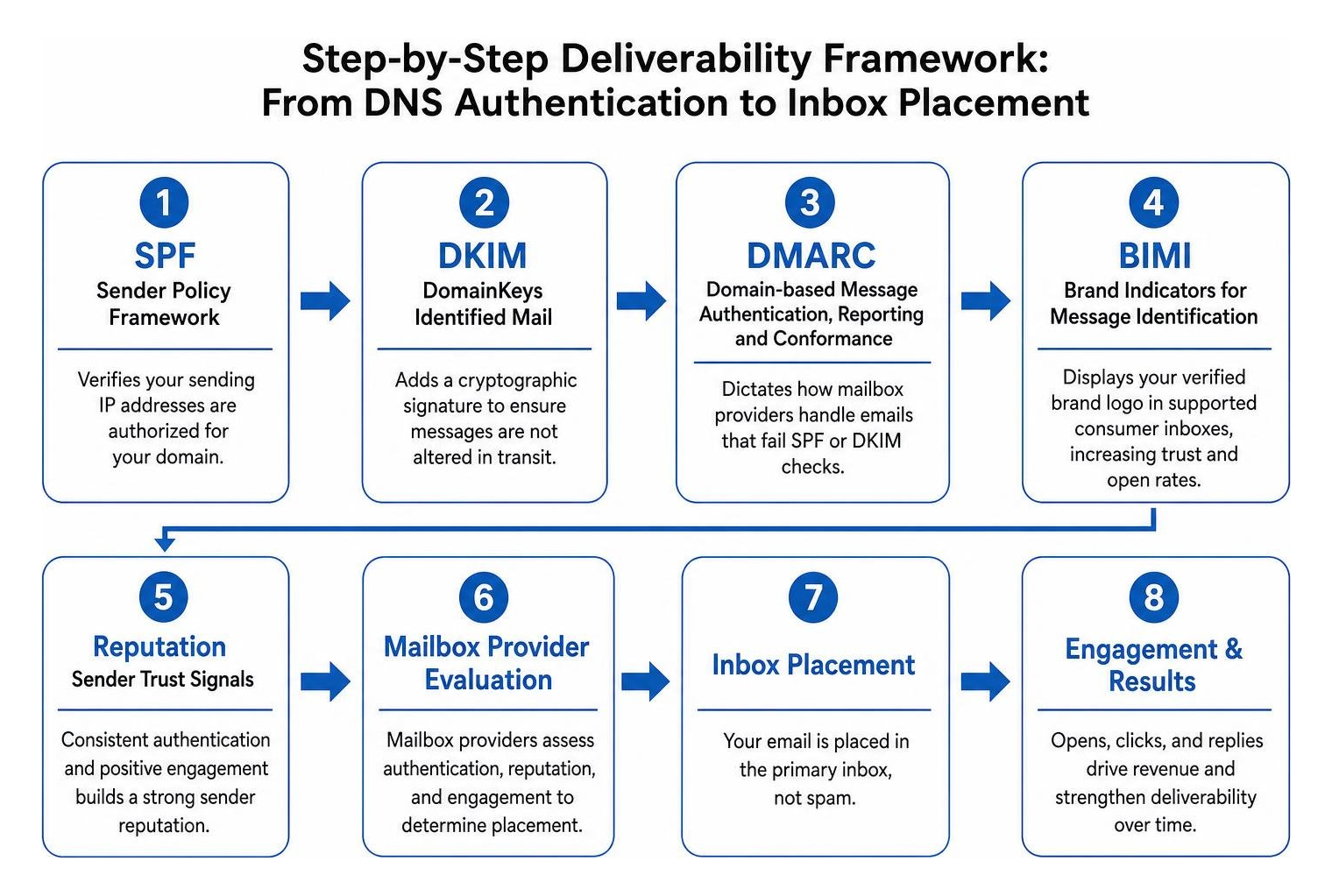
Industry benchmarks reveal an average inbox placement rate of 76.46%, with approximately 9.09% of emails landing in spam folders and an average spam score of 1.53 across standard sends. Achieving consistent inbox placement requires technical rigor:
- SPF (Sender Policy Framework): Verifies that your sending IP addresses are authorized to send mail on behalf of your domain.
- DKIM (DomainKeys Identified Mail): Adds a cryptographic signature to ensure messages are not altered in transit.
- DMARC (Domain-based Message Authentication, Reporting, and Conformance): Dictates how mailbox providers handle emails that fail SPF or DKIM checks, establishing strict domain protection.
- BIMI (Brand Indicators for Message Identification): Displays your verified brand logo in supported consumer inboxes, increasing open rates and technical trust.
Frequently Asked Questions About Email Marketing Automation
How does email automation improve deliverability and revenue?
Automated workflows send messages triggered directly by user actions, ensuring content is timely and relevant. This high relevance leads to superior open and click engagement, which signals to mailbox providers (like Gmail and Outlook) that your domain is trusted. That strong sender reputation drives higher inbox placement across all your marketing campaigns, directly lifting conversion rates.
What is the difference between cold email tools and newsletter platforms?
Cold email tools specialize in outbound 1-to-1 sales communication, emphasizing mailbox rotation, plain-text delivery, automated warmup, and reply tracking to cold prospects. In contrast, inbound newsletter platforms are designed for opt-in marketing audiences, featuring rich HTML builders, visual media, dynamic segmentation, and strict subscription consent management.
What are the standard pricing models for email marketing automation?
Email automation platforms generally follow one of three models: subscriber tier pricing (costs rise as your total contact list grows), volume-based pricing (pay per email sent regardless of list size), or per-seat/mailbox licensing (common in cold outreach tools). For more details on budgeting and campaign execution, review our detailed faqs.
Conclusion
Maximizing return on your marketing technology requires viewing email not as an isolated broadcast channel, but as an intent-driven engine that converts post-click attention into measurable revenue. Whether you are generating sales pipeline, recovering abandoned checkouts, or onboarding software users, the right automation infrastructure frees up operational bandwidth while driving consistent business outcomes.
At ROAZZ, we specialize in performance-marketing strategies that measure real business growth—sales, bookings, subscriptions, and qualified leads—rather than surface-level metrics. Explore our end-to-end performance services or get in touch through our contact page to build high-converting automated campaigns tailored to your growth goals.