What Real Growth Looks Like with a Google Ads Management Agency
How to Choose a Google Ads Management Agency That Drives Real Growth

Choose a Google Ads management agency that can show how ad spend turns into qualified leads, sales, or donations. Ask how it tracks results, improves campaigns, reports costs, and works with your team. Keep ownership of your ad account and billing.
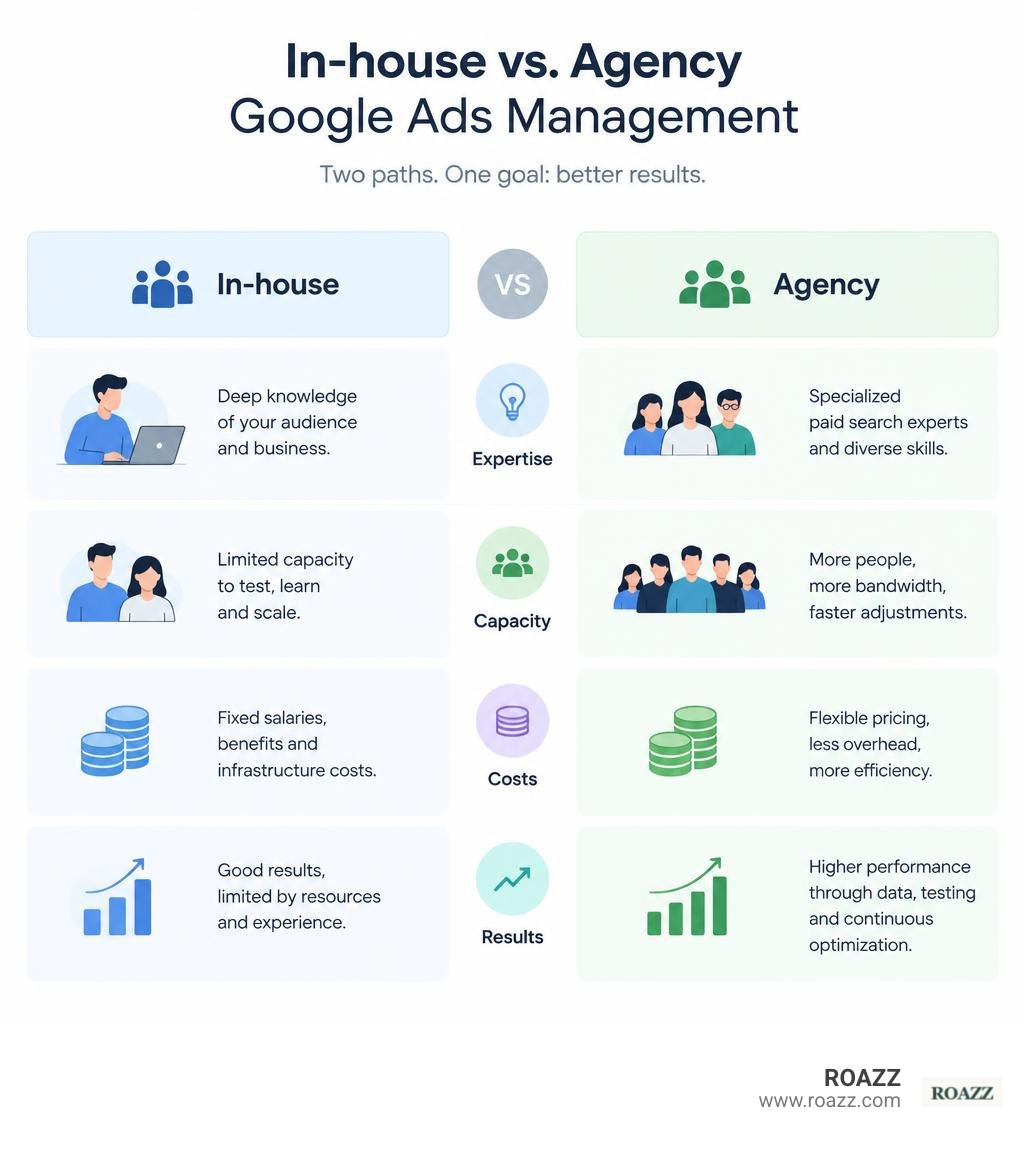
An in-house team may know your audience best. An agency can add paid search specialists and more capacity to test and adjust campaigns. The right choice depends on your team's skills, budget, and goals. Either way, judge growth by business results, not clicks alone. For broader context on how paid search fits into digital advertising, Google Ads is Google's online advertising platform where advertisers bid to display brief advertisements, service offerings, product listings, and videos to web users.
Core Services Provided by a Google Ads Management Agency
Hiring an external partner is about much more than setting up a couple of ad groups and letting automated bids run wild. A dedicated agency builds a comprehensive paid search infrastructure designed to capture intent at every stage of the buyer journey. Businesses make an average of $2 in revenue for every $1 spent on Google Ads (a 200% ROI benchmark), but achieving and exceeding that benchmark requires deliberate management.
When you partner with a specialized team, their core offerings should cover:
- Comprehensive Account Auditing: Inspecting structural waste, negative match conflicts, mismatched tracking tags, and historical quality scores.
- Intent-Driven Keyword Discovery: Identifying commercial-intent search terms while aggressively filtering out low-converting informational queries.
- Strategic Bid Optimization: Customizing automated bid strategies like Target CPA and Target ROAS based on actual margin and profit targets.
- High-Converting Ad Copywriting: Crafting compelling copy tailored for Responsive Search Ads (RSAs) to maximize quality score and click-through rates.
- Landing Page & Conversion Alignment: Ensuring the promise made in the ad perfectly matches the landing page experience to prevent bounce rates.
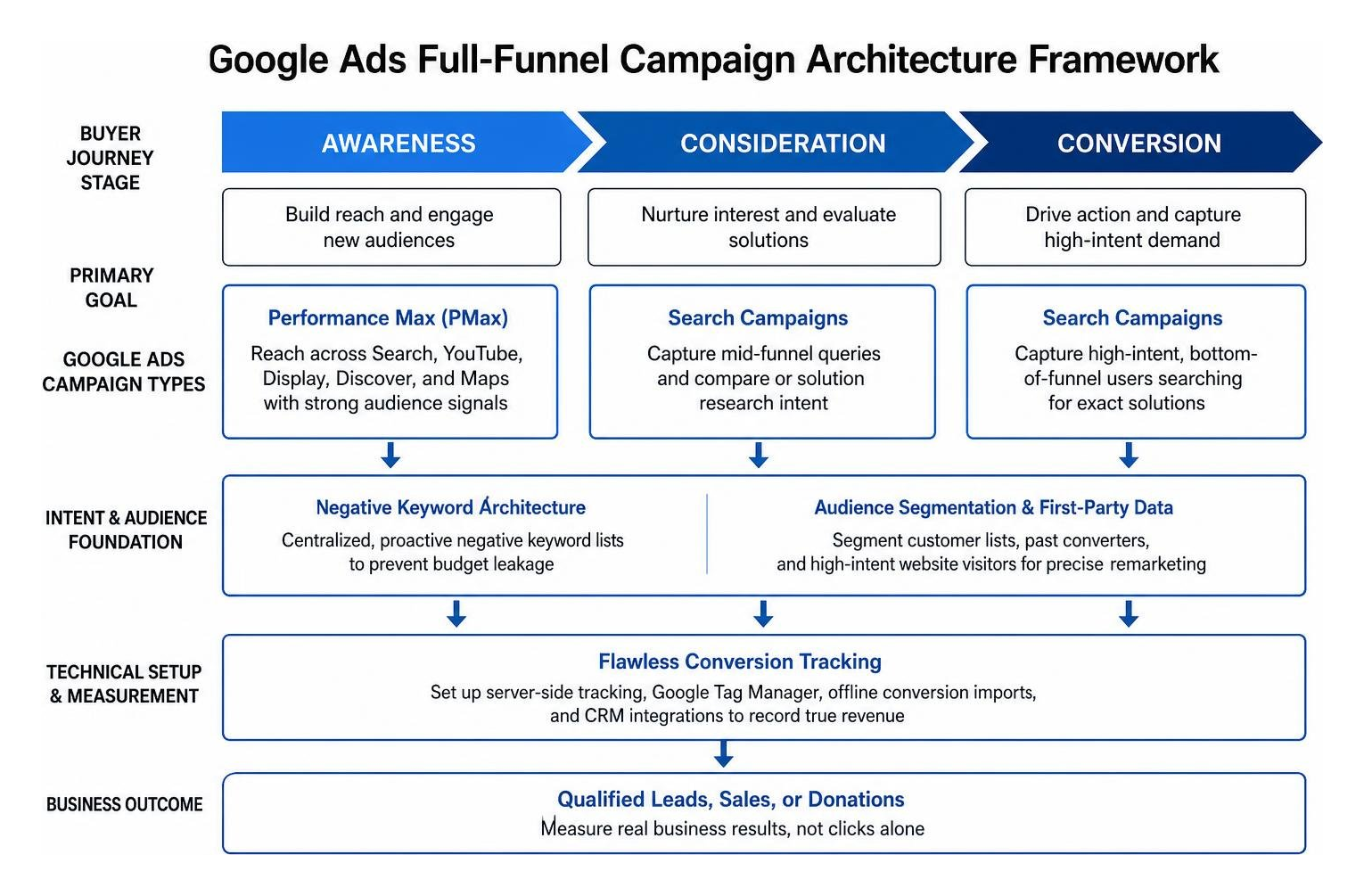
- Flawless Conversion Tracking: Setting up server-side tracking, Google Tag Manager, offline conversion imports, and CRM integrations to record true revenue.
We structure our performance marketing services around measuring genuine business results rather than vanity impressions. By directly linking paid search traffic to pipeline metrics like closed sales, booked appointments, or demo requests, we ensure every dollar supports your bottom line.
Full-Funnel Campaign Architecture and Technical Setup
A mature Google Ads structure does not rely on a single campaign type. Search ads across all industries average a 3.17% click-through rate (CTR), whereas display ads average roughly 0.46%. An agency creates a segmented architecture that guides prospects through awareness, consideration, and conversion:
- Search Campaigns: Capturing high-intent, bottom-of-funnel users searching for your exact solutions.
- Performance Max (PMax): Leveraging machine learning across Search, YouTube, Display, Discover, and Maps while actively steering the algorithm with strong audience signals.
- Negative Keyword Architecture: Building centralized, proactive negative keyword lists to prevent budget leakage on irrelevant queries.
- Audience Segmentation & First-Party Data: Segmenting customer lists, past converters, and high-intent website visitors for precise remarketing.
Continuous Optimization and Conversion Rate Improvement
Setting up campaigns is only step one. Data shows that companies leveraging a specialized partner see an average of 20% higher conversion rates compared to those managing campaigns purely in-house. Furthermore, skilled optimization typically delivers an average 30% reduction in cost per acquisition (CPA) within the first three months.
Ongoing optimization includes:
- Search Query Mining: Weekly reviews of real search terms to harvest new converting terms and exclude non-converting variants.
- A/B Ad Creative Testing: Iterating headlines, descriptions, and dynamic assets to maintain strong ad relevance scores.
- Device, Demographic, and Geographic Bid Adjustments: Allocating larger budget shares to top-performing locations and platforms.
Agency vs. In-House: Weighing Costs, Capabilities, and Execution Speed
Nearly 65% of small to medium businesses outsource their Google Ads management to a specialized partner to save time and improve performance. Managing campaigns in-house provides deep brand familiarity, but it often struggles with capacity constraints and high overhead.
| Evaluation Factor | In-House Team | Specialized Agency |
|---|---|---|
| Direct Costs | Salary, benefits, software licenses, onboarding | Predictable monthly retainer or percentage fee |
| Tool Stack & Tech | Must purchase third-party analytics and click-fraud tools | Enterprise tech stack included in service |
| Skill Diversity | Often limited to one generalist marketer | Dedicated copywriters, data analysts, and strategists |
| Speed to Scale | Slower; dependent on internal bandwidth | Immediate execution and rapid testing cycles |
| Platform Expertise | Knowledge limited to single-account historical data | Broad multi-account insights and platform beta access |
In-House Team vs. a Dedicated Google Ads Management Agency
Hiring a full-time in-house specialist introduces significant fixed overhead: recruitment costs, salaries, benefits, and paid search software subscriptions. If that individual departs, your marketing momentum stalls.

Working with a dedicated agency eliminates single-point-of-failure risks. You gain access to an entire team composed of account strategists, technical tracking specialists, and creative copywriters for a fraction of the cost of building an equivalent in-house department.
Strategic Benefits and Potential Drawbacks of Outsourcing
Understanding both sides of the outsourcing equation ensures a fruitful partnership:
Key Benefits:
- Cross-Industry Insights: Agencies see trends, algorithm shifts, and performance patterns across dozens of accounts simultaneously.
- Execution Speed: Strategic campaign overhauls and testing roadmaps deploy in days rather than months.
- Cost Efficiency: Eliminates expensive tooling fees and internal management overhead.
Potential Drawbacks & How to Mitigate Them:
- Domain Nuance: An agency might not grasp your specific industry jargon on day one. Mitigate this through a thorough kickoff discovery process.
- Communication Latency: Without clear communication protocols, alignment can lag. Establish structured weekly updates and dedicated communication channels.
Critical KPIs and Reporting Standards That Define Real Growth
The average cost per click (CPC) across all industries on Google Ads sits at $1.16 for search and $0.26 for display. However, managing campaigns based solely on CPC or raw traffic volume is a mistake. Real growth requires measuring post-click efficiency and downstream revenue.
Performance Metrics vs. Vanity Click Reporting
Vanity metrics look pretty on a slide deck, but they don't pay the bills. A mature agency focuses on:
- Cost Per Acquisition (CPA): The exact ad spend required to generate a qualified lead or paying customer.
- Lead-to-Opportunity Rate: How many form fills or calls actually turn into sales conversations.
- Target ROAS (Return on Ad Spend): The revenue generated directly relative to your media investment.
- Search Impression Share: The percentage of total available searches your ads capture for critical brand and commercial terms.
- Intent-Driven Action Rate: Tracking high-value actions such as checkout completions, consultation bookings, or subscription signups.
Adapting to Frequent Google Updates and Smart Bidding Automation
Google's ad ecosystem evolves constantly. From the phase-out of expanded text ads to automated smart bidding shifts and automated Performance Max asset generation, staying ahead is essential.
An experienced agency continually trains machine learning models by sending clean, first-party conversion data back into Google Ads via enhanced conversions and offline conversion tracking (OCT). Rather than letting AI guess what a good lead looks like, strategic management guides Google's algorithms toward high-margin outcomes.
How to Evaluate, Select, and Transition to the Right Partner
Selecting the right partner requires vetting both strategic approach and pricing alignment. Our structured campaign onboarding roadmap outlines how an account moves smoothly from discovery to live scaling without downtime.
How to Choose the Best Google Ads Management Agency for Your Business
When evaluating potential partners, use this checklist:
- Strategic Focus: Do they focus on clicks and impressions, or do they discuss pipeline revenue and profit margins? Read more about our strategic marketing approach to see how bottom-line focus changes campaign outcomes.
- Account Ownership: Ensure you maintain 100% administrative ownership of your Google Ads account and billing profiles.
- Transparent Pricing Models:
- Flat Retainer: Predictable fee based on campaign scope and management requirements.
- Percentage of Ad Spend: Scalable fee (typically 10–20%) suitable for growing ad budgets.
- Hybrid / Performance Tiers: Base retainer combined with performance bonuses tied to CPA or ROAS targets.
Account Onboarding and Seamless Campaign Transition
A seamless onboarding process avoids common transition pitfalls:
- Week 1 (Audit & Tag Validation): Reviewing historic conversion tracking, linking Google Analytics 4, and checking tracking pixel health.
- Week 2 (Strategy Alignment & Architecture): Defining target personas, creating negative keyword master lists, and drafting ad messaging.
- Week 3 (Soft Launch & Structural Migration): Launching new campaign structures alongside legacy campaigns to avoid sudden conversion drops.
- Week 4 (Post-Launch Optimization): Pruning low-intent queries, adjusting initial bids, and establishing the baseline reporting cadence.
Frequently Asked Questions About Google Ads Management
What pricing models do paid search agencies typically use?
Most agencies utilize a monthly flat retainer, a percentage of ad spend (usually ranging between 10% and 20%), or a hybrid model. Transparent agencies outline their fees clearly without locking you into hidden tech markups.
How soon should a business expect to see tangible campaign results?
While immediate clicks occur upon launch, Google's smart bidding algorithms require an initial 2- to 4-week learning phase. Most accounts achieve stable optimization and notable CPA reductions within 60 to 90 days of consistent search query mining and testing.
Will our company retain complete ownership of our Google Ads account?
Yes, reputable agencies request manager access (MCC) to your account rather than building campaigns in an agency-owned shell. You retain admin rights, data history, and billing control. If you have questions about account setup, contact us for a direct walkthrough.
Conclusion
Scaling your paid search requires shifting focus from surface-level clicks to bottom-line business outcomes. A dedicated partner aligns keyword strategy, ad creative, and technical tracking with your true revenue goals. When you are ready to build a reliable paid search engine, scale your pipeline with ROAZZ and turn ad spend into predictable growth.