How to Choose an Amazon PPC Management Agency for FBA Growth
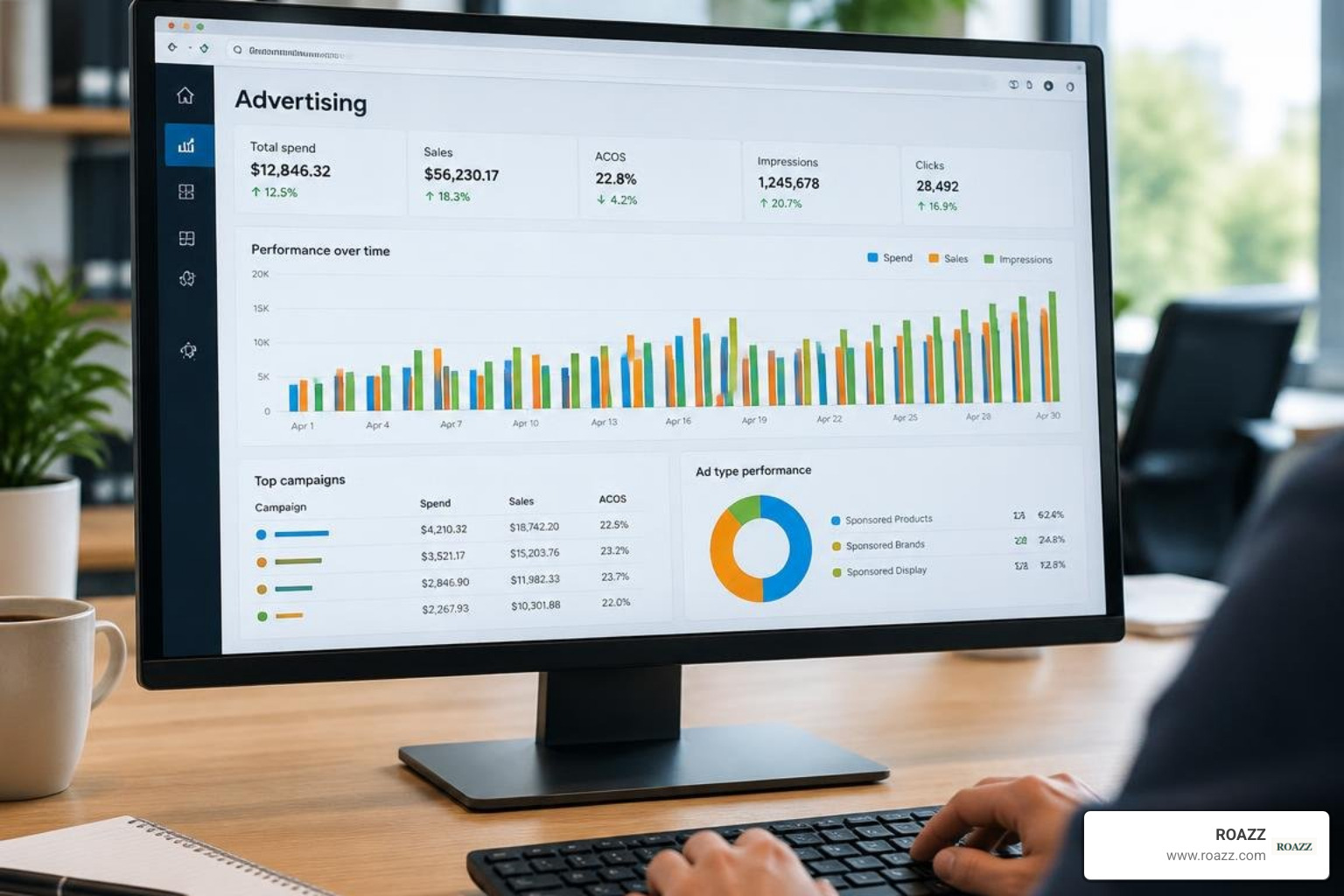
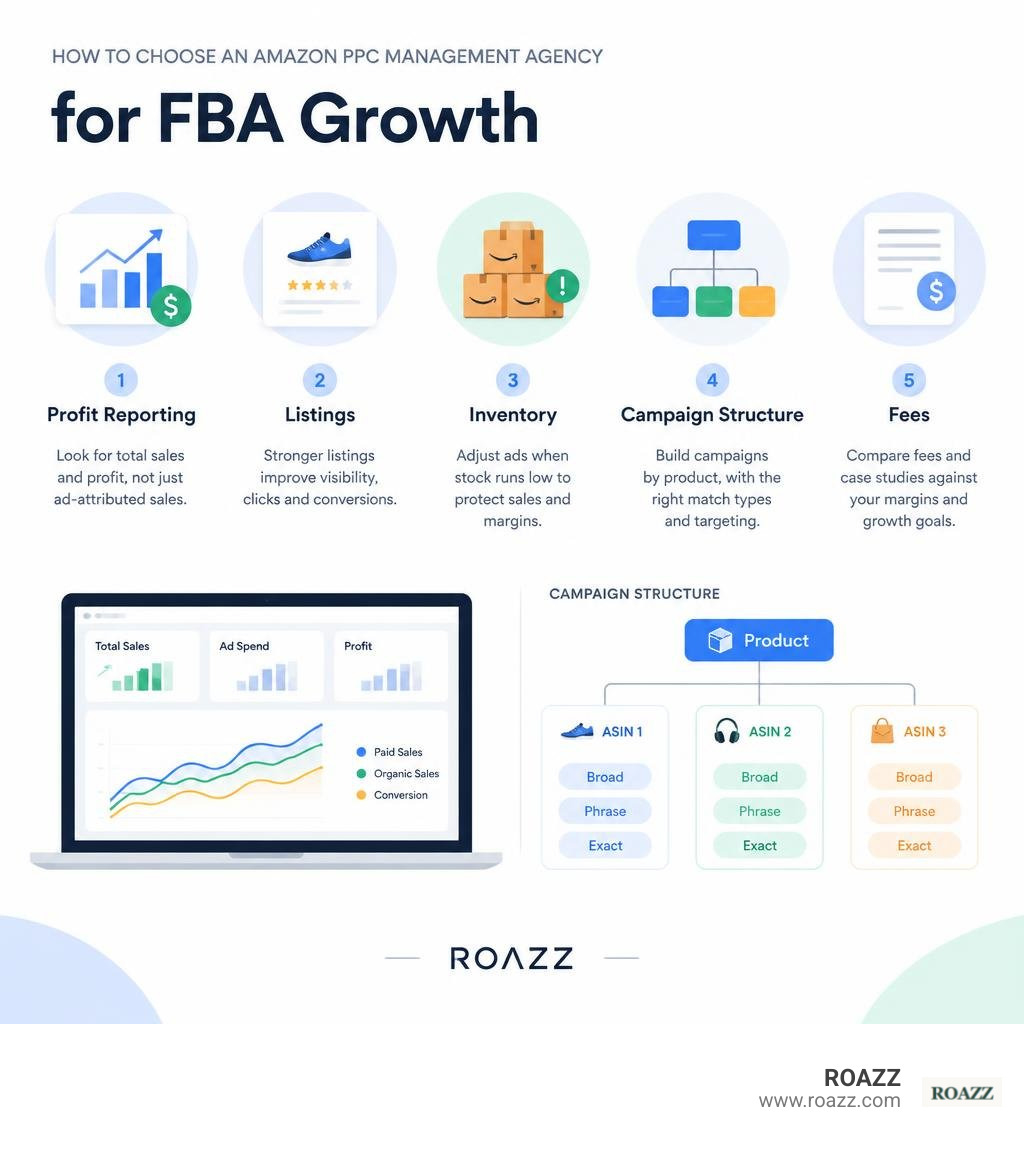
Choose an Amazon PPC management agency that can show how ad spend improves total sales and profit, not just ad-attributed sales. Ask each agency to explain how it will structure campaigns by product, improve listings, adjust ads when stock runs low, and report both ACoS and TACoS. Then compare its fees and case studies against your own margins and growth goals.
The distinction matters: an agency can lower ACoS by cutting ads while your total sales fall. Strong management looks at paid sales, organic sales, and conversion together, so you can see whether growth is worth the spend.
Core Capabilities to Demand from an Amazon PPC Management Agency
Choosing an advertising partner is not just about finding someone to adjust bids every Tuesday. It requires finding a team that understands catalogue depth, post-click customer behaviour, and the mechanics of the marketplace algorithm. Marketplace pay-per-click advertising in October 2026 demands complete alignment between search intent, campaign structure, and ASIN-level margins.

When vetting partners, evaluate how they build systems to protect your margin while winning top-of-search market share. An agency must possess deep technical fluency across Sponsored Products, Sponsored Brands, and Sponsored Display, tied directly to a systematic Amazon advertising strategy.
Advanced Campaign Architecture and Dynamic Catalogue Management
High-performing accounts avoid grouping multiple variations into a single ad group. To control spend precisely, an agency must isolate parent-child variations into dedicated campaigns based on profitability, search volume, and product life cycle stage.

We look for several non-negotiable structural capabilities:
- Single-Keyword Ad Groups (SKAGs) or Isolated Match Types: Isolating top-converting search terms into dedicated exact match campaigns prevents broad queries from draining your budget.
- Systematic Negative Keyword Harvesting: Automated and manual harvesting rules that actively negate non-converting, high-cost search queries across auto and broad campaigns.
- Product Life Cycle Segmentation: Managing launch ASINs with aggressive discovery budgets while maintaining mature SKUs with strict efficiency targets.
- Stock-Aware Bid Rules: Automatic bid adjustments or keyword pausing based on real-time FBA inventory levels to prevent wasteful ad spend when stock runs low.
Amazon Sponsored Ads and Multi-Marketplace Expansion
A capable agency orchestrates every ad format to serve a specific purpose across the customer journey. Furthermore, as brands scale, managing campaigns across additional marketplaces (such as Walmart or Target) alongside Amazon requires a unified view of ad inventory and cross-channel demand.
| Ad Format | Primary Targeting Types | Core Campaign Objectives |
|---|---|---|
| Sponsored Products | Keyword (Exact, Phrase, Broad), Product Targeting (ASIN, Category) | Immediate sales conversion, keyword organic ranking, defensive brand capture |
| Sponsored Brands | Keyword, Category, Storefront spotlight, Video | Brand discovery, market share expansion, video demonstration |
| Sponsored Display | Audiences (lifestyle, in-market), Contextual ASIN re-targeting | Cross-selling catalogue, retargeting viewed products, competitor conquesting |
Measuring Profitability: ACoS vs TACoS in 2026 Advertising
Looking solely at Advertising Cost of Sale (ACoS) gives an incomplete picture of account health. In 2026, benchmark data across 30+ US accounts shows a median ACoS of 38% alongside a median Cost Per Click (CPC) of $1.07. If an agency only reports ACoS, they can hit target numbers by bidding exclusively on your branded terms while your overall market share shrinks.

Why TACoS Determines Organic Rank Compounding
Total Advertising Cost of Sale (TACoS)—calculated as total advertising spend divided by total gross revenue (paid plus organic)—reveals whether your ads are building long-term momentum.
Marketplace advertising operates as a compounding loop: paid conversions generate sales velocity, which improves organic search ranking, which in turn brings in un-paid organic sales. An account achieving an efficient 13.4% blended TACoS is reinvesting ad dollars effectively to grow its entire organic footprint.
Brand Analytics and Search Query Performance Insights
An experienced agency uses Amazon Brand Analytics and Search Query Performance (SQP) reports to monitor real market share. Instead of relying purely on surface-level click metrics, SQP data reveals:
- Search Funnel Breakdown: Tracking impression share, click share, cart-add rate, and purchase share for high-priority search terms.
- Brand vs. Non-Brand Split: Identifying how much revenue comes from true category conquesting versus defending existing brand searches.
- Conversion Efficiency: Pinpointing whether listing drop-offs occur at the click stage (main image, price) or post-click stage (A+ content, reviews).
Evaluating Agency Pricing Models and Aligned Incentives
How an agency charges directly influences how they manage your ad spend. Different fee structures create distinct operational incentives that can either support or undermine your bottom line.
| Fee Model | How It Works | Agency Incentive | Key Risk for Brand |
|---|---|---|---|
| Percentage of Ad Spend | Base fee + % of monthly ad spend | Increase ad budget to grow agency retainer | Spend inflation without regard to profitability |
| Flat Monthly Retainer | Fixed monthly cost regardless of spend | Focus on account stability and efficiency | Agency may limit time spent as account complexity grows |
| Percentage of Revenue / Profit | Base fee + % of total marketplace revenue | Maximize overall top-line or contribution margin | Agency takes credit for organic lifts outside their direct control |
Fee Structures: Flat Retainers vs Spend Percentage vs Revenue Share
A pure percentage-of-ad-spend model can create a conflict of interest: the agency earns more when you spend more, regardless of whether that spend generates net profit.
Flat retainers or hybrid models tied to total marketplace revenue (or net margin) align incentives better. They encourage the agency to optimize for profitable organic lift rather than simply increasing ad budgets.
Vetting an Amazon PPC Management Agency on Reporting and Inventory Sync
Before signing, review how the agency handles operational logistics and reporting:
- Weekly ASIN-Level TACoS Reporting: Granular reporting that shows individual product contribution margins rather than blended, aggregate figures.
- Inventory and Lead Time Integration: Establishing rules to throttle ad spend when inventory levels dip below safe lead-time thresholds.
- Dayparting and Placement Optimization: Adjusting bids dynamically during peak purchasing hours and fine-tuning Top-of-Search placement multipliers.
Avoiding Common Marketplace Advertising Pitfalls
The most common mistake brands make is running aggressive paid campaigns to listings that are not conversion-ready. If a product page has poor imagery, vague copy, or inconsistent reviews, throwing ad budget at it only drives up acquisition costs.
Critical Mistakes When Choosing an Amazon PPC Management Agency
- Hiring a Generalist Search Agency: Marketplace ads are tied directly to Buy Box ownership, inventory levels, and organic ranking algorithms—nuances that non-marketplace agencies often miss.
- Treating Listing Optimisation as Out of Scope: Advertising efficiency relies heavily on post-click conversion rates, making creative and listing copy central to ad performance.
- Optimising for ACoS in a Vacuum: Slashing bids on competitive non-branded keywords to artificially lower ACoS often causes organic ranking and total revenue to decline.
- Ignoring Stockouts: Continuing to advertise low-inventory items can exhaust stock quickly, leading to lost ranking and expensive restock recovery efforts.
The Risk of Treating Marketplace PPC Like a General Search Funnel
General search engines treat paid clicks as independent transactions. Marketplace search algorithms, however, use conversion velocity from paid ads as a direct ranking signal for organic results. Treating Amazon PPC like an isolated ad channel wastes the compounding organic benefit of a well-structured campaign.
Frequently Asked Questions About Amazon PPC Management
What is the ideal TACoS benchmark for an Amazon FBA brand in 2026?
A healthy blended TACoS typically ranges between 10% and 15% for mature accounts, with a 13.4% blended TACoS representing a solid target across competitive categories. For brand-new ASIN launches, TACoS may run higher (20% to 30%+) as you build sales velocity and review history, before gradually scaling down as organic ranking solidifies.
At what monthly ad spend should an FBA brand expand its Sponsored Ads campaigns?
Brands spending between $3,000 and $5,000 per month can run comprehensive Sponsored Products and Sponsored Brands campaigns. As spend scales beyond $10,000 per month, expanding budget into Sponsored Display and audience targeting helps capture in-market shoppers and defend your existing product detail pages.
What listing readiness is needed before launching PPC?
Before turning on paid traffic, your listing should have:
- A high-resolution, compliant main image that maximizes click-through rate.
- Clear, benefit-driven bullet points addressing primary customer questions.
- High-quality A+ Content and Brand Story modules that improve conversion rates.
- An established baseline of positive customer reviews and consistent Buy Box ownership.
Conclusion
Scaling an FBA business requires managing ad spend as a driver of total account profitability, not an isolated expense. Choosing the right partner means finding a team that aligns campaign architecture, listing quality, and inventory awareness with your net margins.
At ROAZZ, we focus on post-click outcomes and intent-driven traffic that grows your bottom line. By prioritizing total business results over vanity metrics, we help brands build scalable advertising systems that drive durable, profitable growth.