How to Start Cross Device Retargeting

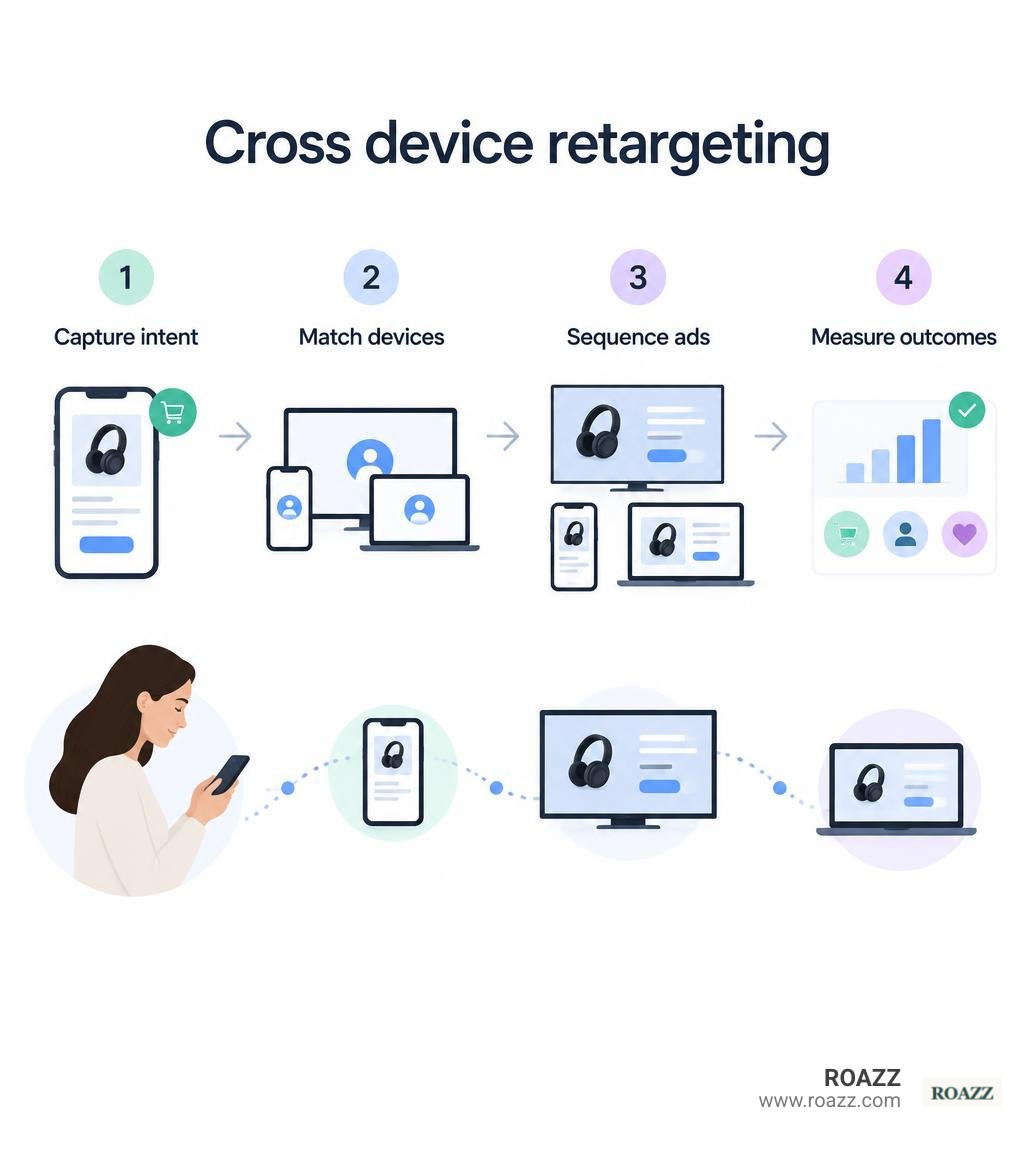
To set up cross device retargeting, start with a high-intent action, such as a product view or abandoned cart. Use consented first-party data to match that visitor across devices. Then show a related ad on another screen, such as connected TV, and measure whether the person later buys, signs up, or donates.
The aim is not to show the same ad everywhere. It is to keep the message useful as someone moves from phone to TV to laptop, while limiting repeat ads and tracking real results, not just clicks.
Understanding Cross Device Retargeting in the Modern Omnichannel Funnel
The modern buyer's journey is rarely confined to a single screen. Consumers fluidly transition between mobile phones, desktop computers, tablets, and connected TVs (CTV) throughout their day. Globally, the average consumer juggles 3.6 connected devices, while in mature digital markets, households frequently operate over a dozen internet-connected screens simultaneously.
When a prospective customer searches for an offer while commuting, they might leave without completing a transaction. Without a synchronized cross-device strategy, that user interaction remains isolated on mobile. Engaging prospective buyers across multiple touchpoints can expand your addressable reach by up to 72%.
Furthermore, data demonstrates that conversion rates for users who interact across multiple screens prior to landing on a website are 230% higher than average single-device pathways. Connecting these disparate touchpoints into an integrated sequence turns fragmented impressions into coherent, post-click conversions.
The Shift from Cookie-Based Device Graphs to First-Party Identity Graphs
Historically, digital marketing relied on third-party cookies and basic device graphs. These legacy systems operated like breadcrumbs, attempting to track hardware footprints across the web. However, evolving browser controls and strict privacy standards have accelerated the decline of standalone cookie-based tracking.
Modern retargeting relies on unified identity graphs powered by consented first-party data. Rather than chasing anonymous browser instances, an identity graph matches deterministic identifiers—such as hashed email addresses, phone numbers, and persistent account IDs—with verified household network signals. Understanding how identity graphs unify customer profiles allows brands to construct durable, privacy-compliant cross-screen associations that withstand ecosystem signal loss.
Why Cross Device Retargeting Outperforms Single-Screen Campaigns
Siloed campaigns risk bombarding users on one platform while ignoring where high-intent decisions actually take place. Delivering relevant, sequential creative across screens drives measurable performance gains:
- Superior Brand Recall: Coordinated cross-screen messaging boosts brand recall by up to 50%.
- Elevated Conversion Rates: Returning visitors engaged through structured remarketing convert at a rate of 24.29%, compared to just 7.55% for first-time visitors. Overall, retargeted prospects are 70% more likely to convert.
- Person-Level Frequency Management: Centralized identity resolution enables impression capping across an individual's entire device cluster, mitigating ad fatigue and wasted spend.
For brands scaling direct-to-consumer sales, bridging mobile consideration to living room CTV screens creates a persistent, high-impact conversion path.
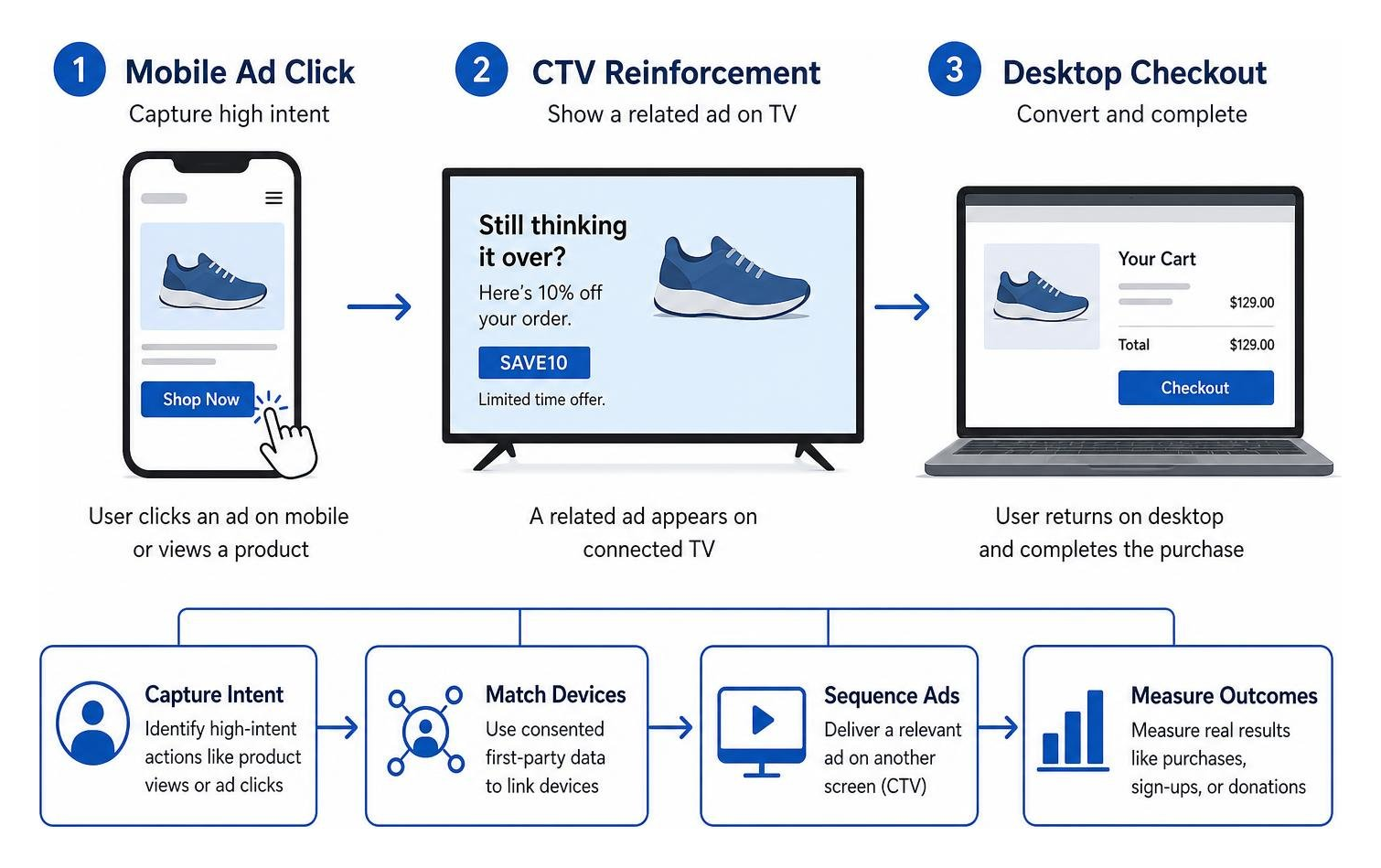
Step-by-Step Implementation: How to Execute a Multi-Screen Campaign
Executing a cross-screen retargeting framework requires a structured data pipeline, automated identity matching, and synchronized creative delivery.
1. Map Touchpoints and Unify First-Party Data Signals
Begin by mapping your customer journey across every digital touchpoint. Audit high-intent events within your web ecosystem, mobile applications, and point-of-sale systems.
- Deploy Unified Tracking Pixels: Install conversion tags and server-side tracking across all web properties to record product page visits, video plays, and cart abandonment events.
- Implement Mobile SDKs: Integrate lightweight mobile measurement partner (MMP) SDKs to capture in-app actions, deep links, and device characteristics.
- Onboard First-Party CRM Data: Hash and clean customer data (such as emails and phone numbers) to securely onboard offline lists and previous purchasers into your identity architecture.
Leveraging modern cross-device ad targeting strategies ensures your first-party signals serve as the bedrock for cross-screen identity matching.
2. Segment Audiences and Synchronize Cross Device Retargeting Sequences
Once your data pipeline is established, segment prospects by intent velocity and engagement depth:
- High-Intent Abandoners: Users who added items to a cart within the last 48 hours receive immediate, synchronized reminders across CTV and mobile.
- Mid-Funnel Researchers: Visitors who viewed category pages or high-value service offerings receive educational video creatives on CTV, followed by direct-response mobile display units.
- Household Clusters: Group individual devices by shared IP and physical location parameters to coordinate shared household decision-making.
Applying Dynamic Creative Optimization (DCO) allows your ad servers to automatically adapt messaging, pricing, and visual assets based on the recipient's current device context.
3. Deploy Cross-Screen Attribution and Bidding via DSPs
Integrate your audience segments into an omnichannel Demand-Side Platform (DSP) configured for multi-device bidding. Ensure your measurement framework accurately attributes downstream actions back to upper-funnel impressions.
Understanding how automated cross-platform optimization works ensures that ad spend flows dynamically toward the specific channel combinations generating measurable post-click revenue and booked appointments.
| Capability / Metric | Deterministic Matching | Probabilistic Matching |
|---|---|---|
| Primary Data Source | Hashed first-party logins, CRM IDs, verified user accounts | IP addresses, device types, browser fingerprints, location signals |
| Match Accuracy | Near 100% precision across authenticated devices | Statistical probability (~70%–85% confidence score) |
| Audience Scale | Limited to authenticated, logged-in user bases | Broad reach across unauthenticated and anonymous visitors |
| Privacy Resilience | High; anchored in explicit first-party user consent | Subject to signal loss and algorithmic degradation |
| Primary Funnel Role | Bottom-funnel conversion and direct customer retention | Upper-funnel discovery, household mapping, and audience expansion |
Connecting Mobile Clicks to Connected TV: Screen Synchronization Strategies
Connected TV has evolved from a pure awareness medium into a direct performance engine. By 2026, CTV will account for 20% of daily media consumption among adults, with global CTV ad revenue surpassing $1 billion. Notably, 65% of performance marketers now classify CTV as a core conversion channel.
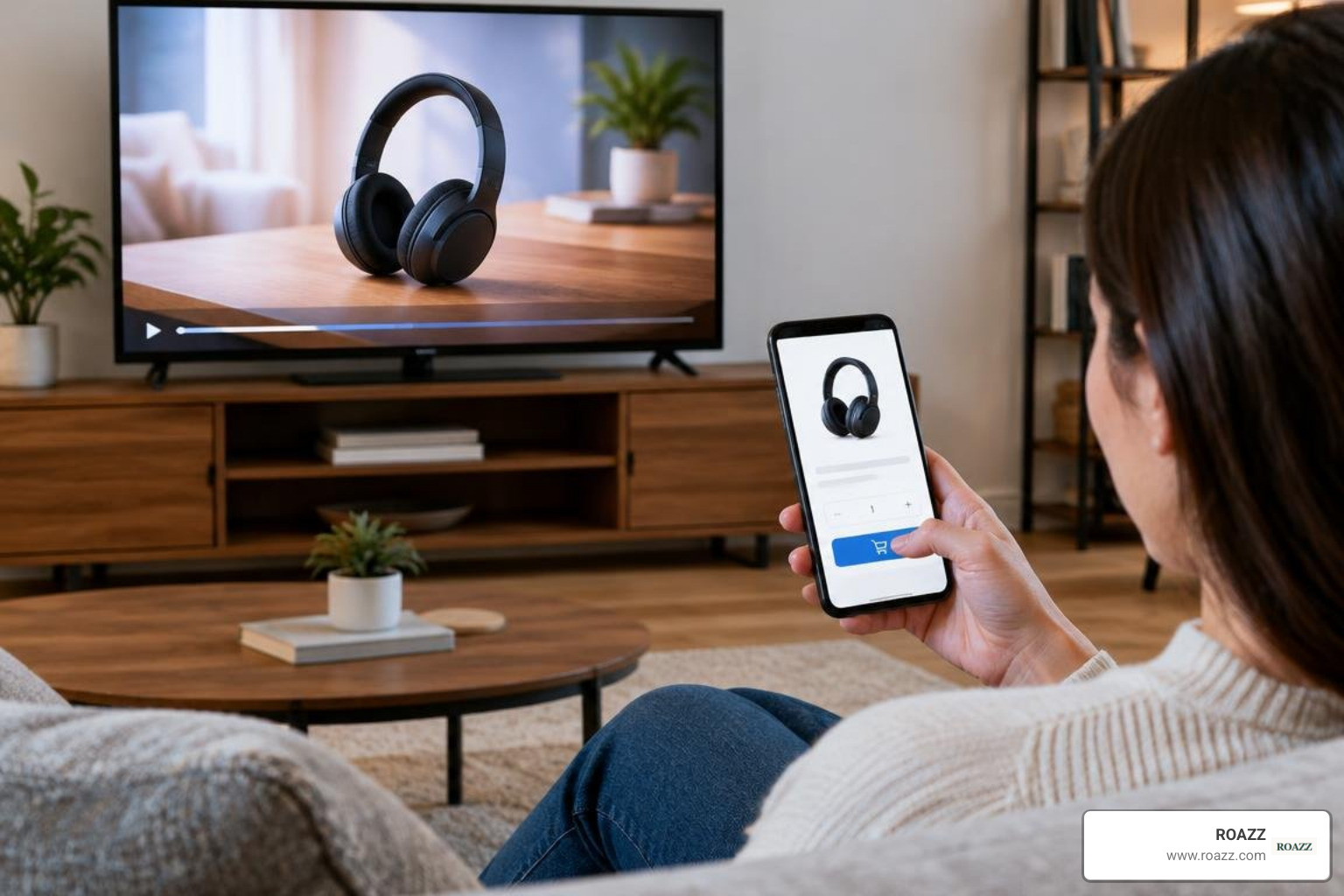
Synchronizing mobile browsing with CTV enables brands to command high-impact attention on the largest screen in the home while keeping conversion pathways active on the personal mobile device in the viewer's hand.
Aligning Dynamic Creative Formats Across Devices
A cohesive cross-screen narrative requires format-specific creative assets that reinforce a single message:
- CTV Video Units (15s & 30s): High-definition, non-skippable video establishing clear value propositions and featuring on-screen interactive elements, such as scannable QR codes.
- Mobile Direct-Response Banners & Stories: Vertical video and mobile-responsive banners served within 30 to 60 minutes of a CTV exposure, offering one-tap checkout or booking buttons.
- Desktop Conversion Portals: In-depth product comparison pages and tailored landing pages configured for fast completion times.
Maintaining visual and thematic continuity across screens is essential across various verticals, including specialized medical practice marketing, where clear communication and trust directly impact appointment bookings.
Leveraging FAST Channels and Household IP Retargeting
Free Ad-Supported Streaming TV (FAST) platforms offer programmatic access to premium, niche-targeted inventory at cost-effective rates. By matching mobile activity to household IP networks, campaigns can serve FAST channel CTV ads when prospects are relaxing at home, followed immediately by second-screen mobile notifications.
This precise cross-screen synchronization is particularly valuable for high-value purchases, such as real estate performance campaigns, where initial discovery on mobile requires household-level alignment before scheduling property viewings.
Overcoming Key Challenges: Attribution, Privacy Compliance, and Ad Fatigue
While multi-screen campaigns deliver substantial conversion lifts, maintaining operational control requires overcoming measurement gaps, privacy shifts, and audience saturation.
Navigating Privacy Frameworks and Consent Requirements
Modern retargeting must operate within strict data-privacy regulations, including GDPR, CCPA, and evolving platform-level privacy controls.
- Implement centralized Consent Management Platforms (CMPs) to verify consent across all web and mobile touchpoints.
- Use Data Clean Rooms to analyze audience overlaps with ad networks securely without exposing raw customer records.
- Restrict data exchanges to SHA-256 hashed customer identifiers to preserve user privacy.
These privacy-first data handling standards are critical for sensitive consumer sectors and ethical outreach programs, such as non-profit outreach strategies.
Controlling Frequency Capping to Prevent Fatigue
Serving too many impressions across multiple devices quickly leads to brand fatigue and inefficient budget allocation.

To manage cross-device impression frequency effectively:
- Implement Universal Person-Level Caps: Set DSP-level parameters limiting total impressions across CTV, mobile, and desktop to a sustainable threshold (e.g., no more than 3 to 5 total exposures per person within a 7-day window).
- Integrate Burn Pixels: Automatically suppress ads across every paired device as soon as a user completes a target conversion.
- Monitor Engagement Decay Curves: Track conversion probabilities relative to total impressions, dialing back bid aggression once additional exposures deliver diminishing returns.
Frequently Asked Questions About Cross Device Retargeting
What is cross device retargeting?
Cross device retargeting is an advertising method that tracks a prospect's engagement on one device (such as browsing a product on a smartphone) and delivers coordinated, sequential ads across their other connected devices (such as a laptop, tablet, or Connected TV) to guide them toward a conversion.
How do Connected TV and mobile devices communicate for retargeting?
CTV and mobile devices communicate via identity graphs and shared household network indicators. When a user interacts on a smartphone connected to a home Wi-Fi network, identity resolution platforms associate that mobile device ID with the household IP and CTV identifiers, enabling synchronized ad delivery across both screens.
How do marketers measure ROI on multi-device campaigns?
ROI is measured through multi-touch attribution models and closed-loop reporting. By pairing deterministic customer IDs and conversion tracking pixels, marketers can tie a final conversion on desktop or mobile directly back to an initial impression served on Connected TV, calculating accurate Return on Ad Spend (ROAS) and Cost Per Acquisition (CPA).
Conclusion
Maximizing campaign performance in an omnichannel ecosystem requires meeting customers across their complete device ecosystem. By uniting consented first-party signals, advanced identity resolution, and dynamic creative sequencing, brands can turn fragmented mobile browsing into high-value CTV engagements and completed purchases.
We focus on engineering performance-marketing frameworks that prioritize measurable business outcomes—sales, qualified leads, subscriptions, and appointments—rather than vanity metrics. Discover how our performance marketing services can build an intent-driven, cross-device strategy that accelerates your revenue growth.